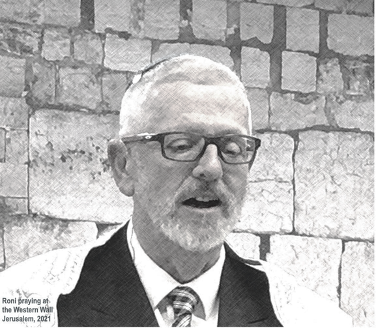
Roni at the entrance to the Israel Museum –– Jerusalem – 2023
Exploring Expressionistic Painting:WHAT LAYERS OF PAINT SAY…
CLICK ON THE LINK BELOW TO LISTEN TO THIS PODCAST:
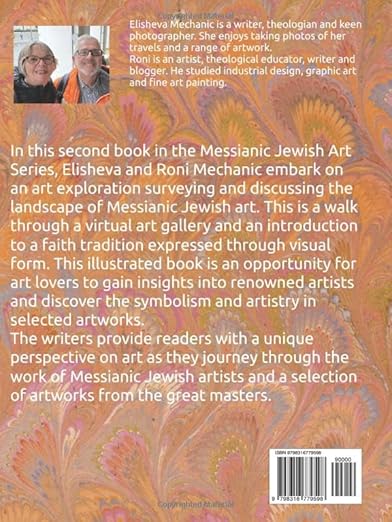
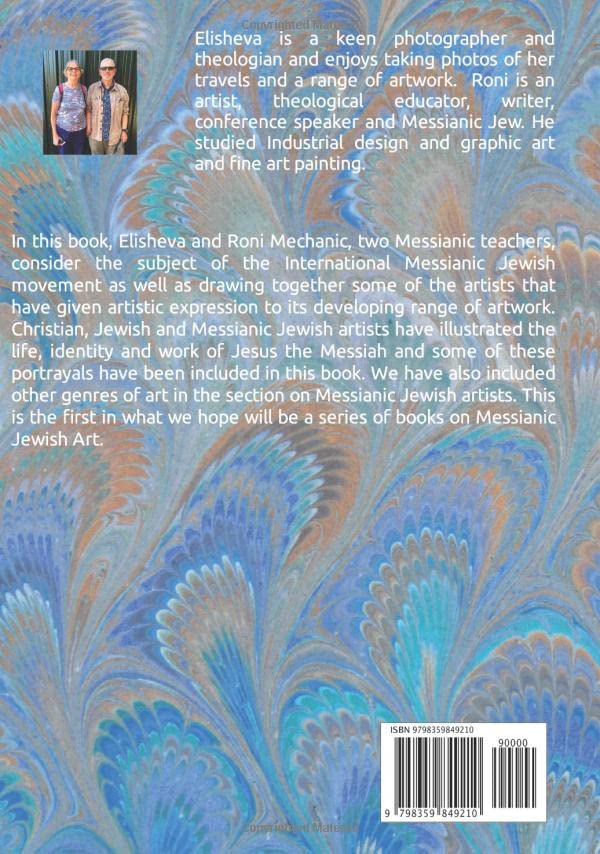
ART BOOKS PUBLISHED BY ELISHEVA AND RONI MECHANIC — Available from AMAZON
Marc Chagall –– Israeli Artist
Bring Them Home!
The Wise Seek Him –– by Roni Mechanic, 2025 –––––––––––––––––––––––––––––––––––––––––– Notice that the forth person in this painting is me. I am being inquisitive and exploring what the three wise men are endeavouring to do.
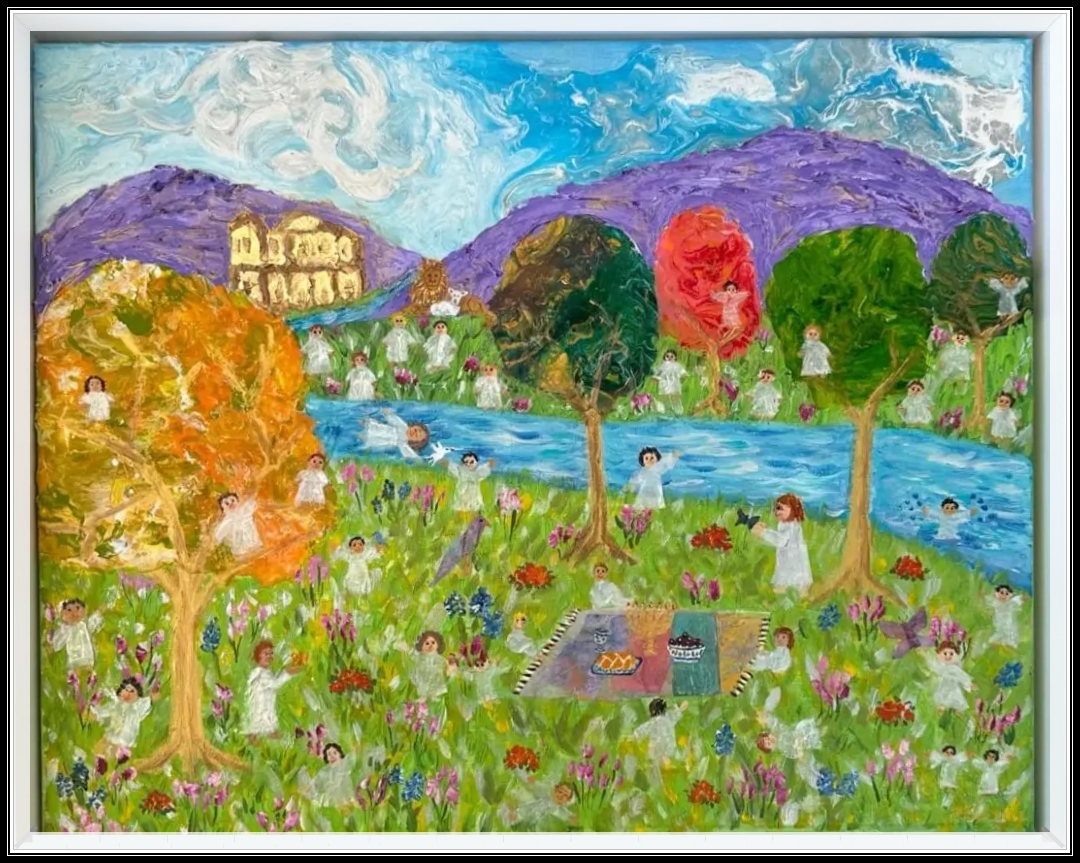
How Helen and Roni gave expression to the tragic loss of the 40 children murdered by Hamas on 7th October, 2023
Helen painted the images of children floating up into the sky. While Roni depicted grave stones as symbols of the murdered children. These stones are also seen floating heavenwards. Included are threeCyprus trees whichare often associated with burial grounds, as viewed in Roni’s painting.
Helen Burman, 2023
Roni Mechanic, 2023
What the Layers of Paint Say

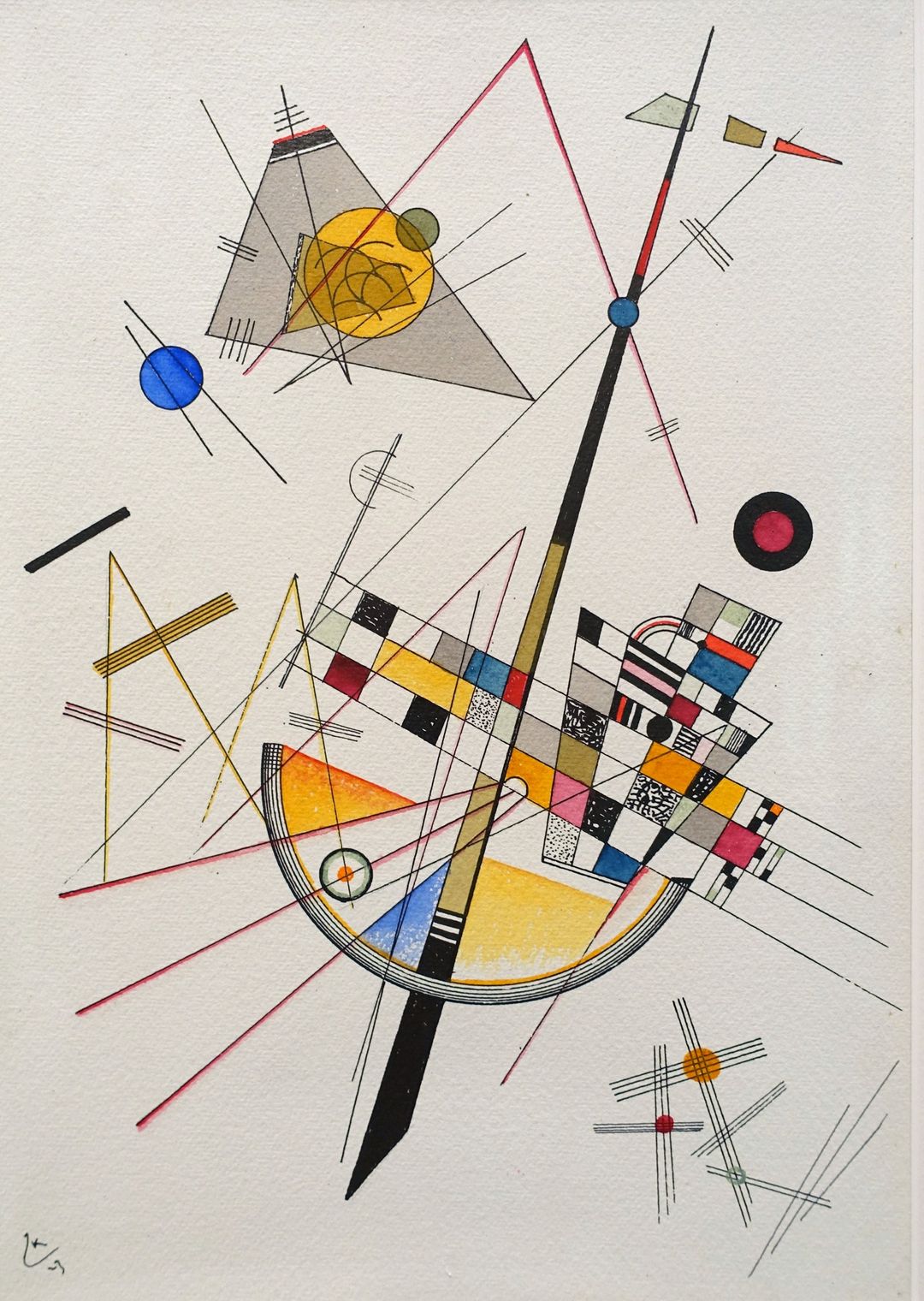
By Roni Mechanic –– Inspired by recent abstract paintings.

Introduction

Colour sings,
shapes speaks,
and lines are more
than what the eye beholds—
spirit traces echoes of the unseen.
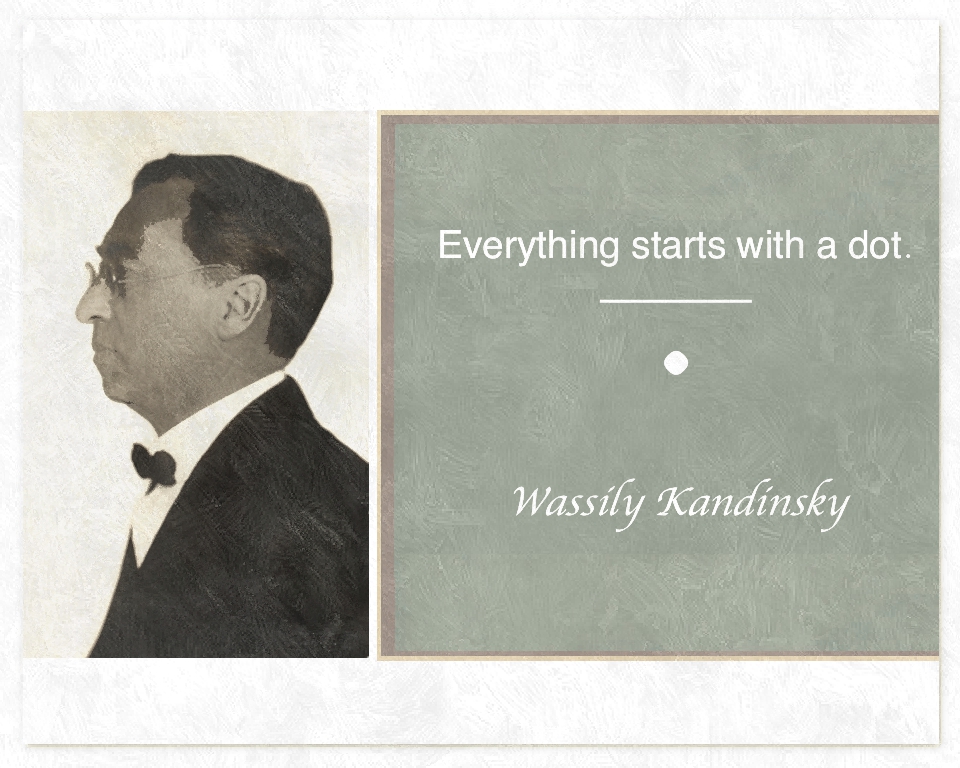
Wassily Kandinsky once glimpsed this truth.

So too the artist paints—
not merely to show,
but to sound,
to let colour pray,
to let praise breathe.

Each canvas becomes a quiet altar,
each stroke, a whispered psalm—
layered with longing,
with wonder,
with the hush of the holy.

Each gesture is a note,
each hue a chord;
the canvas a silent symphony—
layered, rhythmic,
poem and pulse,
alive with something,
just beyond the visual.

Like music felt
through the body’s skin,
the colours move.

They breathe,
they weep and dance—
an abstract language
for the soul.

Layers of Sound

There are voices beneath the surface,
beneath the brush and broken line—
not loud,
but present,
like breath caught in linen,
like Scripture sung in the dark.

A colour trembles.
Another answers.
They speak in tongues—
of saffron, umber, and indigo—
ancient arguments
resolved in silence.

From dust and spirit,
the tapestry is stretched—
threads of mystery,
tangled yet divine.

In the chambers of time,
the pulse of nations stirred.
Two heartbeats in one womb,
two paths divided by a single cry.

Love and rivalry,
covenant and exile—
entwined like roots
beneath ancestral soil.

The breath of prophecy passed
through a mother’s pain—
Rebekah, torn by the war within,
felt the future shift inside her womb:
a tremor that would echo
through the centuries.

Still today,
in city streets and silent prayers,
in borderlands and broken altars,
the ancient wrestling continues.

The Artist’s Vision

The Creative Master made a choice,
bringing forth sons and daughters—
not merely of flesh,
but of calling,
of covenant,
of light drawn from the womb of chaos.

Jacob and Esau—
an eternal struggle,
born in silence and strife.
Rebekah bore more than children that day;
she gave birth to a tension
that shaped the world.

Jew and Arab—
twin destinies entwined—
still carry the weight
of ancient blood and blessing.

Letters emerge—
ancient Chaldaic, Paleo-Hebrew,
and Aramaic,
fragments of Babel’s broken tower:

Hebrew, Arabic, Greek, and Latin.
Not merely differing tongues,
but diverging destinies
written in script.

Hebrew curves,
Roman bones,
Greek questions carved
in broken stones––
lines of faith and empires,
half-hidden, half-revealed,
as if the Word were still being written
in the dust of human longing.

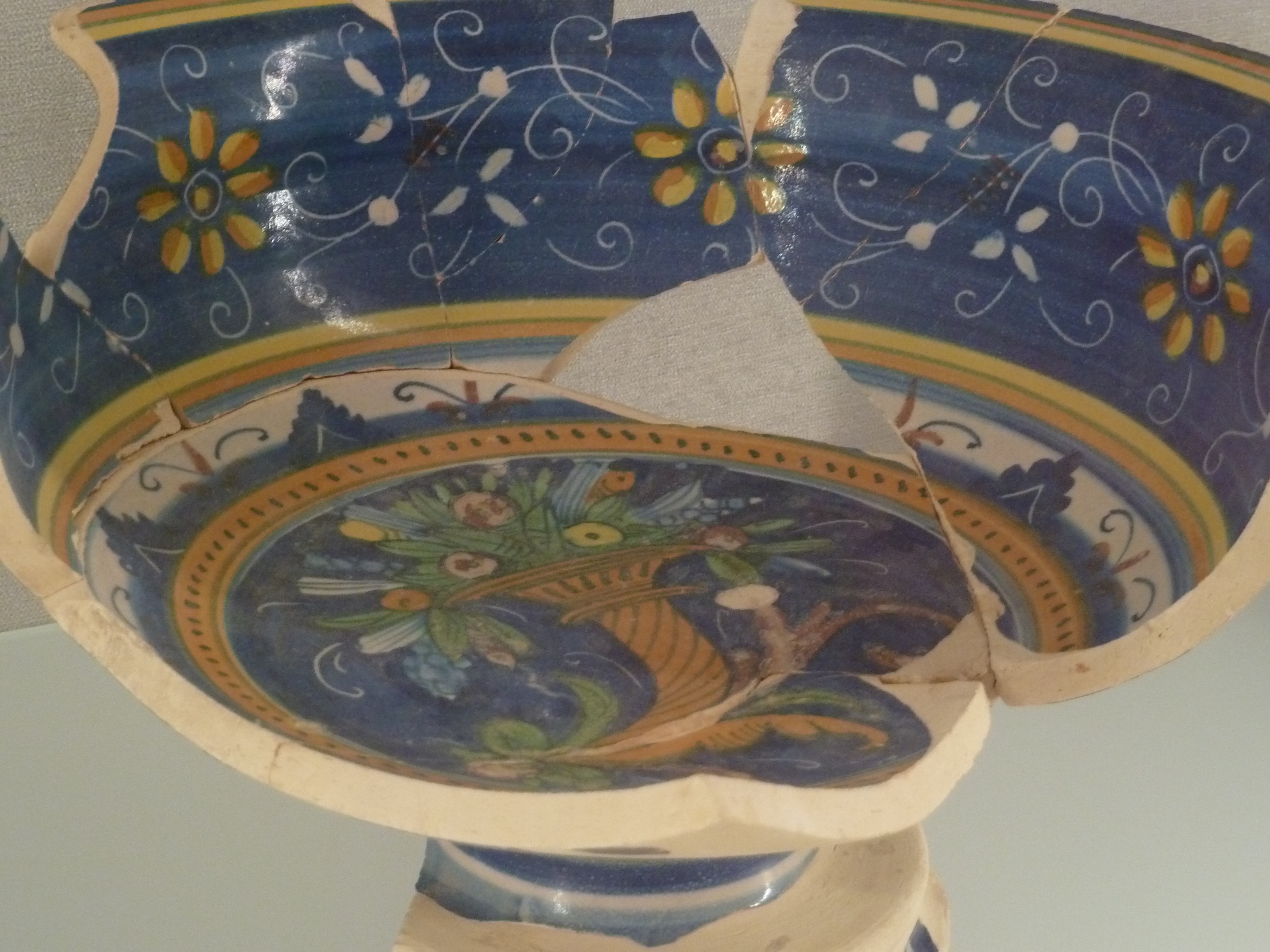
Shattered pottery shards, mosaic fragments—
like lost memories echoing from the past.
Each piece a whisper
of what was spoken.
Each crack a vein of silence
holding meaning.

These remnants speak
in tongues of stone and flame,
where history bleeds into symbol,
and brokenness becomes design.

Alexander, Antiochus, Mattathias Maccabee—
we watched empires rise,
then fall to dust and sea.
Hebrew curves, Roman bones,
Greek thoughts etched into exiled stones.

O seeker, sift the grains with care—
beneath your feet, lies buried there.
Lift your eyes, the thread still shines
from ancient cloth to end of time.

Yeshua, royal, priestly strand,
God’s own binding in the land.
His wounds are knots that tie and hold
the Torah, Spirit, and the gold.

And as the layers thickly paint,
each story worn, both bold and faint,
so too his presence, hidden deep,
awaits the ones who seek and keep.

The veil peels back, the colours blend—
a sacred thread that has no end.
Within the layers, truth is spun:
Yeshua—G_D’s eternal Son.

In the artist’s hand,
they find new order—
not to erase the fracture,
but to honour it.

To make of the broken whole,
and of the scattered, song.
Not Pictures, but Places
These are not pictures.

They are places—
maps of inner terrain
where the soul remembers
what the mind has forgotten.
Icons dissolve into abstraction,
but the holy remains.

A gesture becomes a sanctuary,
a texture, a psalm.
In every layer:
a question.
In every mark:

A memory.

In the space between:
the whisper of the Spirit
hovering,
still creating.

An invisible creative Guiding Hand—
the One who spoke,
and there was light;
form emerging from the void unknown—
Tohu Vavohu,
without form and void.

Just as the artist
grasps for those creative sounds,
so do we—
with brush, palette knife,
sculptor’s clay, or chisel—
tackling blank canvas, clay and wood,
fashioning not from certainty,
but from yearning.

From silence that longs to speak,
from chaos seeking order,
from shadows aching for the light.

We echo the First Artisan—
breathing life into dust and fiber,
calling forth structure from texture,
meaning from gesture,
and hope from hue.

Each mark becomes an offering,
each stroke, a fragment of prayer,
each layer, a testament
to the mystery of being,
and the mercy of becoming.

For what is creation
if not surrender—
to the unseen voice,
to the Spirit hovering still
over waters––
deep and untamed?

To Touch the Hem

For the artist, for the worshipper:
And so, we paint, sculpt, write—
not merely to create,
but to commune.

Each gesture,
each stroke of brush or word,
is an act of reaching
toward the unseen—
to touch the hem
of the garment of glory.

Fringes tipped with sky and light,
swaying at the edge of divinity.

Tekhelet Returns

A slender blue thread,
woven with white,
has quietly returned—
gracing the corners
of prayer and cloth,
almost unnoticed,
until it is everywhere.

It crept in softly,
like memory,
like longing finding form—
a whisper of blue sky
against fields of white.

Now it swings
from the tallit’s edge—
a thread reborn.

Tekhelet once lost,
now found––
in the rhythm of fingers
tying sacred knots.

This week we read:

“Speak to the Children of Israel…”
And still the voice speaks,
calling for corners—
marked with covenant.

With the blue of heaven,
the blue of remembering.
What was hidden in time
has returned in colour—
a renaissance of dye,
a revival of meaning.

Not just a thread,
but a promise—
a whisper of redemption
twisting through generations,
binding earth
to sky,
to G_D.

And somewhere,
a woman once reached
through the crowd—
to touch the fringe,
the p’til tekhelet,
and found herself whole.

Layers of Paint Say:

Thread of Heaven––
a thread of blue, sky-breathed and deep,
is woven where the edges sleep—
on garments kissed by desert wind,
a ribbon where the laws begin.

They said, “Remember, do not stray,”
so G_D dyed sky into the clay.
But who could find that holy hue
where tides conceal and time withdrew?

The chilazon, a mystery’s shell,
its dye once sought, untraceable,
rose from depths where secrets sleep,
the sea’s own shade the prophets keep.
Its blood—once hidden, now revealed—
spoke of a covenant unsealed.

So walked he once among the grain,
where sandals stirred the dusty plain.
No one saw the thread he wore—
it lay beneath the flesh he bore.

A hidden Messiah—now unveiled.

What is his name, once long concealed?
Who dares to name the Son of G_D,
the treasure buried in the sod?
A gleam beneath the desert’s hand,
a secret woven through the sand.

Not pearl or gem held in the hand,
but breath unstirred, divinely planned—
a silence speaking through his death,
a whisper stronger still than breath.

Tekhelet lost, now found anew—
not in dye, but what is true.
A thread not sewn on outer seams,
but stitched within prophetic dreams.

Yeshua, royal, priestly strand,
G_D’s own binding in the land.
His wounds are knots that tie and hold
the Torah, Spirit, and the gold.
Lift your eyes, the thread still shines
from ancient cloth to end of time.

And as the layers thickly paint
each story worn, both faint and quaint,
so too his presence, hidden deep,
awaits the ones who seek and keep.

The veil peels back, the colours blend—
a sacred thread that has no end.
Within the layers, truth is spun:
Yeshua—G_D’s eternal Son.

Unveiled

But who will dare to listen?
To behold what once was hidden?

Then, we did not know or see—
but now, with unveiled faces,
we perceive
what was veiled
in paint, wood, and clay.

Drawing near in wonder,
a new sound awaits
those willing to listen.
Ears unstopped,
eyes opened in amazement.

For what was forgotten
is now being declared.
We, with new perception,
see colours bright
illuminating the way—
ahead and beyond.

A hope recreated—
for all to see,
to hear,
and to know.
Amen, and Amen.
Hallelujah!
When we talk about “Times an Seasons.” it can have wide implications – “Times and seasons.” It’s a phrase often spoken with reverence, a simple expression with profound implications. On the surface, it may seem to mark the natural flow of days, months, and years—the shifting from summer’s warmth to winter’s chill, the quiet rhythms of planting and harvest, or the inevitability of sunrise and sunset. But beneath this poetic veneer lies a concept that is far deeper, one that has shaped human understanding, shaped civilizations, and defined personal journeys.
“Times and seasons” speaks not only of the passage of time but of the appointed moments in our lives—those critical junctures where events align, where decisions are made, and where destinies unfold. It calls us to consider the timing of things, not merely as a function of the clock or calendar, but as a divine orchestration, a pattern we often perceive only in hindsight. In the biblical tradition, this phrase is loaded with spiritual significance. The writer of Ecclesiastes declares that “to everything there is a season, and a time to every purpose under heaven.” These words remind us that life unfolds according to a rhythm and plan that is often beyond our control or comprehension. There are times for sowing and times for reaping, moments of joy and seasons of grief, and each one has its place in the grand narrative of existence.
But “times and seasons” also invites us into reflection on the wider implications—on history, on culture, and on our own personal stories. It challenges us to consider the shifts and turning points in the world around us. What season are we living in, not just individually, but as a community, a nation, or even humanity itself? Is this a time for building or for tearing down? A season of peace or a season of upheaval?
On a personal level, it can help us frame our own experiences. We all go through seasons, times when things fall apart and times when they come together, times of clarity and times of confusion. Recognizing the season we are in helps us respond wisely—whether by waiting patiently in winter’s stillness or by acting boldly in summer’s abundance.
Roni at entrance to Israel Museum, Jerusalem
Roni cooking up a storm
Click on this Link to Listen this Programme:
Happy New Year!
The implications of these ideas ripple out even further. For those who believe in divine sovereignty, the phrase serves as a reminder. We are not the ultimate masters of time. Seasons come and go, often without our consent. Yet, even in the face of this lack of control, there is a hope. This hope is embedded in the idea of seasons. They change. The cold of winter does not last forever; the dryness of drought gives way to the rains. Just as nature cycles through its phases, so too do our lives and the world around us.
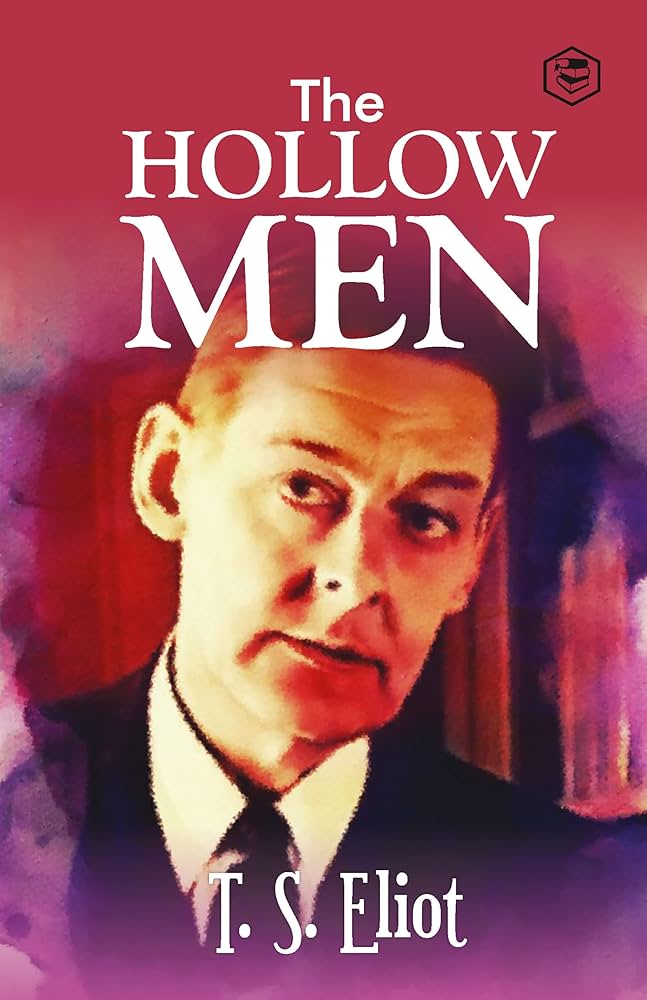
In a world that often demands instant results and constant progress, “times and seasons” urges us to embrace the process. It encourages us to trust the unfolding and find meaning in every phase. It is a recognition that the seasons we pass through—individually and collectively—are not random. They are part of a larger story, one in which every moment, every transition, has purpose. T. S. Eliot focuses on despair in poems like The Waste Land and The Hollow Men. This focus reflects his deep engagement with the cultural, spiritual, and existential crises of his time. It also showcases his own personal struggles. Here are several reasons for this focus:1.
Cultural and Historical Context
2. Philosophical Influences
3. Personal Struggles
4. Religious Quest
5. Themes in The Waste Land and The Hollow Men
6. T.S. Eliot’s Ash Wednesday (1930) is a deeply personal and spiritual poem, marking Eliot’s turn towards Christianity after his conversion to Anglicanism in 1927. It reflects his struggles with faith, doubt, and redemption, encapsulating themes of spiritual renewal and the tension between worldly attachments and divine aspirations.
The poem is structured into six sections, weaving fragmented imagery, liturgical language, and a meditative tone. It explores the journey of a soul turning away from despair and secular distractions, yearning for spiritual transformation and divine grace. The “Ash Wednesday” reference ties to the Christian observance of repentance and mortality, emphasising the soul’s need for humility and hope in the face of human frailty.
Eliot’s use of symbolism, paradox, and allusion creates a complex and layered work that invites contemplation on the challenges and rewards of faith.
6. Symbolism of Despair
Eliot’s obsession with despair is not merely a fixation but a tool to explore the human condition. He presents despair in its starkest form. This approach forces readers to confront the emptiness of modern life. It leads them to consider the possibility of renewal, whether through faith, art, or human connection.
Eliot explores despair through several angles. It results from his historical moment, philosophical influences, personal struggles, and spiritual quest. His poetry serves as both a diagnosis of and a response to the crises of his time.
This timeless truth is significant in various ways. It may be seen through a spiritual, philosophical, or practical lens. It reminds us to align ourselves with the rhythms of life and time. We should embrace them rather than resist them. Seasons will come and go, but how we engage with them defines the legacy we leave behind.
What do we make of the expression: “Now is God’s appointed time for me, and You?” The phrase is personal and universal. It invites us into a deeply meaningful narrative. It is a moment pregnant with meaning, poised between divine providence and human response. The speaker identifies God’s eternal plan converging with the present moment’s immediacy. This is a kairos — the sacred intersection where time and purpose meet.
Imagine a traveler on a journey, worn and weary, pausing at the edge of a river. The path they have walked is full of twists and turns. There are triumphs and regrets. Yet they stand now before an unseen bridge. Only faith can reveal this bridge. The traveler senses a voice, still and small yet unmistakably commanding: Now is the time. The words do not thunder from the heavens; rather, they resonate within, like a melody long forgotten but instantly remembered.
In this moment, the traveler realizes the truth. God’s appointed time is not a distant promise. It is not a future hope. It is here, now, demanding a response. It encourages the traveler to step forward. The traveler must trust that the unseen bridge will hold. They must embrace both the uncertainty and the calling.
But this declaration, “Now is God’s appointed time,” is not solitary. It includes “You.” The phrase is a reminder that divine purpose is never lived in isolation. It suggests a shared calling, a communal moment of reckoning. The “You” could be a friend, a stranger, a congregation, or even the collective human family. It acknowledges that God’s timing is relational, inviting others into the story of faith, repentance, renewal, or action.
In this narrative, the phrase becomes both a challenge and a comfort. It challenges us to recognize the urgency of the present. We need to awaken to the reality that God’s timing is not measured by human clocks. It is measured by the alignment of divine intention and earthly opportunity. It comforts us with the assurance that this moment is not random—it is purposed. God has orchestrated this time for transformation, for stepping into a destiny that is uniquely ours yet intertwined with others.
So, what do we make of this expression? We see it as a call to action and trust. It reminds us that God’s purposes unfold not in abstract futures but in the living, breathing now. It invites us to live fully present. We should be aware that this moment, though fleeting, is eternally significant—for me, and for you.
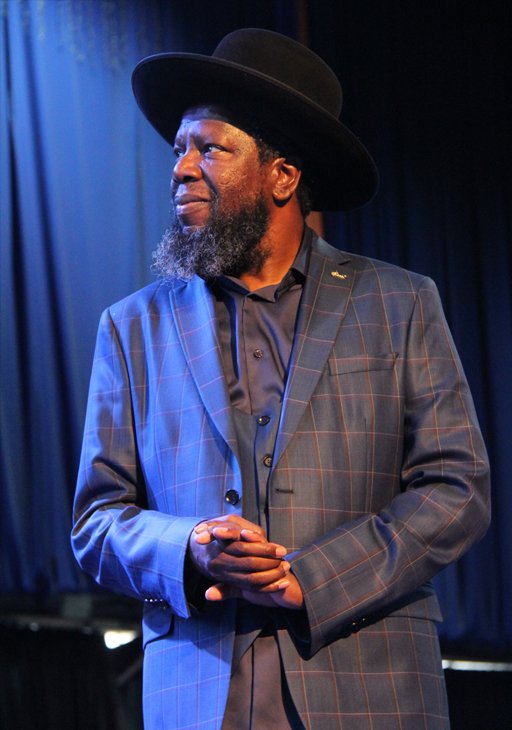
Prophet Phillip Banda
Prophet Philip Banda, founder of Impact for Christ Ministries (IFCM), focuses on faith. He emphasizes healing in his teachings. He also stresses a strong devotion to prayer. He also expresses a particular love for Israel and the Jewish people. Many of his teachings align with Pentecostal and charismatic Christian beliefs. However, several factors could raise questions about their orthodoxy. This depends on specific doctrines he promotes and practices within his ministry.
Factors to Evaluate
Emphasis on Healing and Prophecy: Pentecostal and charismatic movements often emphasize prophecy, miracles, and healing. While these are biblical, excessive focus or deviation from scriptural boundaries (e.g., elevating the prophet above Christ or Scripture) could lead to doctrinal concerns.
Public Teachings: It’s important to examine his public sermons and writings for clarity and alignment with Scripture. Are they Christ-centered, rooted in the Bible, and focused on repentance, grace, and the gospel?
If you have access to specific teachings or doctrinal statements from Prophet Philip Banda, please share them. I can help analyze them for alignment with orthodox Christian theology.
The teachings and ministry of Prophet Philip Banda at Impact for Christ Ministries (IFCM) align with several core aspects. These aspects are part of orthodox Christian doctrine. This conclusion is based on the available information.
Salvation by Grace through Faith:While specific statements on salvation are not detailed in the provided sources, the ministry’s mission to “proclaim the Kingdom of God by preaching the Gospel of the Lord Jesus Christ through the power of The Holy Spirit” implies a focus on evangelism and the message of salvation.
However, without a detailed doctrinal statement, assessing Prophet Banda’s adherence to all aspects of orthodox Christian doctrine is challenging. There are no explicit affirmations of specific creedal formulations like the Nicene Creed.
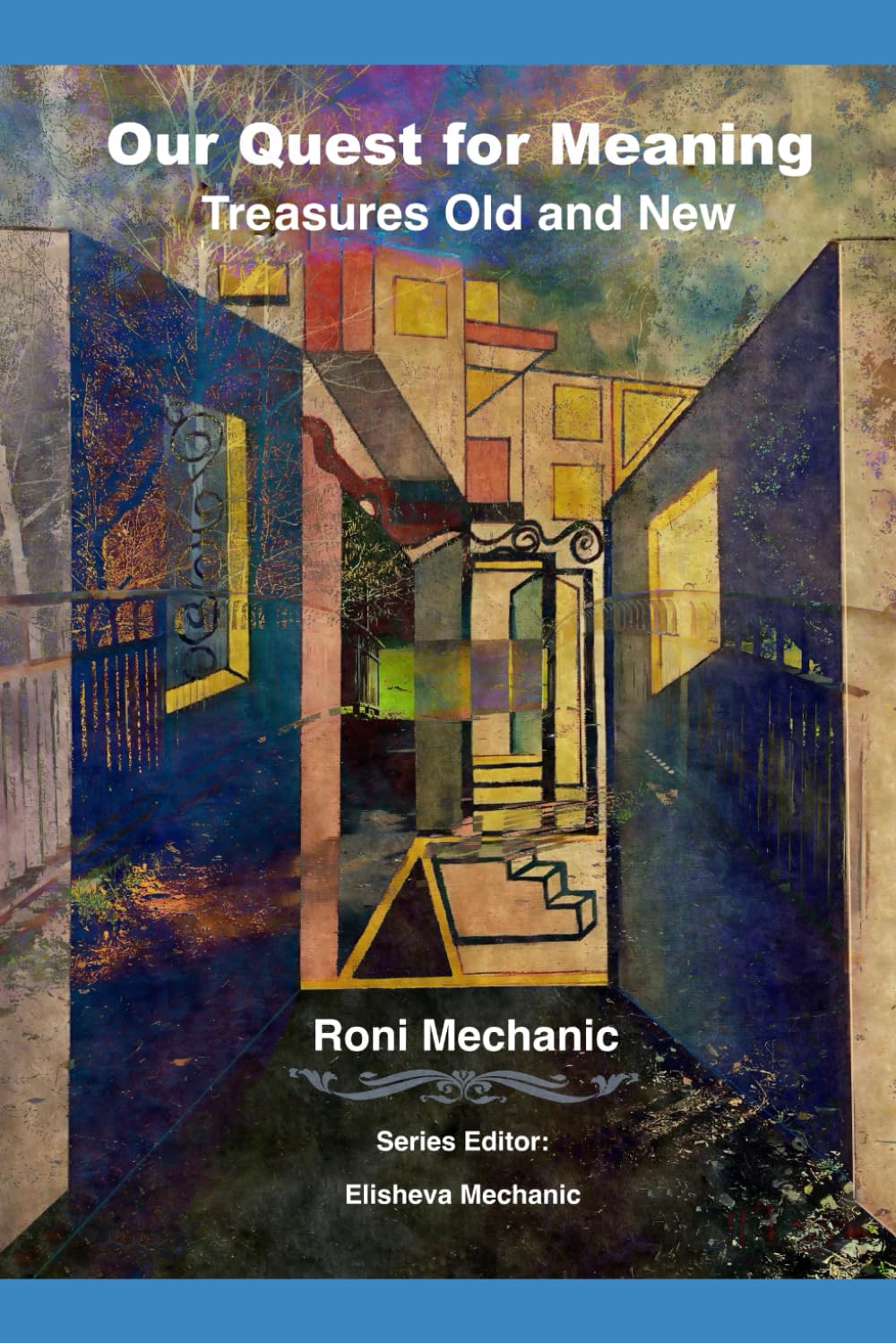
Books Published by Roni & Elisheva Mechanic:
Discover a captivating collection of literary works authored by Roni and Elisheva Mechanic, showcasing their unique storytelling talent and creative insights. These Books are available through Amazon.
Please make a charitable donation towards the running cost of this blog:
What are our expectations? What are your hope & dreams?
Click on Link to Listen:
In contrast, what are your fears & dreads?
Lord’s Prayer (Modern) (New English Version – adopted by the Church of England in 1977):
“Our Father in heaven, hallowed be your name. Your Kingdom come, your will be done, on earth as in heaven Give us today our daily bread. Forgive us our sins, as we forgive those who sin against us. Lead us not into temptation, but deliver us from evil. For the kingdom, the power and the glory are yours. Now and for ever. Amen.”
So,Hopes &Dreams: Fears & Dreads – For starters, a good happy, and life in which we experience a sense of wellness, and wholeness – If we examine each word in turn we will discover a wealth of meaning:
Happy; wellness; wholeness; etc…
Happy – what do we understand from this word?
Wellness – its meaning needs further elaboration…
Wholeness...
In the Lord’s Prayer we express a number of different issues that cover aspects of human life and relationships…
Shalom Radio UK wants to thank you the listener for your support towards this ministry of promoting Messianic Jewish Perspectives – Please repost this Podcast on your network!
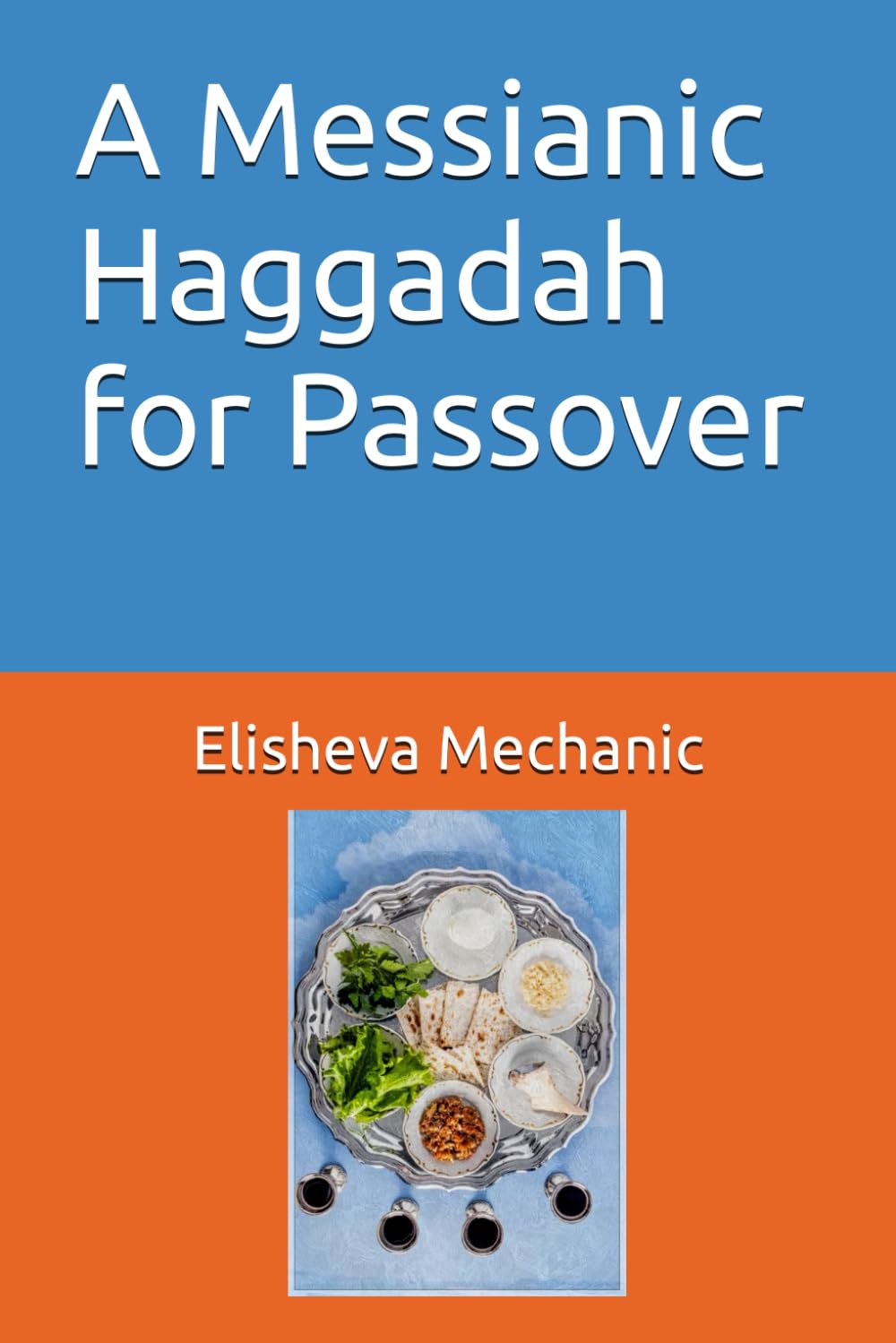
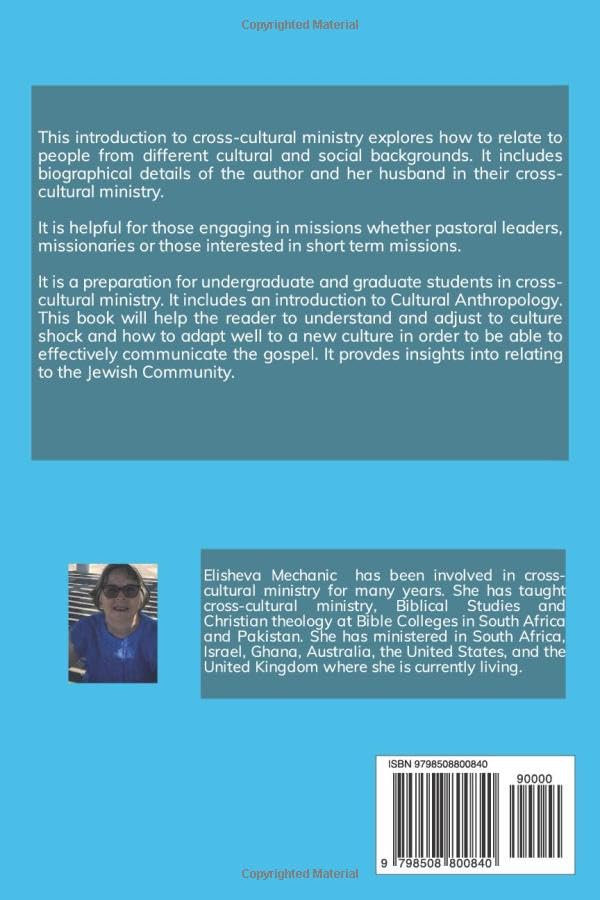
This book is a guide for those beginning a lifetime of cross-cultural ministry and for anyone wanting to spend some time in a cross cultural situation such as a short term mission. It includes some Social Anthroplogy background as well as an understanding of cross-cultural communication and approaching ministry in a new cultual setting. It will help the reader to understand world view and how to overcome the negative effects of adjusting to a new culture and come to an understanding of the customs and outlook on life of a new community of people. Included are insights into understanding the Jewish community as well as several other cultural groups.The Biblical feasts are included as well as an order of service for a Messianic Jewish Passover. Personal anecdotes are included of the author’s experience of cross-cultural ministry and life experiences in ministry.
Version 1.0.0
Please make a charitable donation toward Shalom Radio UK – towards running costs:
What are our expectations? What are your hope & dreams?
Click on Link to Listen:
In contrast, what are your fears & dreads?
Lord’s Prayer (Modern) (New English Version – adopted by the Church of England in 1977):
“Our Father in heaven, hallowed be your name. Your Kingdom come, your will be done, on earth as in heaven Give us today our daily bread. Forgive us our sins, as we forgive those who sin against us. Lead us not into temptation, but deliver us from evil. For the kingdom, the power and the glory are yours. Now and for ever. Amen.”
So,Hopes &Dreams: Fears & Dreads – For starters, a good happy, and life in which we experience a sense of wellness, and wholeness – If we examine each word in turn we will discover a wealth of meaning:
Happy; wellness; wholeness; etc…
Happy – what do we understand from this word?
Wellness – its meaning needs further elaboration…
Wholeness...
In the Lord’s Prayer we express a number of different issues that cover aspects of human life and relationships…
Shalom Radio UK wants to thank you the listener for your support towards this ministry of promoting Messianic Jewish Perspectives – Please repost this Podcast on your network!
This book is a guide for those beginning a lifetime of cross-cultural ministry and for anyone wanting to spend some time in a cross cultural situation such as a short term mission. It includes some Social Anthroplogy background as well as an understanding of cross-cultural communication and approaching ministry in a new cultual setting. It will help the reader to understand world view and how to overcome the negative effects of adjusting to a new culture and come to an understanding of the customs and outlook on life of a new community of people. Included are insights into understanding the Jewish community as well as several other cultural groups.The Biblical feasts are included as well as an order of service for a Messianic Jewish Passover. Personal anecdotes are included of the author’s experience of cross-cultural ministry and life experiences in ministry.
Version 1.0.0
Please make a charitable donation toward Shalom Radio UK – towards running costs:
Shalom Radio UK wants to thank you the listener for your support towards this ministry of promoting Messianic Jewish Perspectives – Please repost this Podcast on your network!
Additional Resources Available:
Elisheva’s New Books are available from Amazon Worldwide:
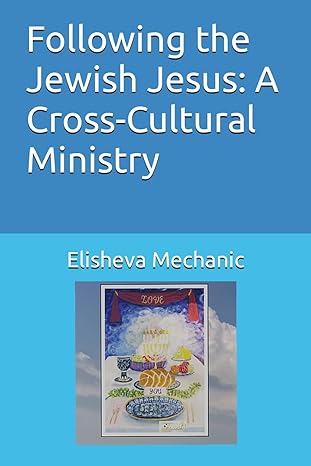
Following the Jewish Jesus: A Cross-Cultural Ministry Paperback – 30 Dec. 2023
This book is a guide for those beginning a lifetime of cross-cultural ministry and for anyone wanting to spend some time in a cross cultural situation such as a short term mission. It includes some Social Anthroplogy background as well as an understanding of cross-cultural communication and approaching ministry in a new cultual setting. It will help the reader to understand world view and how to overcome the negative effects of adjusting to a new culture and come to an understanding of the customs and outlook on life of a new community of people. Included are insights into understanding the Jewish community as well as several other cultural groups.The Biblical feasts are included as well as an order of service for a Messianic Jewish Passover. Personal anecdotes are included of the author’s experience of cross-cultural ministry and life experiences in ministry.
Version 1.0.0
Please make a charitable donation toward Shalom Radio UK – towards running costs:
At the outset I need to say that this programme does contain distressing issues, particularly between members of the three Abrahamic faiths. Furthermore, it is not my intention to stir any anti-Moslem hatred. I sincerely, have the highest regard for all peace loving Arabs, Moslems, and Palestinians.
Click on the Video Link to Watch:
In conversation with a longstanding Jewish friend we were discussing the current Israel – Gaza war and the huge world-wide fallout that has resulted towards Jewish people. Jews just don’t feel safe anymore.
On October 7th, some 3,000 Hamas terrorists invaded Israel from Gaza and perpetrated a barbaric massacre which included horrific atrocities. Days later, bodies were still being found. Now, a month later Israeli forensics teams are struggling to identify many of the remains.1 The Israeli medics and volunteers doing this work have been deeply traumatized by the atrocities.2 According to the latest count, 1,400 people were murdered, mostly civilians and over 240 were taken to Gaza as hostages. It was the worst massacre of Jews in a single day since the Holocaust. This report shows that as soon as news of the horrific slaughter broke, which was live–streamed on social media by some of the terrorists, United Nations Relief and Works Agency (UNRWA) staff immediately celebrated and justified it on Facebook. UNRWA Gaza teacher Osama Ahmed posted “Allah is Great, Allah is Great, reality surpasses our wildest dreams.” UNRWA principal Iman Hassan justified the massacre as “restoring rights” and “redressing” Palestinian “grievances.” Rawia Helles, Director of the Khan Younis Training Center and featured in an UNRWA video, glorified one of the terrorists as a “hero,” “raider,” and “prince of Khan Younis.” English Teacher Asmaa Rafiq Kuheil excitedly called to “sculpture the date” adding a heart emoji. School Administrator Hmada Ahmed posted “welcome the great October.”
I have entitled this programme “Hate Didn’t Start Here.” So, where did it start, and what are the root causes? Why are Jews scapegoated and consistently blamed for the world’s ills? These and many other questions beg answers. I will attempt to address some of the underlying causes, and suggest some attempts to tell a different narrative about Jewish people.
Recently I was listening to a talk on ‘Dream therapy,’ and how to decipher our dreams. Sometimes our dreams don’t have any profound meaning, while at other times their meaning is quite straightforward, sometimes they require us to dig deeper to discover their meaning.
A particular troubling dream: I had a troubling dream the other night after having watched a news report in which Israel was being blamed for committing genocide, pogroms, and ethnic-cleansing of Palestinians. In the dream I had got into an argument with someone who had been accusing me of hating Arabs and Palestinians in particular. It was very life-like and in it I was robustly defending myself against these accusations, and in fact said unequivocally that neither accusation was true, and in fact I have Arab, and Palestinian friends, that include both Moslems and Christians. It was not difficult to discover the meaning to this dream.
A Chosen People – In the musical Fidler on the Roof, the main character Teviah, the milkman from his village Anatefka in the Pale of Settlement, in Eastern Europe is walking along the road pulling his milk cart by himself because his horse is sick. His back is aching and the sweat is running down his brow. He looks up to heaven and says, “God I know we are the chosen people, but would you mind choosing someone else for a change!” I need to add that life in general is tough for Jews with pogroms and hard time for the Jewish people from the authorities, and at times, their Gentile neighbours not treating well either.
So, what does choosiness imply? Chosen to be what and why did God choose the Jews? Well it actually started with one man – Abram, and one woman, Sarai, who latter became Abraham and Sarah, who were from Median which is Modern day Iran and Turkey. First Abraham received the call:
Genesis 12 New International Version
The Call of Abram
12 The Lord had said to Abram, “Go from your country, your people and your father’s household to the land I will show you.
2 “I will make you into a great nation, and I will bless you; I will make your name great, and you will be a blessing.[a] 3 I will bless those who bless you, and whoever curses you I will curse; and all peoples on earth will be blessed through you.”[b]
4 So Abram went, as the Lord had told him; and Lot went with him. Abram was seventy-five years old when he set out from Harran. 5 He took his wife Sarai, his nephew Lot, all the possessions they had accumulated and the people they had acquired in Harran, and they set out for the land of Canaan, and they arrived there.
6 Abram traveled through the land as far as the site of the great tree of Moreh at Shechem. At that time the Canaanites were in the land. 7 The Lord appeared to Abram and said, “To your offspring[c] I will give this land.” So he built an altar there to the Lord, who had appeared to him.
8 From there he went on toward the hills east of Bethel and pitched his tent, with Bethel on the west and Ai on the east. There he built an altar to the Lord and called on the name of the Lord.
9 Then Abram set out and continued toward the Negev.
So, Abram who became Abraham was called a Hebrew and subsequently he became known as a Jew. The term ‘Jew,’ actually come from one of Abraham’s great grand children, the son of Jacob, called Judah from which Jew is derived.
The three Abrahamic faiths – Judaism, Christianity, and Islam, each in term refer to Abraham as their father. So why then all the rivalry, hatred, and killing? Why then the Moslem world who share an ancestor with Jews and Christians, is seeking to dominate in the name of Islam? Both Jews and Christians are being murdered by radical, fanatical Moslems in various parts of the world, particularly driven by the Iranian Moslem regime. But it is far more complex than that, and not all Moslems hate Jews.
Our special focus: The particular focus of the podcast is the current Israel – Gaza war, and the international hate that this has inflamed globally! Dry tinder only requires a single flame to light it, and that flame was the horrific attack by Hamas upon Israel on the 7th October, 2023.
More often, reflecting the refusal of Jews and Christians in Muhammad’s environment to accept his message, the Quran stresses their inability to comprehend the message they possess but do not put into practice and to appreciate that Muhammad’s teaching fulfills that message.
JEWISH POLITICAL STUDIES REVIEW
Volume 29, Numbers 3–4
Introduction
The question of the Koran’s attitude toward Jews is not merely a theoretical-academic matter. Because of the centrality of the Koran in the life of the Muslim and of Muslim communities past and present, this question has had, and still has in our day, a fundamental influence on the formation of attitudes toward Jews. True, this is not the only factor and more everyday ones also come into play. But the topic remains an important one to study and become familiar with.
This article will begin with the history of the first – and very problematic – chapter in Muslims’ relations with the Jewish groups in Arabia, particularly in the city of Medina. It will then present selected verses of the kind – and they are the majority – that propound a negative and hostile attitude toward Jews, along with verses – only few – from which a tolerant attitude can be derived. Finally, I will show the potential for a creative modern interpretation that bolsters the tolerant attitude, an interpretation that is now undergoing a certain revival against the backdrop of the struggles between extremists and moderates in the Islamic world.
In 622 Muhammad with his few believers moved to the city of Medina. More than 10 years of preaching to the residents of his own city, Mecca, had reached a dead end and he had been harshly persecuted. There is no credible information on Muhammad’s relations with Jews before the Hegira, but he may have encountered Jews in his journeys as a trader, which was his profession until he began to prophesize at the age of 40. It is clear, however, that the consent of several individuals and subtribes to receive him in Medina stemmed from these people’s exposure to a Jewish-monotheist influence; there was a significant Jewish presence in the city and its environs.
Three prominent Jewish tribes were in the city at the time of the Hegira: Qaynuqa, Nadir, and Qurayza. The latest research shows that their weight in the city was considerable; they dominated commerce, agricultural land, fortresses, and weapons. They were allies (not wards) of the two dominant Arab tribes, Aws and Khazraj.
The tribes had undergone a long process of Arabization (as reflected in their names, customs, and ways of life). There is no clear evidence of their religious-spiritual inclinations, but it is commonly assumed that they were rabbinic-Talmudic Jews of the familiar kind who observed commandments and were faithful to their God. An instance of this is the Beit Midrash in the city, a kind of “cheder” for the children of the Jews in which the sons of the Muslim elite also studied and, probably, assimilated a monotheistic attitude. It is not surprising that 7 of the 12 local leaders of Medina had been students in the “cheder.”
Attempts at Persuasion: Persecution and Killing
In the first period of his stay in Medina, Muhammad made great efforts to persuade the Jews to recognize him as a prophet and join his camp. To that end he was prepared to order his believers to pray in the direction of Jerusalem and to adopt Yom Kippur as a fast day. But his efforts were totally rebuffed. The Jews (with just a few exceptions) adhered to the rule that prophecy had already been annulled at the beginning of Second Temple days, and at most agreed that Muhammad may have been sent to spread a monotheistic message to the Arabs only. The traditions and the verses of the Koran show that the response to the Jews’ obduracy was a dramatic intensification of the polemics against them, centering on the accusation that they had distorted their own books, which, the Muslims claim, presage Muhammad’s revelation. This polemical escalation led to a staged process of removing the Jews, some of whom were deported and others killed. This process was reinforced by a gradual yet rapid joining of Muhammad’s ranks by non-Jewish residents of Medina. The Jews’ status deteriorated and they could no longer rely on the old defense pacts with the Arab tribes, whose leaders explained to them that “hearts have changed.”
Already in 624, about two years after the Hegira, Muhammad laid siege to the strongholds of the Jewish tribe Qaynuqa and deported them to Syria. They left all their weapons and all their property behind them. About a year later the members of Nadir were also deported after Muhammad’s forces had cut down their date orchards, the source of their livelihood. Their homes and property were also confiscated by the Muslim community. The most dramatic events occurred in 627, when the men of the Qurayza tribe were massacred and the women and children were sold into slavery. The tradition tries to obscure Muhammad’s responsibility for the killing of hundreds of Jews by accusing them of violating agreements, but this charge lacks any solid historical basis. The anti-Jewish campaign concluded with the conquest of the Khaybar oasis north of Medina in 628, the deportation of some of its residents, and the turning of others into tenant farmers. The slogan heard until today (at least in Hamas processions) is “Khaybar, Khaybar, ya Yahud, jish Muhammad sa Ya’ud!” (Khaybar, Khaybar, o Jews! The army of Muhammad will return!). It has become a symbol of the Jews’ subjugation in Arabia only six years after the Hegira.
Two other phenomena are worth noting. First, alongside the physical struggle against the Jews, Muhammad removed Jewish elements from his new religion: the direction of prayer reverted to Mecca instead of Jerusalem; the month of Ramadan replaced Yom Kippur as the time of fasting; and other steps were taken to emphasize Islam’s more independent and elevated status. Second, interestingly, there are no signs of significant cooperation among the Jewish tribes in resisting Muhammad. For now it is hard to find the reason for this.
Some Koranic “Jewish” Verses
When the Koran refers explicitly to the Jews, it uses three different terms: Children of Israel, “Banu Israil;” the Jews, “al-Yahud;” and “the People of the Book,” a term that refers to Jews and Christians alike. The first category concerns the biblical Israelites and almost always echoes the biblical story, in many cases adding materials from the immense Jewish literature of interpretations and legends that do not appear in the Bible, mostly from the Midrash.
The vast majority of the verses are utterly pejorative and it is easy to understand why and how they have been used to justify Muslim anti-Semitic attitudes past and present. In the first category, the stories stress the grave sins of the Israelites, mainly their disobedience of God and their prophets, and the harsh punishments that were their lot throughout their long history of suffering. Some of the punishments will haunt them forever, according to some verses. The tales are shaped to maintain a similarity between the fate of the biblical prophets and the situation of Muhammad vis-à-vis the heathen Arabs and the Jews who rejected him. This setting puts Muhammad on an equal footing with Moses and Jesus, for example, and also provides him with a divine promise that notwithstanding all the hurdles his way and message will finally prevail.
In the second and third categories, the harsh allegations are directed against the Jews who confronted Muhammad and refused to join his new religion. These are basically verses of bitter polemic against the beliefs and actions of those Jews.
As a rule, the Koran lacks any mention of the specific context of the revelation. Nevertheless, the “Jewish” verses usually conform to the basic historical sequence laid down by Muslim tradition and widely accepted today by Western scholarship. So, roughly speaking, we find a few tolerant verses, probably dating to the period when Muhammad still hoped to gain the Jews’ support and/or lacked the power to act directly against them using violent means. These verses are also relevant to the period when he sought to convince his own Meccan tribe that he was God’s Messenger. Even then, and also in later stages, negative verses about the Israelites are also included.
The following is a small selection of relevant verses, each followed by a short summation.
Anti-Jewish Verses
An example of a grave sin of the ancient Israelites.
…The people of Moses took to them, after him, of their ornaments a Calf — a mere body that lowed. Did they not see it spoke not to them, neither guided them upon any way? Yet they took it to them, and were evildoers. (7:145-146)
The Jews are accused of unbelief and of killing their own prophets.
So, for their breaking the compact, and disbelieving in the signs of God, and slaying the Prophets without right, and for their saying, “Our hearts are uncircumcised” — nay, but God sealed them for their unbelief, so they believe not, except a few.… (4:154-155)
A clear reference to the destruction of the two temples and a warning for the future.
And We decreed for the Children of Israel in the Book: “You shall do corruption in the earth twice.…”
So, when the promise of the first of these came to pass, We sent against you servants of Ours, men of great might, and they went through the habitations, and it was a promise performed.
Then We gave back to you the turn to prevail over them.…
Then, when the promise of the second came to pass, We sent against you Our servants to discountenance you, and to enter the Temple, as they entered it the first time. (17:4-7)
The major allegation of falsification, which is much repeated in the Koran.
People of the Book, now there has come to you Our Messenger, making clear to you many things you have been concealing of the Book, and effacing many things.… (5:19)
Part of the sinfulness of the Jews is their adherence to their sages and not directly to the Torah.
The Jews say, “Ezra is the Son of God”; the Christians say, “The Messiah is the Son of God.”
…God assail them! How they are perverted!
They have taken their rabbis and their monks as Lords apart from God. (9:30-31)
Jews are hostile to Muslims:
Thou wilt surely find the most hostile of men to the believers are the Jews and the idolaters. (5:85)
One of the harshest verses, describing the Jews as apes and swine.
Say: “People of the Book, do you blame us for any other cause than that we believe in God, and what has been sent down to us, and what was sent down before, and that most of you are ungodly?…”
Whomsoever God has cursed, and with whom He is wroth, and made some of them apes and swine, and worshippers of idols — they are worse situated, and have gone further astray from the right way. (5:64-65)
An indication of the battles against the Jews, and a divine authorization to kill them.
And He brought down those of the People of the Book who supported them from their fortresses and cast terror in their hearts; some you slew, some you made captive. And He bequeathed upon you their lands, their habitations, and their possessions, and a land you never trod. God is powerful over everything. (33:26)
Tolerant Verses
If God had willed, He would have made you one nation; but that He may try you in what has come to you. So be you forward in good works; unto God shall you return.… (5:54)
No compulsion is there in religion. Rectitude has become clear from error. So whosoever disbelieves in idols and believes in God, has laid hold of the most firm handle, unbreaking…. (2:257)
How can we turn hatred into love? If we continue to perpetuate hatred between Moslems, Jews and Christians, we will continue to hate and seek ways to destroy each other – Love is all we need, the Beetles song says! Nice thought, but the ‘how,’ is much more complex, and that is going to require much more that having nice thoughts about each other!
Gods way: We like to sing, “I want God’s way to be my way as I journey here below, for there is no other highway that a Child of God should go…” Lovely sentiment, yet we cannot escape the harsh reality of all the conflict, hatred, war, and killing that is taking place all too often in the Name of God! Allah Akbar – God is great, as the suicide bomber blow him or her self up, and killing countless other innocent people with them in their declaration of God’s greatness – really?
Yeshua is the way: Jesus, Yeshua or Isa holds the key to unlocking the door upon God’s true love, and helping to end all the strife between the three Abrahamic faiths.
Isa (Arabic: عِيسَى, romanized: ʿĪsā) is a classical Arabic name and a translation of Jesus. The name Isa is the name used for Jesus in the Quran. However, it is not the only translation; it is most commonly associated with Jesus as depicted in Islam, and thus, commonly used by Muslims.
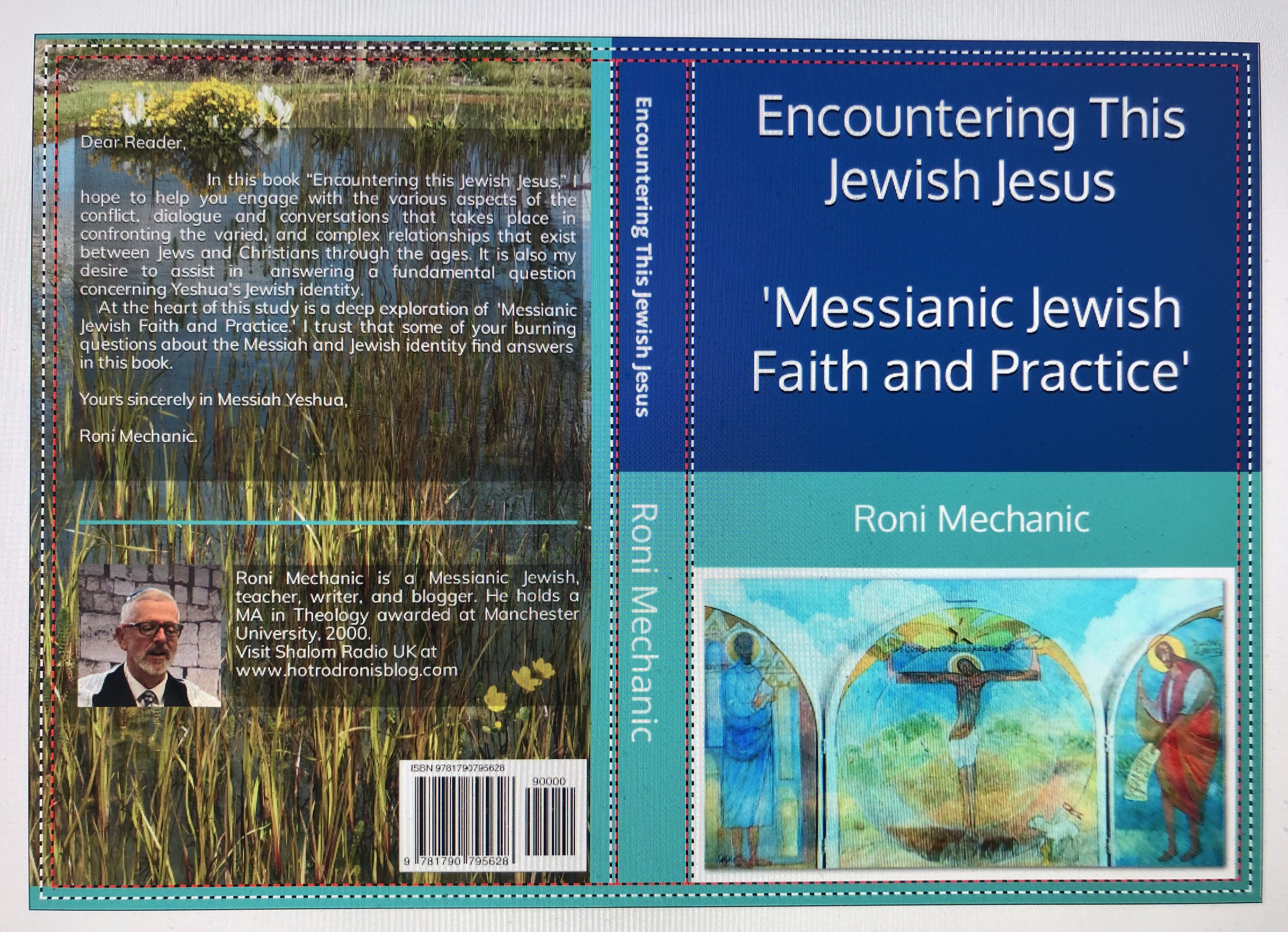
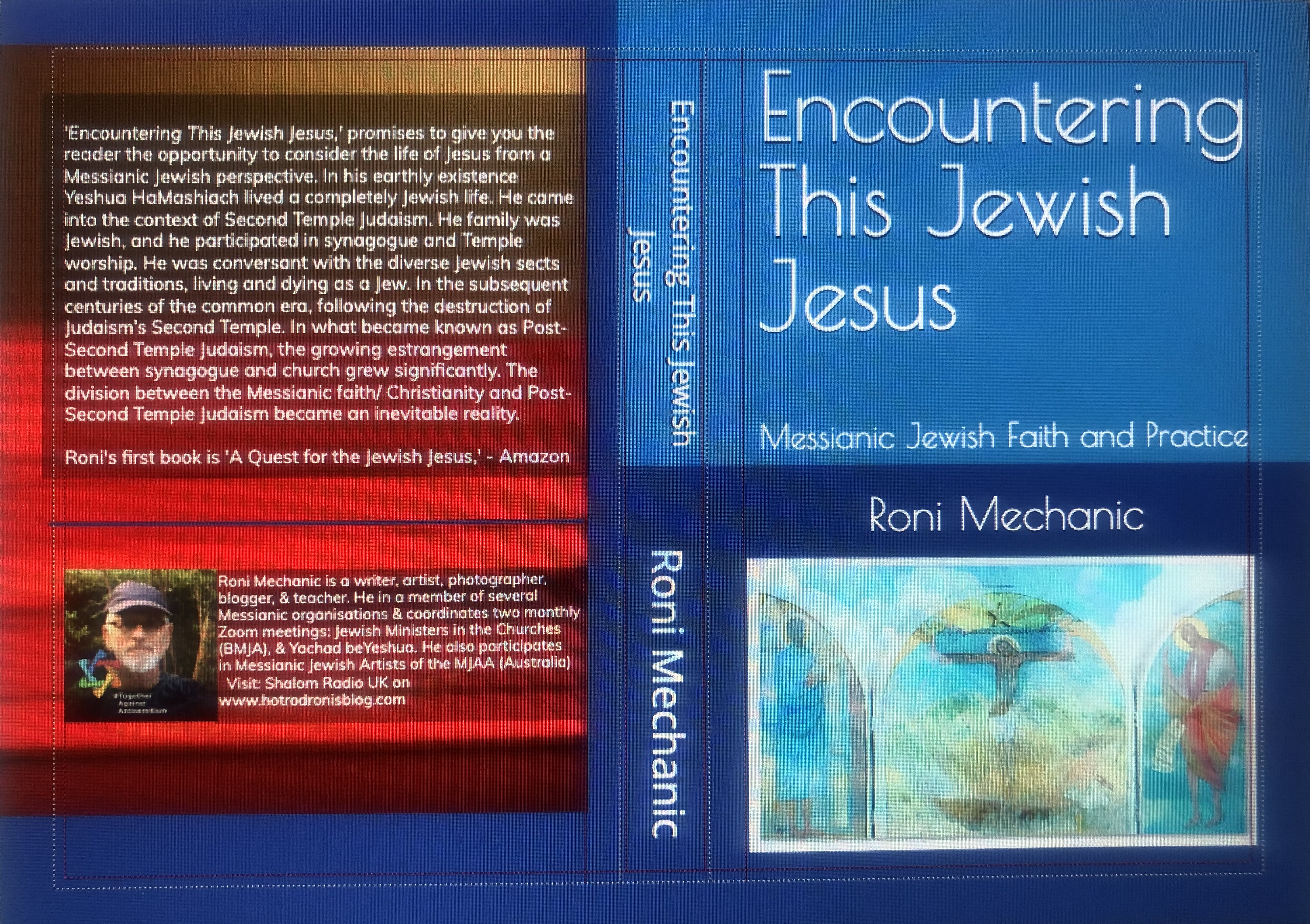
Encountering This Jewish Jesus: Messianic Jewish Faithand Practiceby Roni Mechanic | 27 Aug 2023
Available from Amazon Worldwide:
Roni’s Books Available From Amazon:
English Edition
Please make a Charitable Donation to Help with the Running Costs of this Blog: