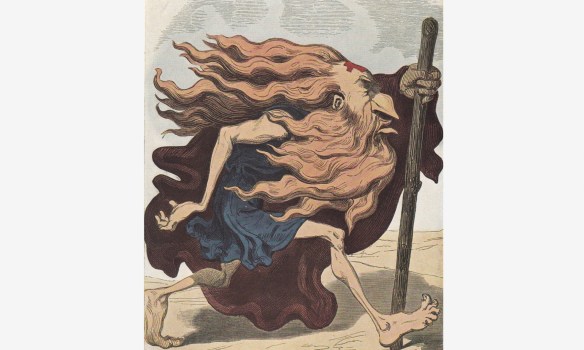
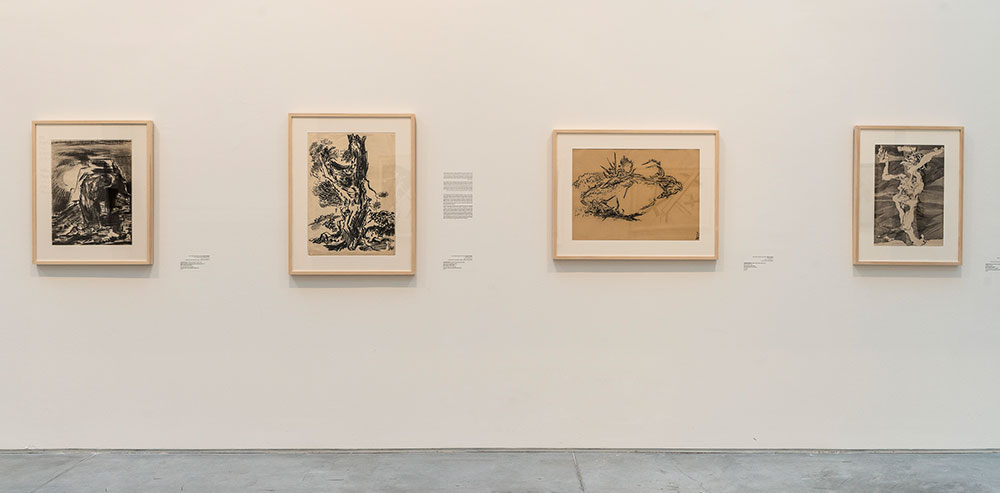
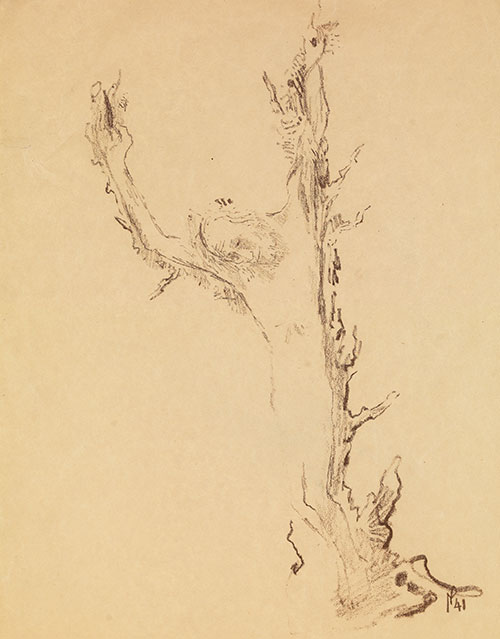
“Genocide” is a term used to describe violence against members of a national, ethnic, racial or religious group with the intent to destroy the entire group. The word came into general usage only after World War II, when the full extent of the atrocities committed by the Nazi …read more
UPDATED ON
Armenian Genocide
HISTORY.COM EDITORS
The Armenian genocide was the ruthless slaughter of millions of Armenians by the Turks of the Ottoman Empire. In 1915, during World War I, leaders of the Turkish government set in motion a plan to expel and massacre Armenians. By the early 1920s, when the massacres and deportations finally ended, between 600,000 and 1.5 million Armenians were dead, with many more forcibly removed from the country. Today, most historians call this event a genocide: a premeditated and systematic campaign to exterminate an entire people. However, the Turkish government still does not acknowledge the enormity or scope of these events.
The Roots of Genocide: The Ottoman Empire
The Armenian people have made their home in the Caucasus region of Eurasia for some 3,000 years. For some of that time, the kingdom of Armenia was an independent entity: At the beginning of the 4th century A.D., for instance, it became the first nation in the world to make Christianity its official religion.
But for the most part, control of the region shifted from one empire to another. During the 15th century, Armenia was absorbed into the mighty Ottoman Empire.
The Ottoman rulers, like most of their subjects, were Muslim. They permitted religious minorities like the Armenians to maintain some autonomy, but they also subjected Armenians, who they viewed as “infidels,” to unequal and unjust treatment.
Christians had to pay higher taxes than Muslims, for example, and they had very few political and legal rights.
In spite of these obstacles, the Armenian community thrived under Ottoman rule. They tended to be better educated and wealthier than their Turkish neighbors, who in turn grew to resent their success.
This resentment was compounded by suspicions that the Christian Armenians would be more loyal to Christian governments (that of the Russians, for example, who shared an unstable border with Turkey) than they were to the Ottoman caliphate.
These suspicions grew more acute as the Ottoman Empire crumbled. At the end of the 19th century, the despotic Turkish Sultan Abdul Hamid II – obsessed with loyalty above all, and infuriated by the nascent Armenian campaign to win basic civil rights – declared that he would solve the “Armenian question” once and for all.
“I will soon settle those Armenians,” he told a reporter in 1890. “I will give them a box on the ear which will make them…relinquish their revolutionary ambitions.”
The First Armenian Massacre
Between 1894 and 1896, this “box on the ear” took the form of a state-sanctioned pogrom.
In response to large scale protests by Armenians, Turkish military officials, soldiers and ordinary men sacked Armenian villages and cities and massacred their citizens. Hundreds of thousands of Armenians were murdered.
Young Turks
In 1908, a new government came to power in Turkey. A group of reformers who called themselves the “Young Turks” overthrew Sultan Abdul Hamid and established a more modern constitutional government.
At first, the Armenians were hopeful that they would have an equal place in this new state, but they soon learned that what the nationalistic Young Turks wanted most of all was to “Turkify” the empire. According to this way of thinking, non-Turks – and especially Christian non-Turks – were a grave threat to the new state.
World War I Begins
In 1914, the Turks entered World War I on the side of Germany and the Austro-Hungarian Empire. (At the same time, Ottoman religious authorities declared a holy war against all Christians except their allies.)
Military leaders began to argue that the Armenians were traitors: If they thought they could win independence if the Allies were victorious, this argument went, the Armenians would be eager to fight for the enemy.
As the war intensified, Armenians organized volunteer battalions to help the Russian army fight against the Turks in the Caucasus region. These events, and general Turkish suspicion of the Armenian people, led the Turkish government to push for the “removal” of the Armenians from the war zones along the Eastern Front.
Armenian Genocide Begins
On April 24, 1915, the Armenian genocide began. That day, the Turkish government arrested and executed several hundred Armenian intellectuals.
After that, ordinary Armenians were turned out of their homes and sent on death marches through the Mesopotamian desert without food or water.
Frequently, the marchers were stripped naked and forced to walk under the scorching sun until they dropped dead. People who stopped to rest were shot.
At the same time, the Young Turks created a “Special Organization,” which in turn organized “killing squads” or “butcher battalions” to carry out, as one officer put it, “the liquidation of the Christian elements.”
These killing squads were often made up of murderers and other ex-convicts. They drowned people in rivers, threw them off cliffs, crucified them and burned them alive. In short order, the Turkish countryside was littered with Armenian corpses.
Records show that during this “Turkification” campaign, government squads also kidnapped children, converted them to Islam and gave them to Turkish families. In some places, they raped women and forced them to join Turkish “harems” or serve as slaves. Muslim families moved into the homes of deported Armenians and seized their property.
Though reports vary, most sources agree that there were about 2 million Armenians in the Ottoman Empire at the time of the massacre. In 1922, when the genocide was over, there were just 388,000 Armenians remaining in the Ottoman Empire.
Armenian Genocide Today
After the Ottomans surrendered in 1918, the leaders of the Young Turks fled to Germany, which promised not to prosecute them for the genocide. (However, a group of Armenian nationalists devised a plan, known as Operation Nemesis, to track down and assassinate the leaders of the genocide.)
Ever since then, the Turkish government has denied that a genocide took place. The Armenians were an enemy force, they argue, and their slaughter was a necessary war measure.
Today, Turkey is an important ally of the United States and other Western nations, and so their governments have likewise been reluctant to condemn the long-ago killings. In March 2010, a U.S. Congressional panel at last voted to recognize the genocide.
However, little has changed in Turkey: Despite pressure from Armenians and social justice advocates throughout the world, it’s still illegal in Turkey to talk about what happened to Armenians during that era.
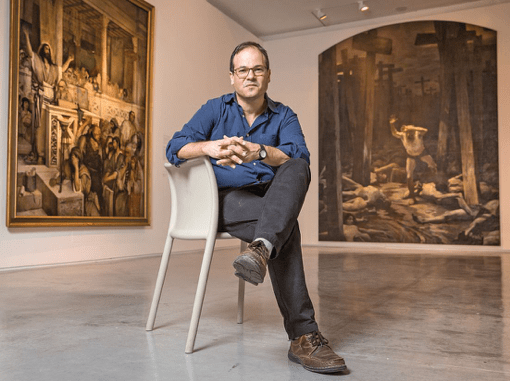
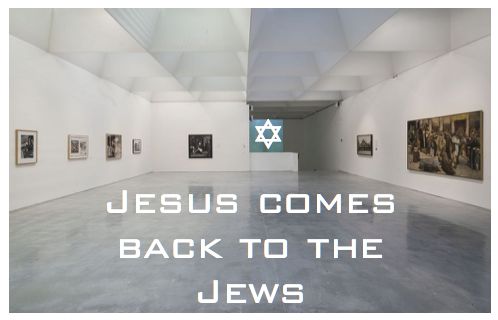
From December, 2016 at the Israel Museum an exhibit, Jesus comes back to the Jews, was boldly featured by the museum’s art curator, Amatai Mendelsohn. The exhibit featured 150 works by 40 mainly Jewish artists exploring the complex, evolving attitudes of Jewish, Zionist and Israeli artists toward the Christian Saviour. The exhibition concluded on the 22nd April, 2017. A companion book called: Behold the Man: Jesus in Israeli Art, was written by Amatai Mendelsohn.
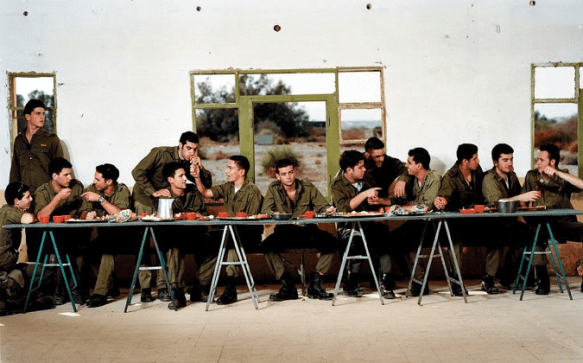
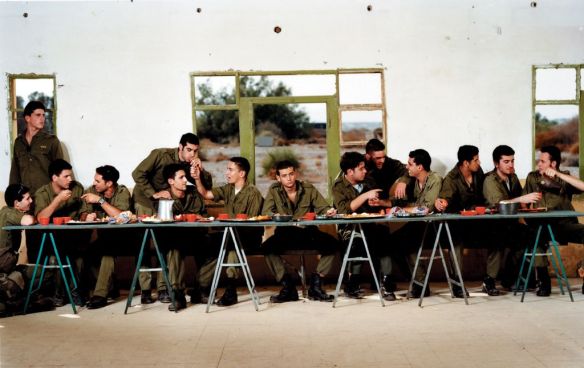
Adi Nes’s ‘Untitled (Last Supper), planned down to the last plate (Courtesy Israel Museum)
Ms Jessica Steinberg said,
“Jesus and the Jews have had something of a complicated relationship.”
In “Behold The Man: Jesus in Israeli Art,” a new exhibit at the Israel Museum, curator Amatai Mendelsohn examines that complex iconography up close, through the prism of Jewish and Israeli art.
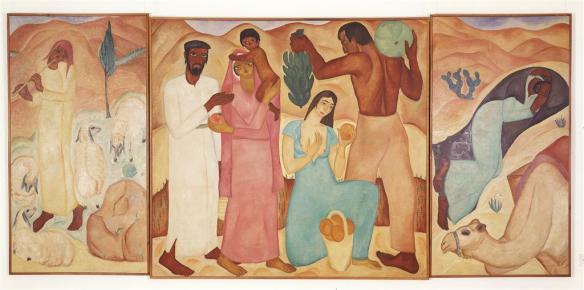
It’s a process Mr Mendelsohn began 10 years ago, when he first laid eyes on an unusual painting by Reuven Rubin, the famed Israeli artist and pioneer. (You may view my programme in Behold the Man series in which I feature Rubin’s work0.
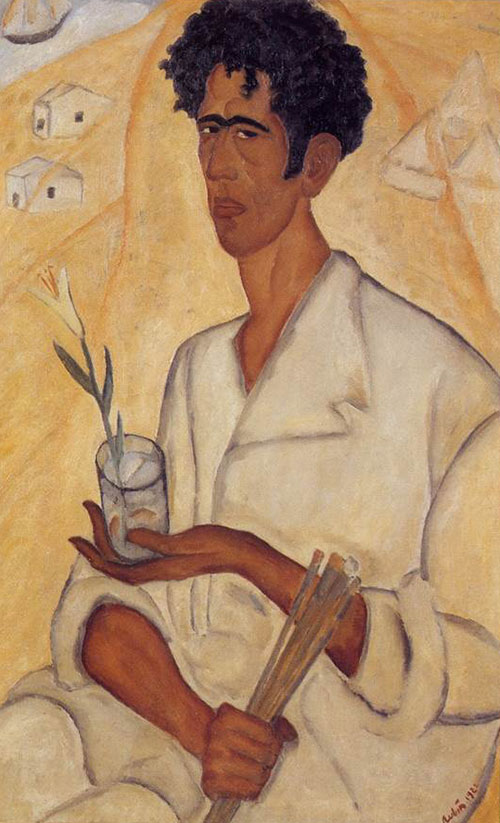
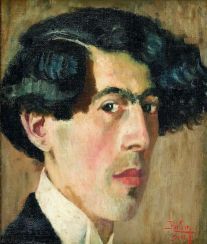
At the time, Mendelsohn was working on an exhibit about Rubin, “Prophets and Visionaries: Reuven Rubin’s Early Years: 1914-23,” and stumbled upon one of Rubin’s earliest self-portraits, in which he mimics aspects of a Jesus figure, as he, the subject, stares down at his bloodied hands.
“Rubin was attracted to Jesus, and that intrigued me,” he said. “Now I know how many Jewish artists dealt with the figure of Jesus.”
In one of the main gallery halls, the exhibit features the 150 works by some 40 artists, in which the evolving attitudes of Jewish, Zionist and Israeli artists toward Jesus is on display..
There are the classic works that place Christian-inspired images in classically Zionist settings, in which Jesus becomes a metaphor for the rebirth of the Jewish people in the Promised Land, and more contemporary, 20th- and 21st-century Israeli artists, who saw Jesus as a more familiar symbol of personal and universal suffering.
The show, which opened in December, brings together works from the museum’s collections and from private and public collections in Israel, as well as several pieces borrowed from the National Museum in Warsaw and Centre Pompidou in Paris. The exhibit is open until April 22, 2017.
It’s a collection of works that Mendelsohn, who has been a curator at the Israel Museum for 20 years, has thought about for much of that time.
“For me, the art history process starts when I see something as part of my daily museum activity,” he said. “It’s a question of how religion and art connect.”
In order to tackle the many works dealing with Jesus, Mendelsohn divided the exhibit into sections, looking at Jesus deployed as a problematic figure in Jewish history, Jesus as the enemy, as a symbol of anti-Semitism, and as someone who had a “huge effect on Jewish existence,” he said.
Christ before his Judges
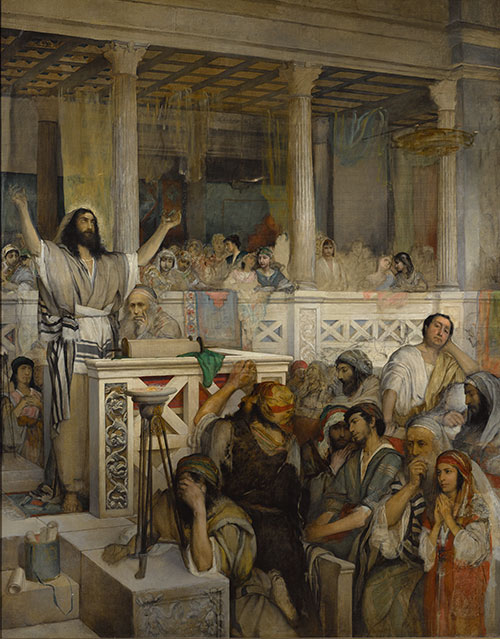
Maurycy Gottlieb – Christ preaching at Capernaum
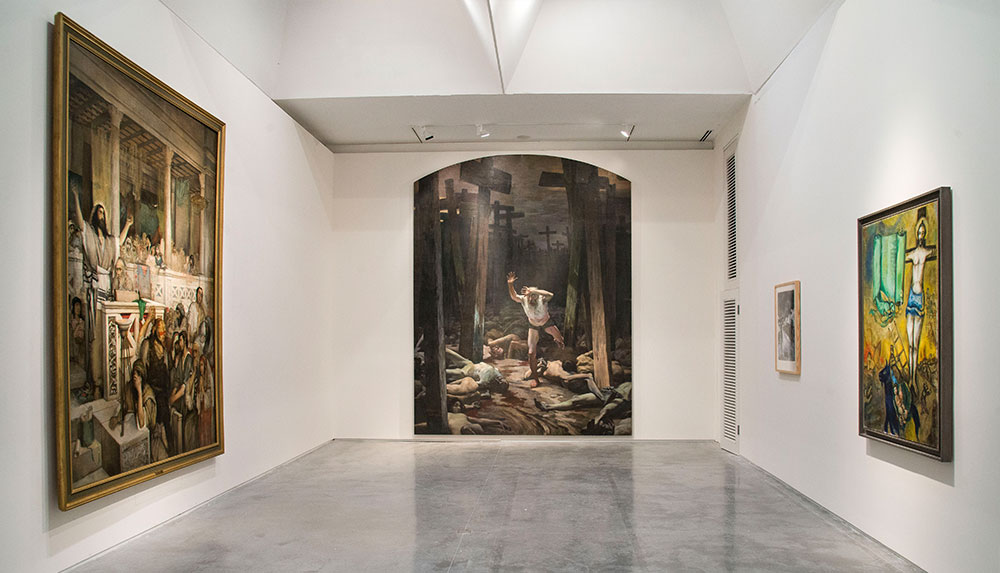
The exhibit begins with “Jesus Preaching in Capernaum,” the last, unfinished piece from 1879 by Maurycy Gottlieb, the Polish artist who died at just 23, and is perhaps best known for his famed Yom Kippur painting. This work resembles that peace, with a similar composition, as it is set in a synagogue, albeit in Kfar Nahum or Capernaum, the northern Galilean town where Jesus famously preached.
Featuring Jesus in the centre with a mix of congregants listening to him, Gottlieb looked at Jesus as a Jew, and as a possible bridge between Christians and Jews, perhaps harkening to what could happen in his native Poland.
“It sets a tone for the show,” said Mendelsohn. “Here was Jesus, and he had a moral, universal, humanistic message.”
It’s a message that echoes the thoughts of German-Jewish philosopher Moses Mendelsohn — whom the curator is not related to — who saw Jesus as a moral Jew, as a prophet, perhaps one of the greatest Jews, but not as God.
“It takes Jesus back to the Jews,” said Mendelsohn.
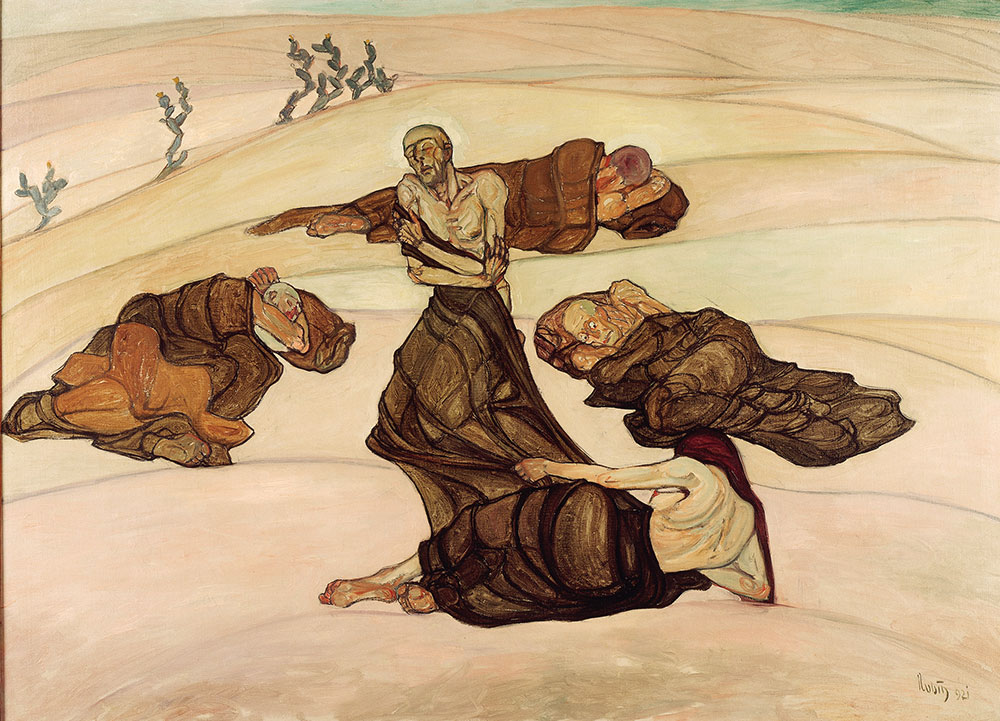
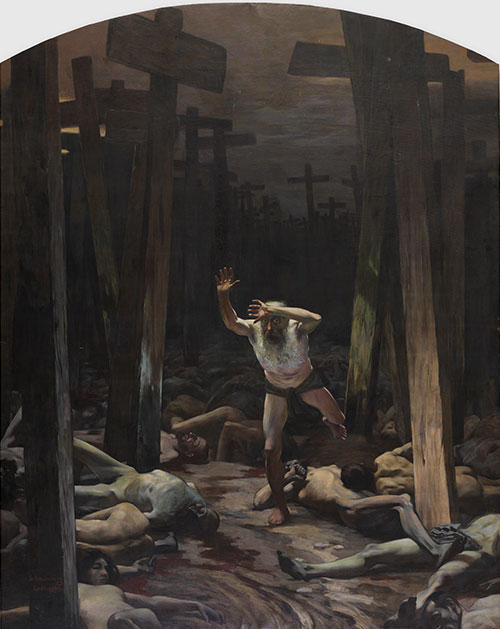
To the right of Gottlieb’s work is “In the Shadow of the Cross,” a massive piece by Polish painter Samuel Hirszenberg, who worked a generation later. Taking a far darker, more sinister look, the Zionist painter created a difficult image of a wandering Jew, barely dressed, wandering among corpses in a cemetery.
It hung in the original Bezalel art school building in Jerusalem for many years, portraying the emergence of the Zionist movement, said Mendelsohn, and the early pioneers’ escape from Europe and anti-Semitism.
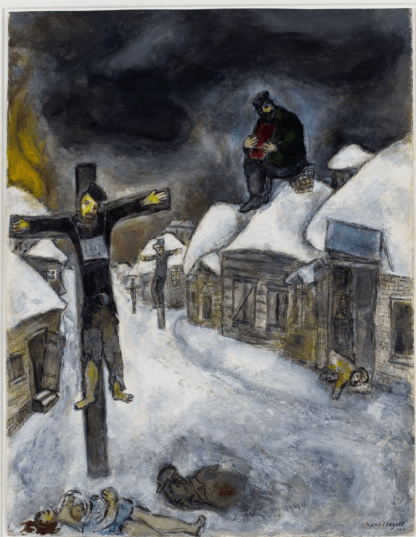
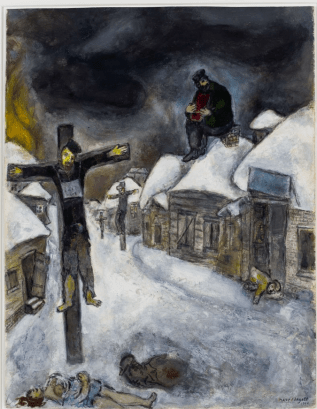
The third wall of the first section is completed with Chagall’s “Yellow Crucifixion” from 1942, depicting a Jew with the halo of a Christian saint, wearing phylacteries.
“Many don’t know that Chagall was attracted to and obsessed by Jesus as a figure of Jewish pain and suffering,” said Mendelsohn.
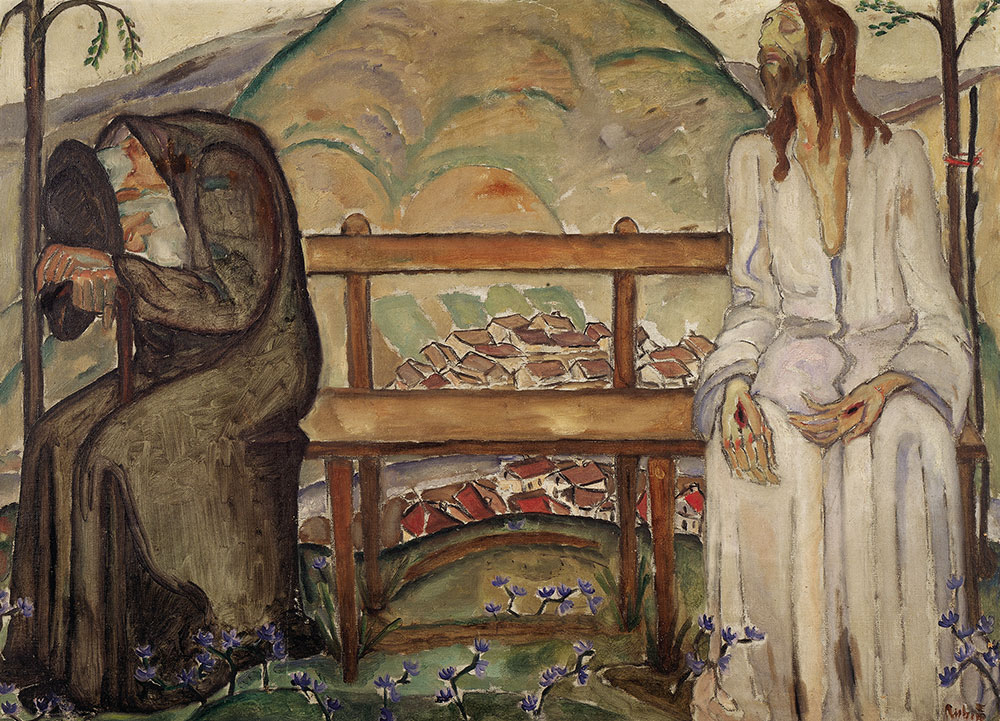
So was Rubin, apparently. One section of the exhibit is devoted to several of his paintings, beginning with that early self-portrait that looks quite different from his other works, noted Mendelsohn.
“When I looked at this, I thought it was a strange Rubin,” he said. “It was all about his agony. Rubin was very interested in the story of Jesus.”
It was painted during Rubin’s early period when he spent some time in New York after 10 years in Romania and a year before that in pre-state Palestine.
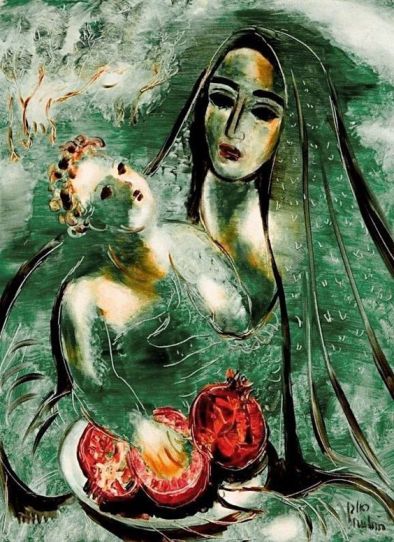
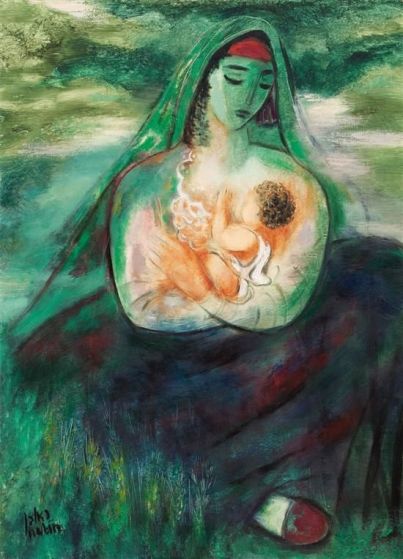
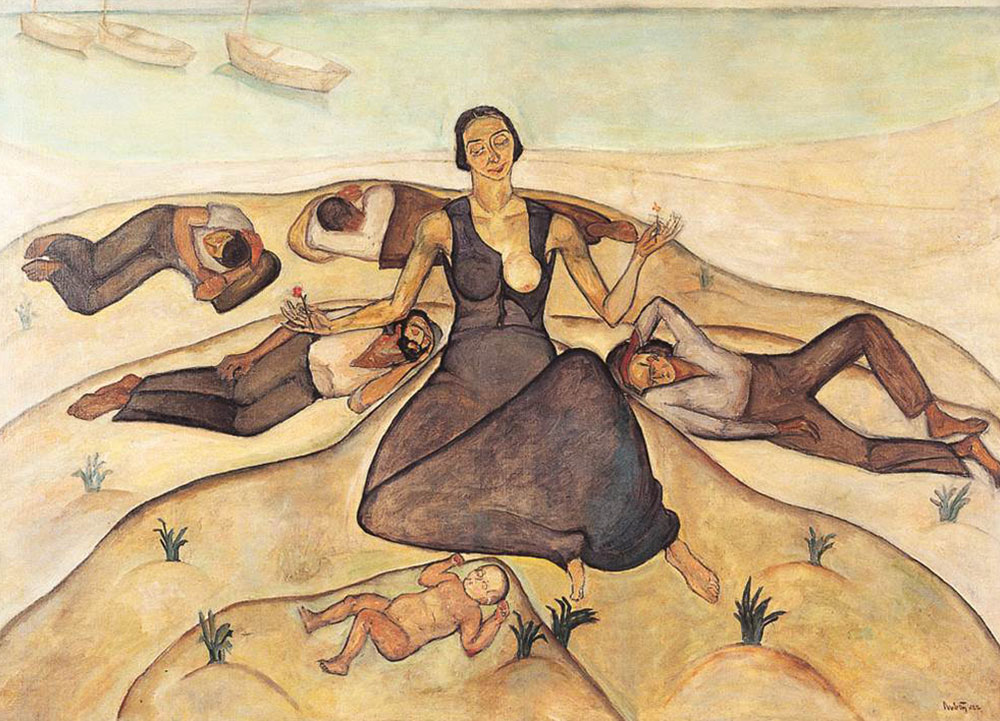
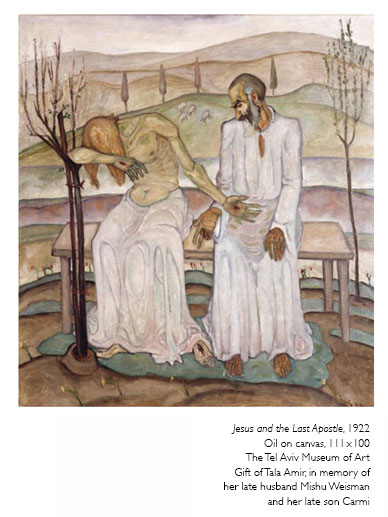
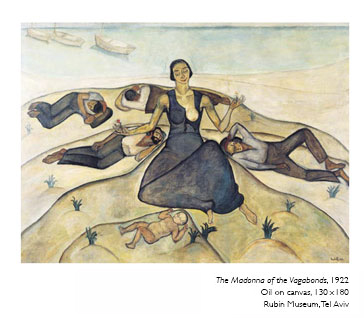
That piece is followed by others from Rubin, including one of an old, religious Jew sitting on a bench with a resurrected Jesus, and others featuring a Madonna, lolling on what looks like the shore of the Galilee, with a baby that could be the baby Jesus reborn in the land of the Jews.
“It’s resurrection of the birth of the baby, all about new beginnings,” said Mendelsohn.
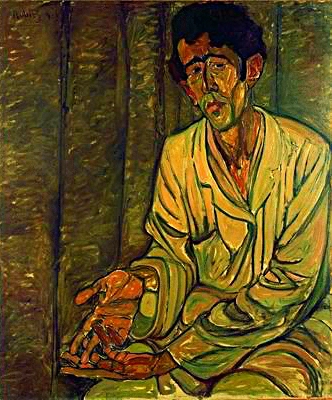
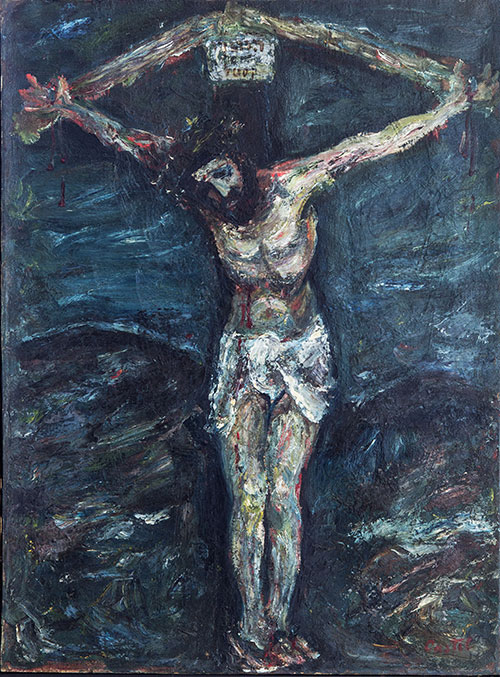
A painting by Moshe Castel, who was born in Ottoman-era Palestine to a religious family, was discovered recently in a locked cupboard of the Moshe Castel Museum of Art in Ma’ale Adumim. It was painted after the artist’s newborn baby and wife died following childbirth.
The painter, who lived in Safed, secluded himself in a monastery and painted the dark, sad self-portrait that mimics other art of Jesus as the long-suffering, misunderstood prophet.
As the exhibit moves into more modern times, there are different sides of Jesus portrayed as well. Yigal Tumarkin, an immigrant from Germany whose father wasn’t Jewish, looks at the crucifixion in his rough, sharp-edged sculpture made from salvaged goods found in Bedouin camps, as he interpreted the tensions in Israeli society and prototypes of Christian art.
Moshe Gershuni’s exhibited works focus primarily on the blood of the crucifixion, perhaps creating a new testament between him and the Israeli public after he came out of the closet as gay, conjectured Mendelsohn.
There are photographs of performance art by multimedia artist Motti Mizrachi, who is disabled, and walked down the Via Dolorosa in 1973 with a cross on his back. Another set of photographs juxtapose a newspaper photograph of a dead Palestinian man being carried during the First Intifada, with the famed paintings of the disciples carrying the crucified Jesus.
The exhibit ends with the now-famous photo by Nes Adi, “Untitled (Last Supper),” a staged photo of Israeli soldiers eating a mess-hall dinner that echoes the “Last Supper” painting by Leonardo da Vinci.
Then there is the video installation by sculptor and installation artist Sigalit Landau, who filmed a series at the Dead Sea, including a piece depicting her floating on a whole watermelon. It conjures images of Mary with Jesus, as Landau’s hands are stretched to the sides, evoking the cross.
“Israelis are funny about Jesus,” said Mendelsohn. “But when we scrape the surface, we realise that there is a lot of Christian imagery all around us, even if we’re unaware of it.”
“Behold The Man: Jesus in Israeli Art,” Israel Museum, open until April 22, 2017.
____________________
Art and Theatre
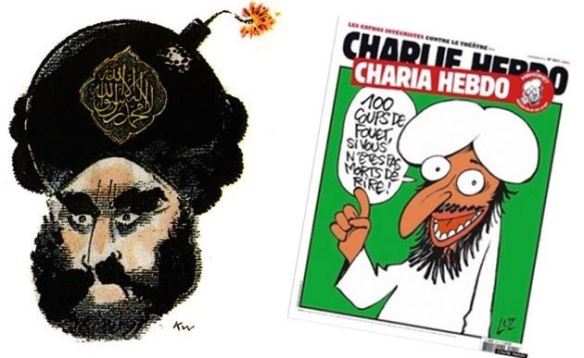
With the depiction of Moses, Jesus and Muhammad, there is a great danger of causing offence – particularly if this is done in a satirical or a mocking caricature of them. Jews, Christians and Moslems do not take kindly to such renderings. Anger, disgust, protest, rage and violence may result from those who have been offended, expressing outrage towards the artist and media personnel who are involved in publicising the offensive material. This is the recent response to the McJesus sculpture and the Charlie Hebdo cartoon – the Christian reaction was comparatively mild and measured in comparison to the cartoon depiction of the Prophet of Islam:
McJesus Sculpture
McJesus’ sculpture sparks outrage among Haifa’s Christians
Arab Christians call for the removal of sculpture that portrays Ronald McDonald as Jesus on the cross; on Friday, protesters hurled a firebomb and stones at the museum, wounding 3 police officers.
[Associated Press |Published: 01.15.19 , 16:23]
An art exhibit featuring a crucified Ronald McDonald has sparked protests by Haifa’s Arab Christian minority.
Hundreds of Christians calling for the removal of the sculpture, entitled “McJesus,” demonstrated at the museum in the northern city on Friday. The police said rioters hurled a firebomb at the museum and threw stones that wounded three police officers. Authorities dispersed the crowds with tear gas and stun grenades.
Church representatives brought their grievances to the district court Monday, demanding it order the removal of the exhibit’s most offensive items, including Barbie doll renditions of a bloodied Jesus and the Virgin Mary.
Charlie Hebdo: from the French ‘Charlie Weekly,’ is a French satirical weekly magazine, featuring cartoons, reports, polemics, and jokes. Irreverent and stridently non-conformist in tone, the publication describes itself as above all secular, skeptic, and atheist, far-left-wing, and anti-racist publishing articles about the extreme right (especially the French nationalist National Front party), religion (Catholicism, Islam, Judaism), politics and culture.
The magazine has been the target of two terrorist attacks, in 2011 and 2015. Both were presumed to be in response to a number of controversial Muhammad cartoons it published. In the second of these attacks, 12 people were killed, including publishing director Charb and several other prominent cartoonists.
Charlie Hebdo first appeared in 1970 as a companion to the monthly Hara-Kiri magazine, after a previous title was banned for mocking the death of former French President Charles de Gaulle. In 1981 publication ceased, but the magazine was resurrected in 1992. Its current editor-in-chief is Gérard Biard. The previous editors were François Cavanna (1970–1981) and Philippe Val (1992–2009). The magazine is published every Wednesday, with special editions issued on an unscheduled basis.
ZOG
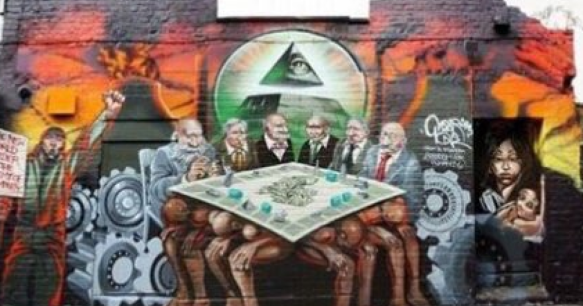
Monopoly Board Game Parody of Jewish Control of World Finances
ZOG – Zionist Occupied Government that controls the world
Equally, to single out Jews for ridicule and to hold to anti-Semitic and conspiracy theories that claim that they control world finances and governments – called ZOG. Alas, even Jeremy Corbyn’s the Labour leader was slow to condemn such ideas:
A Step too far
No serious minded person likes folk to poke fun or ridicule at that which is sacred to them, because of their particular faith – Jews, Christians and Moslems each have their redlines that when folk cross them they voice their opposition as is the case of the two examples given above:
McJesus’ sculpture
Prophet Muhammad depicted wearing a turban that in the shape of a bomb.
Ant-Semitic Monopoly board game mural
While satire and humour may be part of expression of free-speech, however, for some folk there is definitely a crossover point where those who are ridiculing that which fundamental to their faith go too far and they result in giving offence. This is clearly so in these cases that I have given, as well as to perpetuate anti-Semitic tropes as depicted in the last two image above.
Art as self-expression:
You will recall that I did a series of programmes during 2017 on the image of Jesus in Jewish and Israeli art. These were based upon the book by Amatai Mendelsohn –
Behold the Man: Jesus in Israeli Art
Various aspects of this subject were considered over a number of months on my blog. One example is –
Behold the Man: Between Judaism, Zionism, and Christianity
Art that is true art is not simply a dispassionate and visual depiction of a given subject. For the true artist, for her or his work to have a significant impact, it must generally convey something of the artist who created the piece of work – this is equally true when we think about the amazing world in which we live. There is an intelligence behind it that thinks and feels [mind and heart – will and emotions] and those who believe, call the ONE the Creator G_D. For we do not live in a random universe, but it has a perfect order and design, like the fingerprints of the sculptor or brush strokes of the painter.
I recall the work of the sculptor Babara Hepworth who drew her inspiration from the costal environment in which she lived. The crashing of the sea sculpting the rock formation in the cove near where she lived is reflected the awesome beauty that the motion of the sea carved from the rocks. Her inspired work reflects this starkness of the visual and audio impressions that were imprinted on her mind and reflected in her sculptures.
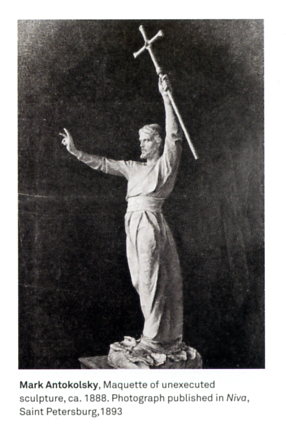
There is a risky and challenging undertaking that faces the Jewish and Israeli artist who seeks to depict Jesus, with the attendant danger and scope for being misunderstood. Both Marc Chagall and Mark Anatokolsky both faced severe criticism for depicting a Jewish looking Jesus – “Why did you paint/sculpture Christ?” said their fellow Jews and “Why did you paint/sculpture Christ like that?” said gentiles when confronted with a very Jewish looking Jesus. No one said that it would be easy, but then artist are often people who challenge the status quo and press the margins of what folk perceive as being acceptable. May one say that they live dangerously. Like the Chinese Chinese avant garde artist Wi Wi who was driven into exile for his challenging the authoritarian communist rule in his native China.
From Personal Experience to National Identity
Moshe Castel, Crucifixion, ca. 1948. Ink on paper, 30 x 21 cm. The Moshe Castel Museum of Art, Ma’ale Adumim, Israel
Moshe Castel
Moshe Castel 1900 – 1991, was born in Israel to Jewish parents that had lived in the Jerusalem for many generations. However, he lived in Paris from 1927 – 1940. Although his paintings dealt with general themes, in the European expressionistic style, when he returned to Israel, he did two paintings of deep significance related to our theme of Jesus in Jewish and Israeli art – they we both depicted a crucifixion of Jesus.
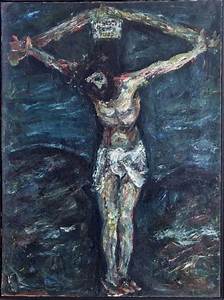
Paintings in sequence: Chaim Soutine 1 and 2, 3; Francis Bacon 4, 5, 6, & 7
_________________________________
As I have said above that the personal life of the artist almost always has an impact upon the content that is portrayed, relating to personal events and impressions.
Painting by Roni Mechanic
________________
Take for example this painting done by me – you will notice that there are the image of three fish. On closer examination, there is a large whale above a dolphin and in the bottom left hand corner there is a shark. My wife Elisheva pointed out to me that she thought that the picture expressed a turbulent time that I had been facing and that the whale symbolised G_D’s protection over me, the dolphin, that was being threatened by the shark. I had not consciously painted these three fish with that in mind, but I had to agree with her summation of the imagery in the painting.
Similarly, Moshe Castel’s Crucifixion paintings gave expression to a very painful episode in his personal life. He painted these in 1948, when he withdrew from public life, spending a year in a monastery on the shores of the Sea of Galilee. This retreat took place after the death of his wife who died giving birth, and their child who died some three years later. It is in an expressive style, very similar to the work of Chaim Soutine. We should note that the third painting by Soutine of the human butchered body is echoed in Francis Bacon’s work – [See panel above for examples of their work]Castel depicts himself as the crucified Jesus, against a background of mountains on a stormy night. The depiction is reminiscent of Matthias Groenewolt’s Isenheim crucifixion.
In Castel’s depiction of Jesus, the face is that of the artist himself and the artist himself:
What Moshe Castel has done is not unique, Paul Gauguin did that as well in his Yellow Crucifixion. Vincent van Gogh’s Peita and Marc Chagall spoke of himself in his anguish as an artist as if he were being crucified. This type of portrayal of the artist as if he were Christ is a way of attempting to describe the depth of their personal anguish. It is particularly significant that Jewish and Israeli artist feel at liberty to cross this threshold of depicting Jesus’ crucified as not only an image of their own suffering, but equally as Chagall had done of Jewish suffering in general.
Van Gogh – Peita
Chagall’s Anguish
Amatai Mendelsohn says, that it is apparent that an enormous emotional investment went into this surprising painting by Castel. One wonders if his time in the Catholic monastery had an influence upon him. This is pure conjecture on my part, but it does not completely surprise me that he should have painted this crucifixion that is at the heart of the Catholic and Christian/Messianic faith. All the more so that these images of the crucified Christ were never seen during the artist life, as the were found locked away in a cupboard in his home after his death.
A great taboo surrounds the question of Jewish and Israeli artist daring to depict the figure and person of Jesus still to this day. Mendelsohn continues in his discussion, that the inscription that went above the painting was planned in two preparatory sketches in which Castle used the proper Hebrew name for Jesus in place of the INRI – he wrote “Yeshua” instead of the “Yeshu,” that is often said and written derisively and is an acronym for “may his name and memory be obliterated.” As I have conjectured, Mendelsohn says, this suggests that the painter’s positive view, rather than the usual Jewish revolution towards Jesus’ name is implied by Castel’s rendering of it.
George Rouault Christ de face [detail]
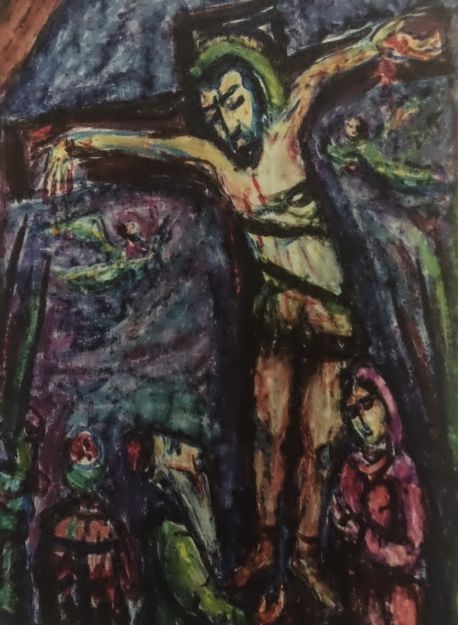
This second painting by Moshe Castle [see below on blog], also unknown to critics or the public is a depiction of the crucifixion of Jesus, the head surrounded by a halo, and a cloth wrapped around his loins, suggesting a prayer shawl – tallit. Also included is the figure of a Jewish man wearing a skull-cap and a Jewish woman standing beneath the cross on which Jesus hung. There is a third figure with his back to the viewers, also wearing a skull cap. Two angels hover beneath the hands of the crucified figure.
________________________________________________
In Paris, Castel had met Chagall and Soutine, and other Jewish artist of the Jewish School of Paris.
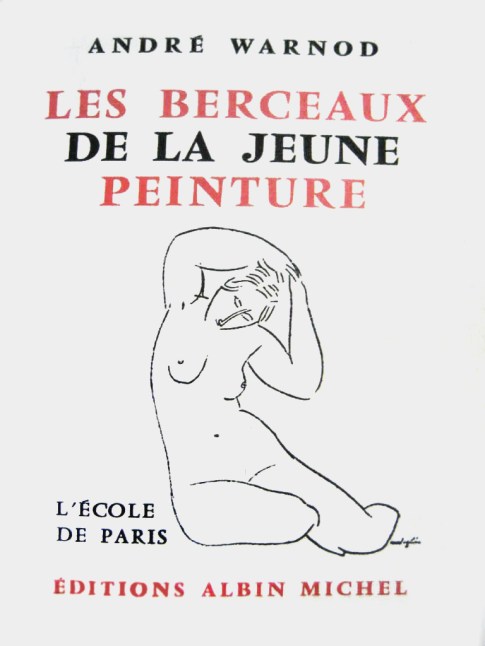
André Warnod, Les Berceaux de la jeune peinture (1925). Cover illustration by Amedeo Modigliani
The Paris “Jewish” School
The term “School of Paris” was used in 1925 by André Warnod [fr] to refer to the many foreign-born artists who had migrated to Paris.[3] The term soon gained currency, often as a derogatory label by critics who saw the foreign artists—many of whom were Jewish—as a threat to the purity of French art.[4] Art critic Louis Vauxcelles, noted for coining the terms “Fauvism” and “Cubism”, also meant disparagingly, called immigrant artists unwashed “Slavs disguised as representatives of French art”.[5] Waldemar George, himself a French Jew, in 1931 lamented that the School of Paris name “allows any artist to pretend he is French…it refers to French tradition but instead annihilates it.”[6]
School of Paris artists were progressively marginalised. Beginning in 1935 art publications no longer wrote about Chagall, just magazines for Jewish audiences, and by June 1940 when the Vichy government took power, School of Paris artists could no longer exhibit in Paris at all.[6]
The artists working in Paris between World War I and World War II experimented with various styles including Cubism, Orphism, Surrealism and Dada. Foreign and French artists working in Paris included Jean Arp, Joan Miró, Constantin Brâncuși, Raoul Dufy, Tsuguharu Foujita, artists from Belarus like Michel Kikoine, Pinchus Kremegne, and Jacques Lipchitz, the Polish artist Marek Szwarc and others such as Russian-born prince Alexis Arapoff.[7]
A significant subset, the Jewish artists, came to be known as the Jewish School of Paris or the School of Montparnasse.[8] The “core members were almost all Jews, and the resentment expressed toward them by French critics in the 1930s was unquestionably fuelled by anti-Semitism.”[9] One account points to the 1924 Salon des Indépendants, which decided to separate the works of French-born artists from those by immigrants; in response critic Roger Allard [fr] referred to them as the School of Paris.[9][10] Jewish members of the group included Emmanuel Mané-Katz, Chaim Soutine, Adolphe Féder, Chagall, Moïse Kisling, Maxa Nordau and Shimshon Holzman.[11]
The artists of the Jewish School of Paris were stylistically diverse. Some, like Louis Marcoussis, worked in a cubist style, but most tended toward expression of mood rather than an emphasis on formal structure.[8] Their paintings often feature thickly brushed or troweled impasto. The Musée d’Art et d’Histoire du Judaïsme has works from School of Paris artists including Pascin, Kikoine, Soutine, Orloff and Lipschitz.[12]
In the aftermath of the war, “nationalistic and anti-Semitic attitudes were discredited, and the term took on a more general use denoting both foreign and French artists in Paris”.[4] But although the “Jewish problem” trope continued to surface in public discourse, art critics ceased making ethnic distinctions in using the term. While in the early 20th century French art critics contrasted The School of Paris and the École de France, after World War II the question was School of Paris vs School of New York.[13]
Post-World War II (Après-guerre), the term “School of Paris” often referred to tachisme, and lyrical abstraction, a European parallel to American Abstract Expressionism. These artists are also related to CoBrA.[14] Important proponents were Jean Dubuffet, Pierre Soulages, Jean-Michel Coulon, Nicolas de Staël, Hans Hartung, Serge Poliakoff, Bram van Velde, Georges Mathieu, Jean Messagier and Zoran Mušič, among others. Many of their exhibitions took place at the Galerie de France in Paris, and then at the Salon de Mai where a group of them exhibited until the 1970s.
________________________________________________
Moshe Castel’s second painting of The Crucifixion, 1940 – 1945, is a watercolour on paper, mounted on canvas, 50 x 36 cms, The Moshe Castel Meseum of Art, Ma’ale Adumim.
This painting was influenced by Marc Chagall and by George Henri Rousalt (see detail of the head of Christ, above).
George Henri Rousalt
Chagall’s White Crucifixion is the most important painting of the crucified Jewish Christ of the Paris Jewish School.
The Expressionistic style of Rousalt, was influenced by religious icons and medieval artistic rendering of Biblical New Testament themes. The use of heavy bold colours, shapes and lines giving expression to the emotion and the drama of the death of Jesus.
While the depiction of the image of humans and the divine was forbidden in Judaism, Jewish artist looked elsewhere for references to be able to depict biblical and religious themes. What makes the Paris Jewish School’s work unique is that these Jewish artists were not under the constraint of the Jewish religious establishment who would have disapproved of their rendering of the image if Jesus in particular. One should note that Marc Chagall’s windows at the Jerusalem Hadassah Hospital of the Twelve Tribes of Israel, is largely abstract in its rendering of these biblical themes.
The Measure of the Person
Apart from Moshe Castel’s two Crucifixion paintings and a few sketches, he did not publicly paint any images of Jesus in his work. He was the son of a respected rabbi, and he was intimately familiar with his religious and cultural Jewish heritage. In his art he explored the Jewish Bible, mysticism, and other Jewish themes. The enigma of what inspired him to pain these two Crucifixions after he left Paris and returned to Eretz-Israel, remains unanswered. What I personally find fascinating that in the desire to express his deepest, private pain and loss, he turned to the theme off the crucifixion of Jesus.
Amatai Mendelsohn suggests that a reason for this, may be found in his bitter anger towards the Jewish G_D. How ironic that while he sought to give expression to his anger towards HaShem, who he must have felt had abandoned him, nonetheless, he turns to his Jewish Son, who was despised and rejected by Jew and gentile alike. This private anger towards God and fascination with Jesus, may suggest his ambivalence and fear about identifying himself publicly with an image that traditionally was considered as idolatrous. He did not stand alone for there were other Jewish people like Uri Zvi Greenberg, the poet, who was also drawn to his “brother’ on the cross, and this included Aharon Kabak, whose novel on the life of Jesus, also rose out of tragic personal loss.
Looking UNTO Jesus
Jewish people like so many others in their darkest hour of loss and despair have turned to Jesus – Yeshua and found him as their Messiah and Lord. Was this the case of Moshe Castel’s darkest secret that only emerged after his death? Locked away in a hidden cupboard, but there in the hidden chambers of his heart was the Saviour who was able to give him comfort and hope.
The prophet Zechariah says,
“And I will pour out on the house of David and the inhabitants of Jerusalem a spirit of grace and supplication. They will look on me, the one they have pierced, and they will mourn for him as one mourns for an only child, and grieve bitterly for him as one grieves for a firstborn son: (12:10).
Isaiah 52:13 – 53:12:
13
Behold, my servant shall deal prudently, he shall be exalted and extolled, and be very high.
14
As many were astounded at thee; his visage was so marred more than any man, and his form more than the sons of men:
15
So shall he sprinkle many nations; the kings shall shut their mouths at him: for that which had not been told them shall they see; and that which they had not heard shall they consider.Who hath believed our report? and to whom is the arm of the LORD revealed?
2
For he shall grow up before him as a tender plant, and as a root out of a dry ground: he hath no form nor comeliness; and when we shall see him, there is no beauty that we should desire him.
3
He is despised and rejected of men; a man of sorrows, and acquainted with grief: and we hid as it were our faces from him; he was despised, and we esteemed him not.
4
Surely he hath borne our griefs, and carried our sorrows: yet we did esteem him stricken, smitten of God, and afflicted.
5
But he was wounded for our transgressions, he was bruised for our iniquities: the chastisement of our peace was upon him; and with his stripes we are healed.
6
All we like sheep have gone astray; we have turned every one to his own way; and the LORD hath laid on him the iniquity of us all.
7
He was oppressed, and he was afflicted, yet he opened not his mouth: he is brought as a lamb to the slaughter, and as a sheep before her shearers is dumb, so he opens not his mouth.
8
He was taken from prison and from judgment: and who shall declare his generation? for he was cut off out of the land of the living: for the transgression of my people was he stricken.
9
And he made his grave with the wicked, and with the rich in his death; because he had done no violence, neither was any deceit in his mouth.
10
Yet it pleased the LORD to bruise him; he hath put him to grief: when thou shalt make his soul an offering for sin, he shall see his seed, he shall prolong his days, and the pleasure of the LORD shall prosper in his hand.
11
He shall see of the travail of his soul, and shall be satisfied: by his knowledge shall my righteous servant justify many; for he shall bear their iniquities.
12
Therefore will I divide him a portion with the great, and he shall divide the spoil with the strong; because he hath poured out his soul unto death: and he was numbered with the transgressors; and he bare the sin of many, and made intercession for the transgressors.
You too
You too can make the awesome discovery that the Suffering Sevant of G_D is both Lord and Messiah.This is a reality that countless Jews and gentiles testify to.
Amen.
Charitable Donation to Support Shalom Radio UK’s Running Costs This is to enable you the listener to express your thanks and help me expand the work of Shalom Radio UK by making a donation CLICK ON LINK TO DONATE:
The answer to this question is a complex one and there is no one simple answer to why the German nation that produced a Goethe, Heine, Bach, Handel, Mendelssohn, Beethoven, Mahler, Kant, Hegel, Dilthey, Heidiger, Marx, Einstein, could also produce a Wagner, Nietzsche and Hitler? Though Nietzsche was not a proto-Nazi, but Nazi thinkers did imbibe some of his philosophical ideas in their ideology, while Wagner was inherently anti-Semitic and desired to return to the pre-Christian, pagan roots of the German people.
It has been said if there had been no Hitler, there would have been no Holocaust. However, it is not as simple as that – Take just one example of the Jewish massacre of the 12the century:
Massacre of the Jews of Metz during the First Crusade, by Auguste Migette
El Malé Rahamim – God of Mercy prayer for the murdered communities, in prayer book from the city of Altona
The Rhineland massacres, also known as the persecutions of 1096 or Gzerot Tatnó[1] (Hebrew: גזרות תתנ”ו Hebrew for “Edicts of 4856”), were a series of mass murders of Jews perpetrated by mobs of German Christians of the People’s Crusade in the year 1096, or 4856 according to the Jewish calendar.
Prominent leaders of crusaders involved in the massacres included Peter the Hermit and especially Count Emicho.[2] As part of this persecution, the destruction of Jewish communities in Speyer, Worms and Mainz was noted as the “Hurban Shum” (Destruction of Shum).[3] These were new persecutions of the Jews in which peasant crusaders from France and Germany attacked Jewish communities. A number of historians refer to the antisemitic events as “pogroms“.[4]
According to David Nirenberg,[5] the events of 1096 in the Rhineland “occupy a significant place in modern Jewish historiography and are often presented as the first instance of an antisemitism that would henceforth never be forgotten and whose climax was the Holocaust.”[6]
Adolf Hitler was not a German, but he was an Austrian who only became a naturalised German citizen on February 25, 1932. This does not mean that the German nation is therefore not responsible for the Nazi Holocaust against the Jews. Once National Socialism became the ruling regime, the majority of the German nation willingly complied with his Nazi policy of the Final Solution to the Jewish Question.
Killing Fields
In 1933, before Hitler, there were approximately 500,000 Jews in Germany. Most were Germans first and Jews second. Hitler and the National Socialists of course changed that.
Germany was a nation of affluent Jews, much more so than in Poland and Russia naturally. That being said, there were still MANY Jews in Germany who were far from being wealthy. Only a minority of German Jews were bankers and stock brokers. Most were working men. Machinists, metal fabricators, mill operators and foundry men. Only the National Socialists deluded themselves that ALL Jews were rich and all were stock brokers, bankers and lawyers. When the National Socialists began to systematically deprive Jews of their civil rights, German Jews began to leave in earnest.
I have no idea of how many Jews were still in Germany in 1939. Over 300,000 had already fled the country and many of the others were arrested and confined in camps, later to be killed. Not all, and oddly there were some who stayed the war and were never placed in camps, but not so many.
Why Such a Hatred?
In Hitler’s Mein Kamph he describes the development of his loathing of the Jewish people and how it gradually developed. This pathological hate says more about Hitler’s own psychological state, than it does about the Jewish people as a group worthy of the kind of hate filled madness that afflicted the deeply disturbed Hitler. He was on the one hand consumed with an overwhelming sense of failure. He was an unemployed, social misfit who worked sporadically, in low paid jobs after he was demobbed after WWI. He had had a moderately successful military career, but only achieved the rank of sergeant. He was prone to fits of rage and even ranting and people found his at times uncouth and awaked. However, on the other hand he was consumed with a sense of destiny and delusions of grander. When he was not working he spent his time copiously reading every news paper and article about the socio-political condition in Germany, post the humiliating defeat of WWI.
With the great economic hardship and social unrest in Germany, with high unemployment due to the crippling financial situation, Hitler became involved in politics and join various right wing political groups that were striving a better deal and an end to the humiliation of the German people. He blamed capitalists, Bolsheviks and Jewish financiers for many of the ills that they were experiencing.
Few would have thought that the Nazi Party, starting as a gang of unemployed soldiers in 1919, would become the legal government of Germany by 1933. In fourteen years, a once obscure corporal, Adolf Hitler, would become the Chancellor of Germany.
World War I ended in 1918 with a grisly total of 37 million casualties, including 9 million dead combatants. German propaganda had not prepared the nation for defeat, resulting in a sense of injured German national pride. Those military and political leaders who were responsible claimed that Germany had been “stabbed in the back” by its leftwing politicians, Communists, and Jews. When a new government, the Weimar Republic, tried to establish a democratic course, extreme political parties from both the right and the left struggled violently for control. The new regime could neither handle the depressed economy nor the rampant lawlessness and disorder.
This site explores the consequences of Germany’s defeat in WWI.
The German population swallowed the bitter pill of defeat as the victorious Allies punished Germany severely. In the Treaty of Versailles , Germany was disarmed and forced to pay reparations to France and Britain for the huge costs of the war.
This site contains the complete Treaty of Versailles as well as maps and related material.
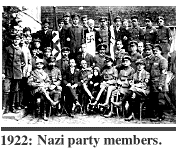
The German Workers’ Party , the forerunner of the Nazi Party, espoused a right-wing ideology, like many similar groups of demobilised soldiers. Adolf Hitler joined this small political party in 1919 and rose to leadership through his emotional and captivating speeches. He encouraged national pride, militarism, and a commitment to the Volk and a racially “pure” Germany. Hitler condemned the Jews, exploiting antisemitic feelings that had prevailed in Europe for centuries. He changed the name of the party to the National Socialist German Workers’ Party, called for short, the Nazi Party (or NSDAP). By the end of 1920, the Nazi Party had about 3,000 members. A year later Hitler became its official leader, or Führer.
Adolf Hitler’s attempt at an armed overthrow of local authorities in Munich, known as the Beer Hall Putsch , failed miserably. The Nazi Party seemed doomed to fail and its leaders, including Hitler, were subsequently jailed and charged with high treason. However, Hitler used the courtroom at his public trial as a propaganda platform, ranting for hours against the Weimar government. By the end of the 24-day trial Hitler had actually gained support for his courage to act. The right-wing presiding judges sympathised with Hitler and sentenced him to only five years in prison, with eligibility for early parole. Hitler was released from prison after one year. Other Nazi leaders were given light sentences also. This site details Hitler’s Beer Hall Putsch.
While in prison, Hitler wrote volume one of Mein Kampf (My Struggle), which was published in 1925. This work detailed Hitler’s radical ideas of German nationalism, antisemitism, and anti-Bolshevism. Linked with Social Darwinism, the human struggle that said that might makes right, Hitler’s book became the ideological base for the Nazi Party’s racist beliefs and murderous practices. This site discusses many of the ideas contained within Mein Kampf.
After Hitler was released from prison, he formally resurrected the Nazi Party. Hitler began rebuilding and reorganising the Party, waiting for an opportune time to gain political power in Germany. The Conservative military hero Paul von Hindenburg was elected president in 1925, and Germany stabilised.
Hitler skillfully maneuvered through Nazi Party politics and emerged as the sole leader. The Führerprinzip, or leader principle, established Hitler as the one and only to whom Party members swore loyalty unto death. Final decision making rested with him, and his strategy was to develop a highly centralized and structured party that could compete in Germany’s future elections. Hitler hoped to create a bureaucracy which he envisioned as “the germ of the future state.”
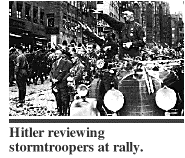
The Nazi Party began building a mass movement. From 27,000 members in 1925, the Party grew to 108,000 in 1929. The SA was the paramilitary unit of the Party, a propaganda arm that became known for its strong arm tactics of street brawling and terror. The SS was established as an elite group with special duties within the SA, but it remained inconsequential until Heinrich Himmler became its leader in 1929. By the late twenties, the Nazi Party started other auxiliary groups. The Hitler Youth , the Student League and the Pupils’ League were open to young Germans. The National Socialist Women’s League allowed women to get involved. Different professional groups–teachers, lawyers and doctors–had their own auxiliary units.
From 1925 to 1927, the Nazi Party failed to make inroads in the cities and in May 1928, it did poorly in the Reichstag elections, winning only 2.6% of the total vote. The Party shifted its strategy to rural and small town areas and fuelled antisemitism by calling for expropriation of Jewish agricultural property and by condemning large Jewish department stores. Party propaganda proved effective at winning over university students, veterans’ organisations, and professional groups, although the Party became increasingly identified with young men of the lower middle classes.
The Great Depression began in 1929 and wrought worldwide economic, social, and psychological consequences. The Weimar democracy proved unable to cope with national despair as unemployment doubled from three million to six million, or one in three, by 1932. The existing “Great Coalition” government, a combination of left-wing and conservative parties, collapsed while arguing about the rising cost of unemployment benefits.Reich president Paul von Hindenburg’s advisers persuaded him to invoke the constitution’s emergency presidential powers. These powers allowed the president to restore law and order in a crisis. Hindenburg created a new government, made up of a chancellor and cabinet ministers, to rule by emergency decrees instead of by laws passed by the Reichstag. So began the demise of the Weimar democracy.
Heinrich Brüning was the first chancellor under the new presidential system. He was unable to unify the government, and in September 1930, there were new elections. The Nazi Party won an important victory, capturing 18.3% of the vote to make it the second largest party in the Reichstag.
The Great Depression has a large impact on Germany
This is a description of the Nazi Party’s 1930 campaign for Reichstag seats.
Hindenburg’s term as president was ending in the spring of 1932. At age 84, he was reluctant to run again, but knew that if he didn’t, Hitler would win. Hindenburg won the election, but Hitler received 37% of the vote.Germany’s government remained on the brink of collapse. The SA brownshirts, about 400,000 strong, were a part of daily street violence. The economy was still in crisis. In the election of July 1932, the Nazi Party won 37% of the Reichstag seats, thanks to a massive propaganda campaign. For the next six months, the most powerful German leaders were embroiled in a series of desperate political manoeuvrings. Ultimately, these major players severely underestimated Hitler’s political abilities.
A more complete account of the complexity of German politics in 1932 is available.
Lesson plans, discussion questions, term paper topics, reproducible handouts, and other resources for teaching about the rise of the Nazi Party are available here.Mobs broke into synagogues, vandalising their interiors, smashing everything they could find. View of the old synagogue in Aachen after its destruction on Kristallnacht.”
1938
On November 9 to November 10, 1938, in an incident known as “Kristallnacht”, Nazis in Germany torched synagogues, vandalised Jewish homes, schools and businesses and killed close to 100 Jews. In the aftermath of Kristallnacht, also called the “Night of Broken Glass,” some 30,000 Jewish men were arrested and sent to Nazi concentration camps. German Jews had been subjected to repressive policies since 1933, when Nazi Party leader Adolf Hitler (1889-1945) became chancellor of Germany. However, prior to Kristallnacht, these Nazi policies had been primarily nonviolent. After Kristallnacht, conditions for German Jews grew increasingly worse. During World War II (1939-45), Hitler and the Nazis implemented their so-called “Final Solution” to the what they referred to as the “Jewish problem,” and carried out the systematic murder of some 6 million European Jews in what came to be known as the Holocaust.
Hitler and Anti-Semitism
1933 – 1938
Soon after Adolph Hitler became Germany’s chancellor in January 1933, he began instituting policies that isolated German Jews and subjected them to persecution. Among other things, Hitler’s Nazi Party, which espoused extreme German nationalism and anti-Semitism, commanded that all Jewish businesses be boycotted and all Jews be dismissed from civil-service posts. In May 1933, the writings of Jewish and other “un-German” authors were burned in a communal ceremony at Berlin’s Opera House. Within two years, German businesses were publicly announcing that they no longer serviced Jews. The Nuremberg Laws, passed in September 1935, decreed that only Aryans could be full German citizens. Furthermore, it became illegal for Aryans and Jews to marry or have extramarital intercourse.
At the annual party rally held in Nuremberg in 1935, the Nazis announced new laws which institutionalised many of the racial theories prevalent in Nazi ideology. The laws excluded German Jews from Reich citizenship and prohibited them from marrying or having sexual relations with persons of “German or related blood.” Ancillary ordinances to the laws disenfranchised Jews and deprived them of most political rights.
The Nuremberg Laws, as they became known, did not define a “Jew” as someone with particular religious beliefs. Instead, anyone who had three or four Jewish grandparents was defined as a Jew, regardless of whether that individual identified himself or herself as a Jew or belonged to the Jewish religious community. Many Germans who had not practiced Judaism for years found themselves caught in the grip of Nazi terror. Even people with Jewish grandparents who had converted to Christianity were defined as Jews.
For a brief period after Nuremberg, in the weeks before and during the 1936 Olympic Games held in Berlin, the Nazi regime actually moderated its anti-Jewish attacks and even removed some of the signs saying “Jews Unwelcome” from public places. Hitler did not want international criticism of his government to result in the transfer of the Games to another country. Such a loss would have been a serious blow to German prestige.
After the Olympic Games (in which the Nazis did not allow German Jewish athletes to participate), the Nazis again stepped up the persecution of German Jews. In 1937 and 1938, the government set out to impoverish Jews by requiring them to register their property and then by “Aryanizing” Jewish businesses. This meant that Jewish workers and managers were dismissed, and the ownership of most Jewish businesses was taken over by non-Jewish Germans who bought them at bargain prices fixed by Nazis. Jewish doctors were forbidden to treat non-Jews, and Jewish lawyers were not permitted to practice law.
Like everyone in Germany, Jews were required to carry identity cards, but the government added special identifying marks to theirs: a red “J” stamped on them and new middle names for all those Jews who did not possess recognisably “Jewish” first names—”Israel” for males, “Sara” for females. Such cards allowed the police to identify Jews easily.
Key Dates
September 15, 1935
Nuremberg Laws are instituted
At their annual party rally, the Nazis announce new laws that revoke Reich citizenship for Jews and prohibit Jews from marrying or having sexual relations with persons of “German or related blood.” “Racial infamy,” as this becomes known, is made a criminal offence. The Nuremberg Laws define a “Jew” as someone with three or four Jewish grandparents. Consequently, the Nazis classify as Jews thousands of people who had converted from Judaism to another religion, among them even Roman Catholic priests and nuns and Protestant ministers whose grandparents were Jewish.
October 18, 1935
New marriage requirements instituted
The “Law for the Protection of the Hereditary Health of the German People” requires all prospective marriage partners to obtain from the public health authorities a certificate of fitness to marry. Such certificates are refused to those suffering from “hereditary illnesses” and contagious diseases and those attempting to marry in violation of the Nuremberg Laws.
November 14, 1935
Nuremberg Law extended to other groups
The first supplemental decree of the Nuremberg Laws extends the prohibition on marriage or sexual relations between people who could produce “racially suspect” offspring. A week later, the minister of the interior interprets this to mean relations between “those of German or related blood” and Roma (Gypsies), blacks, or their offspring.
________________________________________
SEE ALSO
PROJECT – The Holocaust: A Learning Site for Students
During the early part of the Millennium, my wife Elisheva and I we participated in a wedding of a friend in Groenheider, south of Berlin. On the Sunday morning after the wedding, we returned to Berlin and were joined by two friends, Mark from UK who lives in Germany and Dirk a German national and party worker for the Social Democratic Party. They decided to take us on a tour of Berlin, and to visit some of the significant sites, We did three tours – The Wall tour and the Jewish tour and the Parliament buildings in the afternoon.
Following the reunification of Germany part of the dividing line that demarked Western Germany and the Democratic Republic of Germany (East Germany), included the Berlin Wall. This very contentious barrier witnessed many aspect of the conflict of the two Germanys. Brandenberg Gate, Wall Memorial and lookout tower, etc.
The Jewish tour is of particular interest as this bears testimony to some of the aspects of the rise of Nazism, and how it impacted upon the German Jewish community. While this is a vast subject, I will attempt to paint a few sketches of those thing that impressed Elisheva and I:
Reform Synagogue
Jewish Hospital
Belsen transport station
Hitler’ Bunker – Holocaust Memorial
Reform Synagogue
In the photograph above we witness the great Reform Synagogue on fire. It was all, but destroyed on“Kristallnacht” – Those who have sought to remember this tragic event, have only done a partial restoration, with one of the domes having been rebuilt together with the entrance vestibule which is now a museum. An interesting fact, related to the synagogue, is that a good friend of mine told me that it was his grandfather, who had been the Chief Reform Rabbi of Beliand was the incumbent at the time of the rise of Nazism and the destruction of his synagogue.
Jewish Hospital
A Jewish hospital was confiscated by the Nazi authorise and turned to other use. This was part of the systematic marginalisation of the Jewish population of Berlin and the closing down of all Jewish institutes of health and learning. A high standard of medical care was lost with this draconian action.
The Jewish Hospital and the Resumption of Community Life in Berlin
From Our Holdings
One year after the end of the Second World War, on 3 June 1946, the synagogue at the Jewish hospital on Iranische Strasse in the Berlin district of Wedding was rededicated. Torah scrolls were festively paraded around the synagogue and Rabbi Martin Riesenburger, Cantor Oscar Ruschin, and many dignitaries and Allied military representatives took part in the service. The photograph shows Erich Nelhans, then chair of the Jewish Community of Berlin, in the middle of the frame wearing glasses and a prayer shawl.
Rededication of the Synagogue at the Jewish Hospital; Jewish Museum Berlin, Gift of Klaus M. Zwilsky
Makeshift Community Arrangements
In the period just after the war, the reawakening of Jewish community life in Berlin was a tentative affair, the future of Judaism in Germany being extremely uncertain. But gradually, the Jewish Hospital became the centre of community work. Here, in the small hospital synagogue, a Soviet army rabbi had conducted one of the first prayer services in Berlin since the end of the war, on 11 May 1945.
Personal Memories
This photograph is one of a large collection donated to the Jewish Museum by Klaus Zwilsky. The photograph also depicts his father Erich Zwilsky, second from the right. Erich Zwilsky had been a pharmacist at the Jewish Hospital since 1941 and was head of administration for a brief period after the war. He emigrated with his wife Ruth and son Klaus to the United States via Sweden in 1946. Our donor also had a personal connection to the synagogue: his bar mitzvah had been held there in July 1945, the first in postwar Berlin.
Standing on a railway overpass bridge and looking down upon the platform and railway tracks, it could have been any insignificant railway line to numerable destinations, but not this track – Chris Rea’s album, Road to Hell, is a collection of songs for truckers caught in traffic jams on highways, ‘”tail to tail, tailbacks…” This was indeed a rail to hell and not Rea’s road, though frustrating in having to spend time in traffic jams, has nothing to do with the way to death and destruction that the Nazis inflicted upon its Jews and countless others whose journey, did not end with an eventual arrival at one’s destination of home and comfort, but most terrible suffering a death.
Adjoining the bridge, a short distance away, was a Memorial sculpture remembering the numerous trains that transported those who were assigned to the death camps.
Memorial to the Murdered Jews of Europe
From Wikipedia, the free encyclopaedia
Hitler’ Bunker – Holocaust Memorial
Visitors walking among the stelae
The Memorial to the Murdered Jews of Europe[1] (German: Denkmal für die ermordeten Juden Europas), also known as the Holocaust Memorial (German: Holocaust-Mahnmal), is a memorial in Berlin to the Jewish victims of the Holocaust, designed by architect Peter Eisenman and engineer Buro Happold. It consists of a 19,000-square-metre (200,000 sq ft) [2][3] site covered with 2,711 concrete slabs or “stelae“, arranged in a grid pattern on a sloping field. The stelae are 2.38 metres (7 ft 10 in) long, 0.95 metres (3 ft 1 in) wide and vary in height from 0.2 to 4.7 metres (7.9 in to 15 ft 5.0 in).[2] They are organized in rows, 54 of them going north–south, and 87 heading east–west at right angles but set slightly askew.[4][5] An attached underground “Place of Information” (German: Ort der Information) holds the names of approximately 3 million Jewish Holocaust victims, obtained from the IsraelimuseumYad Vashem.[6]
Building began on April 1, 2003, and was finished on December 15, 2004. It was inaugurated on May 10, 2005, sixty years after the end of World War II in Europe, and opened to the public two days later. It is located one block south of the Brandenburg Gate, in the Mitte neighborhood. The cost of construction was approximately €25 million.[7]
My Lasting Impression
The lasting impression that I have following our visit and the considerable research and study that I have done over the years since my visit to Berlin, is one of an overwhelming sense of sadness, that a great European nation was also able to provide the futile ground for such a monstrous ideology as Nazism was able to flourish with such devastating consequences.
Though the Austrian born Hitler was not a German, he was albe to find his way into German society and propagate his hatred against the Jews with such success. What transpired in Germany spread like a most deadly plague throughout Europe and he found willing collaborators wherever it spread. Even neutral Sweden and Finland found those willing to participate in the muderous schemes of the Nazis.
German Acknowledgement
At least Germany did acknowledge and gradually faced up to what had happened during the Holocaust. Recognition, healing, reparation and restitution has taken place and it continues to be an ongoing process as the last of those who were victims of the Nazi era come to the end of their lives – 80 and 90 year old perpetrators and victims will soon all be gone.
Never Forget
Forgive (if one can?), but never forget – When the last of them have died through old age it will be up to us and our children and grandchildren to not only remember, but also to learn the lessons of what caused this great evil of Nazism and to strive for a better world.
On Prejudice
“There is nothing inevitable about human prejudice. There is no biological gene that stimulates that groups should harbour distrust against ‘others.’ If there is pessimism, it is because of the conditions that have created the movement of populations are exactly those which politicians can exploit by using nationalist messages to appeal to popular insecurities.
On the other hand, these conditions also create other possibilities. Instead of fear of ‘otherness,’ there is the possibility of celebrating difference… Thus groups which bring together people from different religions can symbolise a more hopeful future. The precondition is not that groups come together to learn about ‘the other,’ as if the other were an interesting anthropological specimen. Instead there should be a willingness to accept that, in learning from others, oneself changes. What might have seemed alien becomes familiar – and that otherness, which has been learnt, becomes part of oneself. This is the very condition that terrifies the authoritarian personality – the acceptance of one’s otherness. However, this acceptance is all the more pressing if tolerance is to prevail over the psychological forces of bigotry; and if understanding, acceptance and hope are to conquer fear.” (Michael Billing, Prayer Book, Reform Judaism, p 550-551).
What Michael Billing says, is very important particularly in the light of the recent history of what transpired during WWII, and what is also taking place globally with the mass migration of different people groups. There is no place for xenophobia and race hate, whatever shape of form that it might take – this equally applies to the host countries, but equally those new immigrants that arrive. We need to ask what baggage do they bring with them? Moslems who hate Jews, due to the Israel-Palestine question, alas bring with them to their host countries anti-Semitic and anti-Zionist attitudes, which at times find fertile breading ground for those who wish to ferment Jew-hatred at home. An example is of the British Labour movement whose current leadership holds deep rooted anti-Zionist attitudes that has found expression in the new face of anti-Semitism with attacks upon Jewish Labour MPs in the UK. This is equally true in Germany, France, Belgium, Holland, Sweden, Austria, Poland, Hungry, United States of America, and Canada where far right groups spurred on by Moslem-racist attitude who target Jews in collaboration with other traditional far-right anti-Semitic organisations.
Love and Not Hate
Pursue those things that make for peace, rejecting all forms of prejudice and race-hate. Have nothing to do with anti-Semitic attitudes and join in the Campaign Against Anti-Semitism:
Become informed – find out what is happening both globally and locally concerning anti-Semitic activities and seek how you may speak up and out against those who propagated all forms of race-hate and anti-Semitic attitudes.
_________________________________________
Charitable Donation to Support Shalom Radio UK’s Running Costs
This is to enable you the listener to express your thanks and help me expand the work of Shalom Radio UK by making a donation CLICK ON LINK TO DONATE:
I recall that during the late 1990’s my wife Elisheva, children and I were traveling by train across Germany on the way to Hamburg on route to Denmark. We were waiting for a connecting train at Osnabruck. It was a sleepy countryside station – we were sitting in the station café on the platform. We awaited our ‘transport’ to arrive. Our son was three years old, and our two daughters were in their teens. A German lady also sitting there showed an interest in our family group and we got chatting.
In my imagination a very different scenario was being played out – we were not waiting for our connection to Hamburg, but rather “transport” to one of the death camps in the east: Bregen-Belsen or Ravensbruck. You may think, “what a shocking and even vile thought?” But nonetheless it is was a horrible possibility if it were some 50 years earlier, from we had enough Jewish ancestry in our heritage to have included my family and I in Hitler’s Final Solution. Anyone up to one quarter Jewish was designated libel to extermination. None of the pleasant conversation with our fellow German traveller, but only Nazi SS guards, herding those waiting like cattle being sent to the abattoir for slaughter.
Martin Niemöller
First, they came for the socialists, and I did not speak out
— Because I was not a socialist.
Then they came for the trade unionists, and I did not speak out
— Because I was not a trade unionist.
Then they came for the Jews, and I did not speak out
— Because I was not a Jew.
Then they came for me
and there was no one left to speak for me.
Niemöller’s earliest speeches, written in 1946, lists the Communists, incurable patients, Jews and Jehovah’s Witnesses, and civilians in countries occupied by Nazi Germany. In all versions, the impact is carefully built up, by going from the “smallest, most distant” group to the largest, Jewish, group, and then finally to himself as a by then outspoken critic of Nazism. Niemöller made the cardinal “who cares about them” clear in his speech for the Confessing Church in Frankfurt on 6 January 1946, of which this is a partial translation.
Jewish suffering and persecution go back millennia, but reached its horrific climax in the Holocaust, when over six million Jewish people perished under Nazi Germany’s Final Solutionto the Jewish question/ problem. Hitler and his cohorts and numerous collaborators did not either perceive of or design the Holocaust upon a sudden whim, but it was the culmination of systematic hatred of the Jewish people in Europe. Though no one else can be blamed for Hitler’s heinous crimes, other than those who participate in it, yet centuries of bad Christian theology about the Jewish people did contribute to the final outcome. Accusations of Decide – “Christ killers,” was only finally revoked at Vatican II in the 1960’s. Negative attitudes, alas result in negative and destructive outcomes. Martin Luther’s tract On the Jews and Their Lies* is a pernicious piece of filth penned by an aged Luther. He may have been the great reformer of the Church, but this blight upon his record, remains a reality. Luther was by no means alone in his anti-Judaism and the denigration of the Jewish people and the Jewish religion.
My objective is not to induce a deep sense of guilt, but to give a stark warning to all of us that the progression from anti-Judaism, quickly develops into anti-Semitism and this is all too often followed by anti-Zionism. This is sometimes referred to as the new face of anti-Semitism. With the desire for justice for the Palestinians, it must equally be coupled with an equal desire for justice for the Jews, not only in Israel, but throughout the world.Martin Luther King gives expression to this desire in his speech “I HAVE A DREAM,” AUGUST 28 1963:
However, together with Dr Martin Luther King Jr., I too have a dream: “When we allow freedom to ring, when we let it ring from every village and every hamlet, from every state and every city, we will be able to speed up that day when all of God’s children, black men and white men, Jews and Gentiles, Protestants and Catholics,will be able to join hands and sing in the words of the old Negro spiritual:
“Free at last! Free at last! thank God Almighty, we are free at last!” (Martin Luther King, Jr.). In its original context Dr King was expressing his dream to witness the end of racial segregation in the United States of America and particularly for its black citizens – nonetheless, he equally acknowledges that freedom from racial oppression for one, is freedom for all. In this he included Jewish people.
Why do strangers kill strangers?
You may ask: “Why do strangers kill strangers?” Equally, “Why do neighbours kill neighbours? Think of the Greeks and Turks; Rwanda; Kosovo and Bosnia-Herzegovina, when Serbian, Croatian and Moslem turned on each other. Where communities and families that had lived together for centuries suddenly go insane, murdering each other? While we commemorate the victims of genocides, we need to ask, but do we do so with understanding? These questions are asked by Timothy Snyder in his book Black Earth.
In Simon Reeves documentary series on the Tropic of Capricorn he interviewed a Herero historian on a visit to Namibia. She said, that the Germans have practiced [genocide] on the Herero people before they did that to the Jewish people. Between 65000 and 80000 Hereros were destroyed by the Germans around 1908. Then there was the Armenian genocide by the Turks from 1910 -1918 when a million and a half died.Though the most heinous Jewish and Gypsy genocide under the Nazis, from 1939 – 1945 has become part of the history of the mid-twentieth century, yet still other acts of genocides have followed. The Soviet and Chinese mass murder of its own citizens under Stalin and Mao, plus, Biafra, Cambodia, Zimbabwe, Rwanda, Kosovo, Bosnia and Herzegovina,Syria, Darfur, Democratic Republic of the Congo, North Korea, and Rohingya Moslems, and so the list goes on.
Should we be confident that a holocaust is behind us? Just because some of these killings are not officially recorded as ‘genocide,’ that does not diminish the reality of state sponsored mass killing that took place. Take for example the nearly 1000 infant mortality caused by the Apartheid forced removal of the black population of Grahamstown, Easter Cape, South Africa to Dimbaza a wasteland that is 40 miles away from Grahamstown – though this was not a deliberate act of genocide, nonetheless, this does not diminish the seriousness of the Apartheid government policy that resulted in the death of these children, partly due to no access to medical care.
There is no place for complacency
There is no room for complacency, because this world in which we live is a dangerous place. It is changing and reviving fears that were familiar in Hitler’s time and to which Hitler responded in the way that he did. He exploited the defeat and humiliation of the German nation after WWI. The Treaty of Versailles, brought German to its knees with not only its military defeat, but crippling economic retribution that was exacted upon it by the Allies. The history of the Holocaust is not over, for its precedent/ significance is eternal, and alas, its lessons have not yet been learned.
A history of the Holocaust must be contemporary, says Timothy Snyder, due to the fact that humankind is prone to forget. Equally, memory can be very selective, as we choose to recall and remember only those things that fit in with our world-view. The Holocaust is not only about history, it is equally a warning, says Snyder. It is not enough to say, “Never again!” – particularly when we live in such a dangerous age. There are ominous storm clouds building in the East and West. Xi’s China, Putin’s Russian and Trump’s America. Not forgetting the Middle-East theatre of engagement were proxy wars are being played out: Russia, America, NATO, UN, Turkey, Saudi Arabia, Iran, Syria, and Israel. PYPM – the Push Me Pull Yougame is being enacted by the major global players.
Our Guilty Silence
Dare we sit silently and not speak out against all forms of racial hatred and xenophobia? Wherever it raises its ugly head, we need to expose it and speak up and speak out against it. I grew up in Apartheid South Africa and as a privileged white person, I know that I could have done more than I did. Equally today, while we think of the death of the 6 million Jewish people, let us not forget the other genocides that have taken place in the last 100 years –a million and a half Gypsies, the physically and mentally disabled, homosexuals, and a multitude of Poles and Slavs also perished during WWII. Then there is the Armenian genocide at the hands of the Turks that has never been acknowledged. Even while we sit here in peace and security, there are other acts of cruelty being carried out in various parts of the world. A new partnership is being forged: The Campaign Against Anti-Semitism is a growing alliance of people all over the world speaking up, and standing against anti-Semitic hatred and acts of violence. I encourage everyone who loves God, to equally love his people the Jews and stand with them in this hour of opportunity and equally face the challenges that lay ahead. https://antisemitism.uk/introduction/
The Race Is Not to the Swift nor the Battle to the Strong
Let us draw some comfort from the Scripture that indicates to us “that the race is not to the swift, nor the battle to the strong.” (Eccl. 9:11.) Time and again the Scriptures indicate that those who endures to the end, they shall be delivered. The race of life is not a sprint, it is not the 100-meter dash, nor is it really a middle-distance run. It’s a marathon run. It’s a long-distance run. In the race of life, at times it is hard. It begins early. I was confronted by my first experience of anti-Semitism at the age of 9 when a fellow pupil in my class in Johannesburg, South Africa abused me for being a Jew. Even 61 years later people I can recall that difficult experience at primary school. We remember what it felt like, perhaps, that the race was hard because you were too short or too skinny or you had to wear glasses or braces, or because you are from a different ethnic background or religion?
All of those things can either have negative or positive outcomes. Don’t let them define you or torment your soul. As you went and go through difficult times remember that the God of Israel is there and he neither slumbers or sleeps – He is the Shepherd of Israel. In these tests of life, none of us are promised that it will be an easy race. However, from the Book of Hebrews, the writer says, as you run the race of life: “And let us run with patience the race that is set before us” …So if the race sometimes seems difficult, this is what helps to build character. It puts steel into your soul. Don’t let it crush you, but “we shall overcome, some day.” Wherever you are currently, this is God’s appointed time for each one of us to run the race of life this day. The race is not too difficult; nor are the obstacles too hard to surmount. Remember, the God of Jacob is with us and Jacobs beloved son Joseph the patriarch did come forth from prison to sit up the thorn on high. From a Christian perspective, so too, Jesus of Nazareth, did arise as the redeemer and Lord of all. Some may say, if Jesus is redeemer, then where is the universal peace that is meant to be part of the messianic reign? Isaiah the prophet of Israel does testify of the Servant of the Lord, who will suffer for humanity and be their sin bearer.
Dr Sam Wells from St Martins-in-the Field, London, UK gave an excellent talk in 2016 at a conference in Co Durham which he based upon the book and Film entitled the Boy in the Striped Pyjamas and he renamed it, God in Stiped Pajamas – This is due to the fact that God is always with us when we suffer as he identifies with human suffering in and through the Suffering Servant of the LORD.
Dr Wells gave Roni permission to use his talk as he saw fit. This is beautifully read by Elisheva Mechanic on this occasion of Holocaust Remembrance on 27th January, 2019.
Charitable Donation to Support Shalom Radio UK’s Running Costs
This is to enable you the listener to express your thanks and help me expand the work of Shalom Radio UK by making a donation CLICK ON LINK TO DONATE:https://paypal.me/hotrodronisblogcom
Shalom Radio UK, Sponsored by MTMI – Messianic Teaching Ministry International
This Programme contains some very distressing descriptions of the systematic murder of Jewish People in the death camps!
Click on Link Below to Listen:
DUE TO THE LENGTH OF PART 2 A – PART 2 B IS A SEPARATE PODCAST THAT FOLLOWS THIS MONTH
In 2008 a friend Dave Traher and I visited Cracow:
We went there and came back, unlike so many people of Jewish descent
Day One: Visit to the Jewish Old Town in Cracow
Lunch at the Ariel Restaurant
A Jewish style restaurant like so many of the other aspects of Jewish life in Cracow was like a shadow and ghost of the past. Though the food was authentic Polish Jewish cooking, with many of the traditional dishes just like my mother cooked, none of the staff or owner is Jewish.
*
Day Two: Visit to the Death Camps
Auschwitz-Birkenau Memorial and Museum Tours
The Auschwitz-Birkenau Memorial and Museum is the resting place for some 1.5 million people, as the site once served as a concentration camp and extermination site of the European Jewish community during World War II. Today, Auschwitz-Birkenau is an important historical area, allowing visitors to reflect on the monumental horrors that occurred during the genocide.
The Basics
Auschwitz-Birkenau tours take visitors through some of the 13 surviving prison blocks that now feature museum exhibitions, many dedicated to victims and displaying documentary photographs and historical artifacts. In addition the main camp, a much larger camp called Birkenau (or Auschwitz II) sits about 1.25 miles (2 kilometers) to the west. This site has been left almost exactly as it was when the Nazis abandoned it at the end of the war, complete with gas chamber ruins, and is also considered a part of the UNESCO-listed Auschwitz-Birkenau Memorial and Museum. An official visitor’s center can be found at the entrance to Auschwitz I.
The two sites are often visited together on group or private tours from Krakow Old Town, available in a number of languages and generally including transport between the memorial areas, plus hotel pickup and drop-off or airport transfers. It’s recommended that travelers allot about 90 minutes for each of the sites. A visit is also sometimes combined with a trip to the nearby Wieliczka Salt Mine.
How to Get There
Auschwitz-Birkenau is in Oswiecim, about 40 miles (65 kilometers) west of Krakow, from where most tours depart. A few tours are offered from Warsaw 196 miles (315 kilometers) away, although transport takes four hours. Both memorial sites have paid parking lots, and shuttles run between the two. Zakopane is located 80 miles (130 kilometers) south.
SPONSORED BY MTMI – MESSIANIC TEACHING MINISTRY INTERNATIONAL
Charitable Donation to Support Shalom Radio UK’s Running Costs
This is to enable you the listener to express your thanks and help me expand the work of Shalom Radio UK by making a donation CLICK ON LINK TO DONATE:https://paypal.me/hotrodronisblogcom
Poland, Czech Republic, Germany and Croatia are four European countries that I have visited in the past ten years and each has a story to tell of the tragic destruction of their Jewish communities. They were betrayed and destroyed by both the Nazis and their collaborators.In my own personal background I have one Polish Jewish gradmother who was my mother’s mother. Mini Levitson moved to England as a young girl together with her family that included her grandmother. So as far as I know none of my direct close relatives from her family perished in the Holocaust. That of course does not mean that members of my extended Polish family did not die under the Nazis and their Polish collaborators.
Annie’s Grandmother
My Mom – Annie Mechanic nee Abrahms
Please Note that the recorded programme differs substantially from the written record on this blog
*
Charitable Donation to Support Shalom Radio UK’s Running Costs
This is to enable you the listener to express your thanks and help me expand the work of Shalom Radio UK by making a donation
CLICK ON LINK TO DONATE:
https://paypal.me/hotrodronisblogcom
£10.00
Prior to WWII, one in ten Poles were Jewish, which made 10% of the polish population Jewish. The Pale of Settlement included Poland:
The Pale of Settlement (Russian: Черта́ осёдлости, chertá osyódlosti, Yiddish: דער תּחום-המושבֿ, der tkhum-ha-moyshəv, Hebrew: תְּחוּם הַמּוֹשָב, tẖum hammosháv) was a western region of Imperial Russia with varying borders that existed from 1791 to 1917, in which permanent residency by Jews was allowed and beyond which Jewish residency, permanent or temporary,[1] was mostly forbidden. Most Jews were still excluded from residency in a number of cities within the Pale as well. A limited number of Jews were allowed to live outside the area, including those with university education, the ennobled, members of the most affluent of the merchant guilds and particular artisans, some military personnel and some services associated with them, including their families, and sometimes the servants of these.
The Russian Empire in the period of the existence of the Pale was predominantly Orthodox Christian. The area included in the Pale, with its large Jewish, Uniate and Catholic populations, was acquired through a series of military conquests and diplomatic manoeuvres, between 1654 and 1815.
The end of the enforcement and formal demarcation of the Pale coincided with the beginning of the First World War, and ultimately with the February and October Revolutions of 1917, i.e., the fall of the Russian Empire.
Though Jewish life in Poland was at times turbulent and difficult for its Jewish population prior to WWII, there was never an attempt to systematically annihilate its Jewish population as the was promulgated by the Nazis. What is tragic is the many Polish citizens collaborated with the Nazis, as was the case with Ustasha in Croatia. However, far fewer devout Catholics were willing to participate in the Nazi genocide and a much higher percentage actively protected and hid Jewish people during those dark days. This included, priests, nuns and Catholic lay folk.
Public execution of Polish priests and civilians in Bydgoszcz’s Old Market Square on 9 September 1939.
The Catholic Church in Poland was brutally suppressed by the Nazis during the German Occupation of Poland (1939-1945). Repression of the Church was at its most severe in Polish areas annexed by Nazi Germany, where churches were systematically closed and most priests were either killed, imprisoned, or deported. From across Poland, thousands of priests died in prisons and concentration camps; thousands of churches and monasteries were confiscated, closed or destroyed; and priceless works of religious art and sacred objects were lost forever. Church leaders were targeted as part of an overall effort to destroy Polish culture. At least 1811 Polish clergy died in Nazi concentration camps. An estimated 3000 clergy were killed in all. Hitler’s plans for the Germanization of the East saw no place for the Christian Churches.[1]
The massive crimes inflicted against Polish Catholicism took place in the wider context of the Nazi crimes against Poles under Generalplan Ost, as the German regime implanted a general policy of eventually eliminating Poland’s existence. Adolf Hitler himself remarked in August 1939 that he wanted his Death’s Head forces “to kill without pity or mercy all men, women, and children of Polish descent or language.”[2]
Catholicism had a presence in Poland stretching back almost 1,000 years.[3] The historian Richard J. Evans wrote that the Catholic Church was the institution that, “more than any other had sustained Polish national identity over the centuries”.[4] By 1939, around 65% of Poles professed to be Catholic.[3] The invasion of predominantly Catholic Poland by Nazi Germany in 1939 ignited the Second World War. Britain and France declared war on Germany as a result of the invasion, while the Soviet Union invaded the Eastern half of Poland in accordance with an agreement reached with Hitler. The Catholic Church in Poland was about to face decades of repression, both at Nazi and Communist hands.[5]
The Pact created a Nazi-Soviet alliance and sealed the fate of Poland.
Nazi Germany invaded Poland from the West on 1 September 1939 and a period of brutal occupation commenced. Racist Nazi ideology targeted the Jews of Poland for extermination and categorized ethnic Poles (mostly Catholics) as an inferior race. Jews were rounded up into Ghettos or sent to extermination camps. The ethnic Polish intelligentsia were also targeted for elimination, with priests and politicians alike murdered in a campaign of terror. Forced labour was also extensively used. The Red Army invaded Poland from the East on 17 September 1939.[6]The Soviets were also responsible for repression of Polish Catholics and clergy, with an emphasis on “class enemies”. Operation Barbarossa, the German attack on the Soviet Union was launched in June 1941, shattering the Nazi-Soviet non-aggression pact, and bringing Eastern Poland under Nazi domination.[7]Norman Davies wrote:[8]
Jews and Poles faced a common enemy through the Nazi onslaught
The Nazi plan for Poland entailed the destruction of the Polish nation. This necessarily required attacking the Polish Church, particularly in those areas annexed to Germany.[9] According to Hitler biographer Ian Kershaw, in his scheme for the Germanization of Eastern Europe, Hitler made clear that there would be “no place in this utopia for the Christian Churches”.[1] Historically, the Catholic Church had been a leading force in Polish nationalism against foreign domination, thus the Nazis targeted clergy, monks and nuns in their terror campaigns to eliminate Polish culture. Nazi ideology was hostile to Christianity and Hitler held the teachings of the Catholic Church in contempt. Hitler’s chosen deputy and private secretary, Martin Bormann, was firmly anti-Christian as was the official Nazi philosopher, Alfred Rosenberg. In his “Myth of the Twentieth Century“, published in 1930 Rosenberg wrote that the main enemies of the Germans were the “Russian Tartars” and “Semites”—with “Semites” including Christians, especially the Catholic Church:
________
In Search of a Lost People – Part 2 B
Due to the length of Part 2 A – Part 2 B is a separate Podcast that will follow next month
In 2008 a friend Dave Traher and I visited Cracow:
*
Day One: Visit to the Jewish Old Town in Cracow
Lunch at the Ariel Restaurant
A Jewish style restaurant like so many of the other aspects of Jewish life in Cracow was like a shadow and ghost of the past. Though the food was authentic Polish Jewish cooking, with many of the traditional dishes just like my mother cooked, none of the staff or owner is Jewish.
*
Day Two: Visit to the Death Camps
Auschwitz-Birkenau Memorial and Museum Tours
The Auschwitz-Birkenau Memorial and Museum is the resting place for some 1.5 million people, as the site once served as a concentration camp and extermination site of the European Jewish community during World War II. Today, Auschwitz-Birkenau is an important historical area, allowing visitors to reflect on the monumental horrors that occurred during the genocide.
The Basics
Auschwitz-Birkenau tours take visitors through some of the 13 surviving prison blocks that now feature museum exhibitions, many dedicated to victims and displaying documentary photographs and historical artifacts. In addition the main camp, a much larger camp called Birkenau (or Auschwitz II) sits about 1.25 miles (2 kilometers) to the west. This site has been left almost exactly as it was when the Nazis abandoned it at the end of the war, complete with gas chamber ruins, and is also considered a part of the UNESCO-listed Auschwitz-Birkenau Memorial and Museum. An official visitor’s center can be found at the entrance to Auschwitz I.
The two sites are often visited together on group or private tours from Krakow Old Town, available in a number of languages and generally including transport between the memorial areas, plus hotel pickup and drop-off or airport transfers. It’s recommended that travelers allot about 90 minutes for each of the sites. A visit is also sometimes combined with a trip to the nearby Wieliczka Salt Mine.
How to Get There
Auschwitz-Birkenau is in Oswiecim, about 40 miles (65 kilometers) west of Krakow, from where most tours depart. A few tours are offered from Warsaw 196 miles (315 kilometers) away, although transport takes four hours. Both memorial sites have paid parking lots, and shuttles run between the two. Zakopane is located 80 miles (130 kilometers) south.
SPONSORED BY MTMI – MESSIANIC TEACHING MINISTRY INTERNATIONAL
Charitable Donation to Support Shalom Radio UK’s Running Costs
This is to enable you the listener to express your thanks and help me expand the work of Shalom Radio UK by making a donation
CLICK ON LINK TO DONATE:
https://paypal.me/hotrodronisblogcom
At lunch time we went to the Ariel Jewish restaurant and I ordered a traditional Polish Jewish meal as did Dave. I asked the waiter if he was Jewish and he replied that he was not. I then enquired as to whether the owner was Jewish and he again said that he was not a Jew and nor was the chef – Yes a Jewish style restaurant, but no Jews were involved. This was symptomatic of the reality of Polands lost Jews. Shadows and memories of Polands tragic history.
On the Tuesday morning bright and early our tour coordinator picked us up at the hotel where Dave and I where we were staying. Together with four other British visitors we traveled the 40 miles to Auschwitz and joined a lager group of English speaking visitors.
Our tour guide for the morning at the main camp gave us each headsets so that we could listen to her commentary as we progressed through the concentration camp.
At the entrance be first encountered the sign over the entrance that declares Abrbeit Macht Frei – Work/ Labour Makes Free – the only freedom that most of those who entered would be the freedom from the sufferings of this mortal life that results from death.
A first impression that the undiscerning visitor may get is that this place is a boarding school or college campus and not a place of torture and death on a level of the deepest level of human depravity.