Source: *Behold the Man: Man of Sorrows and Zionist Messiah (Part A)
*Behold the Man: Man of Sorrows and Zionist Messiah (Part A)
Reply


Behold the Man: Man of Sorrows and Zionist Messiah
1 “Man of Sorrows,” what a name
For the Son of God who came
Ruined sinners to reclaim! Hallelujah! what a Saviour!
2 Bearing shame and scoffing rude, In my place condemned He stood; Sealed my pardon with His blood; Hallelujah! what a Saviour!
3 Guilty, vile, and helpless, we,
Spotless Lamb of God was He;
Full redemption—can it be? Hallelujah! what a Saviour!
4 Lifted up was He to die,
“It is finished!” was His cry;
Now in heaven exalted high;
Hallelujah! what a Saviour!
5 When He comes, our glorious King,
To His kingdom us to bring,
Then anew this song we’ll sing, Hallelujah! what a Saviour!
Part 3: Man of Sorrows and Zionist Messiah |
In the continued development of our theme of Behold the Man, this programme focuses upon how Jewish and Israeli artists give expression to the Man of Sorrows and how this motif expresses the personality of the Zionist Messiah.
In the hymn “Man of Sorrows, what a man…” we are given the classic Christian interpretation of the rejection and crucifixion of Jesus, however, the Jewish and Israeli approach while using this image of Jesus as that man of sorrows, he becomes a symbol of Jewish suffering both individually and corporately. This will become apparent as we consider this portrayal by Jewish and Israeli artists.

Reuven Rubin (ראובן רובין, 1893 – 1974) was a Romanian-born Israeli painter and Israel’s first ambassador to Romania.
Rubin Zelicovici (later Reuven Rubin) came from a poor Romanian Jewish Chasidic family. In 1912, he left for Ottoman-ruled Palestine to study art at Bezalel Academy of Art and Design in Jerusalem. Finding himself at odds with the artistic views of the Academy’s teachers, he left for Paris, France in 1913 to pursue his studies at the École Nationale Supérieure des Beaux-Arts. At the outbreak of World War I, he was returned to Romania, where he spent the war years.
In 1923, Rubin emigrated to Mandate Palestine.
The history of Israeli art began at a very specific moment in the history of international art, at a time of Cezannian rebellion against the conventions of the past, a time typified by rapid stylistic changes. Thus Jewish national art had no fixed history, no canon to obey. Rubin began his career at a fortunate time.


He rejected the neo-classical style of the late 19th and early 20th century fully embracing the impressionistic style of painting and is sometimes referred to as the father of modern art.
In Palestine, Rubin became one of the founders of the new Eretz-Yisrael style. Recurring themes in his work were the biblical landscape, folklore and people, including Yemonite and Chasidic Jews as well as Arabs. Many of his paintings are sun-bathed depictions of Jerusalem and the Galilee.
Other Jewish painters together with Rubin depicted the country’s landscapes in the 1920s rebelled against Bezalel school’s style. They sought current styles in Europe that would help portray their own country’s landscape, in keeping with the spirit of the time. Rubin’s Cezannesque landscapes from the 1920s were defined as both modern and a naive, portraying the landscape and inhabitants of Israel in a sensitive fashion. His landscape paintings in particular paid special detail to a spiritual, translucent light.


Rubin might have been influenced by the work of Henri Rousseau whose style combined with Eastern nuances, as well as with the neo-Byzantine art to which Rubin had been exposed in his native Romania. In accordance with his integrative style, he signed his works with his first name in Hebrew and his surname in Roman letters. [https://en.wikipedia.org/wiki/Reuven_Rubin].



In his early years he was still searching for an artistic voice and the influence of Eugene Delacroix, Paul de Chavannes a symbolist and together with Jewish artists such as Hirzenberg, Lilien and Schatz is apparent in his early work as a painter as well as the Romanian artist Lucian Grigoreseu (p 96, Beold the Man).
For the purpose of this programme we will focus upon the portrayal of Jesus and other related scenes of suffering involving Israelites and Jews.

Rubin’s painting – By the River of Babylon

By the River of Babylon is a complex allegorical portrayal of Jewish suffering in exile, as was the case of the depiction by Eduard Bendemann, E M Lilien in his illustration for the Lutheran Bible. Rubin would have been aware of these two works, but his painting makes a departure from most works on this subject.

An analysis of the picture by Rubin shows the group of human figures against the background of a massive rock and surrounded by water. This group of five people are gathered, with the centrepiece of a seated woman feeding an infant. Her breasts are bared and she gazes down at the infant with a sad expression. Of the five figures only one is fully clad and including the infant the four are completely naked. The standing image of a naked bearded man is clutched by an elderly man who is wearing a cloak. What may be the reason for this depiction of figures in the way that Rubin painted them?
An explanation of the figures is that each represents a stage in the cycle of life and has a symbolic meaning. Alongside the obvious biblical Jewish theme of those who look downcast due to their exile by the River of Babylon, the painting relates to Christian iconography. The core of the scene is the nursing mother with infant child from a traditional representation of Madonna and child. An example of this classic portrayal by Gerard David’s painting The Rest on the Flight into Egypt. The naked by with sling shot alludes to David, forefather of the messianic dynasty in Christianity as well as Judaism. “This is the most active figure in the picture: in the struggle for self-preservation, he takes destiny into his own hands” (p 97). Also the baby is a symbol of hope for the future and the rider on the camel points East to some place across the water, that is beyond the frame of the painting. The focusing upon the mother and infant is reminiscent of Gerard David’s The Rest on the Flight into Egypt. This may allude to the Jewish people’s enduring exile that began in Babylon millennia ago and the hoped return to their ancient homeland. We should note that the mother and child motif reoccurs in Rubin’s work in a number of paintings (p 97).
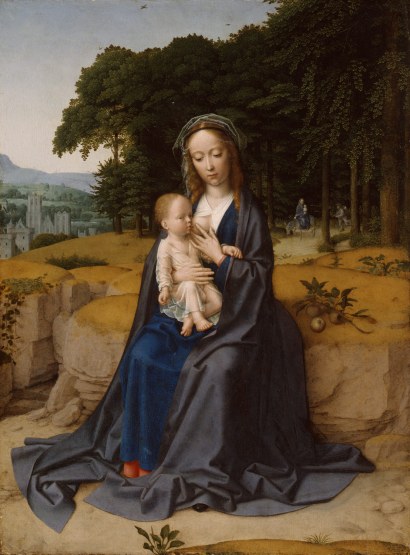
From 1919 Rubin’s paintings found its voice with a new expression that acquired a destructive religious overtone. He depicted prophets and ascetics as well as na intriguing preoccupation with the figure of Jesus (p 97).
He drew inspiration from such artists as El Greco, Schiele, Picasso (in his Blue Period), and particularly Ferdinand Holder who Rubin met in 1915.


Rubin’s Temptation in the Desert

Holder’s style influenced Rubin’s style


Rubin’s painting Temptation in the Desert which he did in 1921 is a key work. It is a complex painting of personal identification with the figure of Jesus (p 98). An analysis of the picture reveals five figures in various poses on the parched desert sand dunes at dawn. In the centre is an emaciated kneeling man with his upper torso naked clutching himself. A faint white halo can be seen surrounding the head of the figure. He is in profound concentration with eyes closed.
“The New Testament story of the temptation in the desert (or wilderness) relates that Jesus spent forty days in the desert, steadfastly affirming his faith when he was challenged in various ways by Satan (Matthew 4:1-11; Luke 4:1-13) – (p 99).
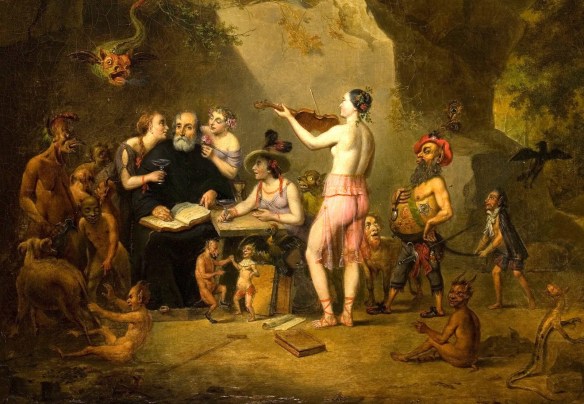
St. Anthony (ca. 251-356), viewed as the one who established Christian monasticism, was subjected to a long series of tortures by Satan. These included temptations of the flesh during his time as a hermit living in the desert. The story of St. Anthony inspired many European Masters to do portrayals of his temptations.
Rubin’s encounters with these paintings of the late nineteenth century during his studies in Paris, France, “…[W]hen the destructive femme fatale* became a prevalent literary and artistic motif, female temptresses and erotic imagery featured strongly in depictions of St. Anthony” (p 99).

*A femme fatale (French: [fam fatal]) is a stock character of a mysterious and seductive woman whose charms ensnare her lovers, often leading them into compromising, dangerous, and deadly situations. She is an archetype of literature and art. Her ability to entrance and hypnotise her victim with a spell was in the earliest stories seen as being literally supernatural; hence, the femme fatale today is still often described as having a power akin to an enchantress, seductress, vampire, witch, or demon, having power over men (https://en.wikipedia.org/wiki/Help:IPA/French).

Returning to the Temptation in the Desert, Rubin comments, “That the figure in the middle is myself…it is I resisting temptation, continuing on my way of suffering in spite of the hands that reach out to grasp me…she [the woman] is trying to hold me back, but i am going on. I shall go on!” It is as if Rubin is telling the woman in the foreground o the painting, not to impede his artistic mission (p 101).
The fervent supplication of a self-sacrificing holy man, while around him sleep, and the idea of resisting earthly temptation come together in the Temptation in the Desert to identify Rubin with Jesus. On analysing this painting the viewer is presented with an depth of understanding that Romantics felt that their devotion to art entailed suffering and abstinence, joining their lot to Jesus, saints and other ascetics (p 101).
Rubin was profoundly influenced by his brother Baruch’s death, who died from an epidemic during WWI while they were living in Romania. While Baruch died through disease, Rubin regarded his death as a casualty of war. This led to a period of deep depression and Rubin recounts of his brother, that he was “closest to me in age and sympathy” (p 102). In this way Rubin fussed his brother and himself into a single figure who he directly linked to the figure of Jesus.


Rubin joins the ranks of his contemporary artists such as Max Beckman and the sculptor Jacob Epstein, who both depicted Jesus in the context of the horrors of the WWI as an indictment of human evil and in humanity.
Jewish writers, poets and artists have a clear insight and understanding of the suffering Jesus, however, there is much more to the person and work of Jesus that needs to be grasped. Thomas F. Torrance in his book, Atonement, the Person and Work of Christ, explains,
Jesus is firstly, a Prophet, i.e. [the foretelling of the] Word made flesh, the advocate, corresponds to the incarnation or goel aspect of redemption.
Jesus is secondly, Priest, i.e. this corresponds to the cultic-forensic or kipper aspect of redemption.
Jesus is thirdly, King, this corresponds to Christus Victor, Christ the victor, or the padah aspect of redemption, salvation through the mighty act of God (p 59).
To make sense of this we need to explore the meaning of the three Hebrew theological terms, goel, kipper, and padah.
Goel [Prophet/Go-Between-G_D] (stress on the nature of the redeemer), indicate that Jesus is a Kinsman-redeemer. By his incarnation and becoming a human being, he fully identifies with our humanity, and as Son of God. As if that was not enough, he establishes a New Covenant by laying down his life in atoning sacrifice.
He became the Kipper (expiatory and substitutionary) covering for sin by the shedding of his life blood on the cruel Roman execution stake (cross) or to use Jewish Biblical terminology he was hanged on the Cursed Tree. This fulfils the Day of Atonement sacrifices, with the death of the sacrificial goat’s blood that is sprinkled upon the altar and the scape goat (akidah), that carries away the sin of the people of God into the wilderness and dies outside the camp. Jesus was crucified outside the city walls of Jerusalem.
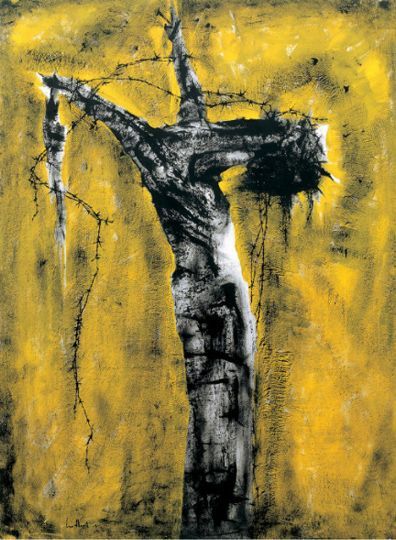
He was hanged on the Cursed Tree
Padah (the dramatic act), this signifies that this act of redemption is accomplished by the Mighty hand of God. It is a sheer act of grace setting free not only Israel, but all humanity. This was accomplished by Jesus obedience unto death, that he freely did because of God’s great love for all (p 48-51).
In the Hagaddah (The Telling of the Passover Story) Jewish people every year hold a Seder Meal at which the story of Israels’ redemption from the land of Egypt is retold. How did this deliverance take place? A Padah: It was wrought through a dramatic act the Mighty hand of G_D, and with signs and wonders and his judgment upon Pharaoh and all of Egypt, because of their refusal to let the Israelites leave the land of bondage!
We, as the reader and listener, must beware least we fall into the trap of reducing Jesus into a mere symbol of Jewish, Black, Hispanic, Native American Indians (First Nation), Asian, Kurdish, Gypsy, Armenian, Arab, Rohingya people, and human suffering in general, with whom we can identify. We need to stress that he is much more than an exemplar, role model or symbol of a Man of Sorrows.
Artists, beginning with Vincent van Gogh and Paul Gauguin onwards have used the image of the Suffering Jesus as a symbol and motif of their own personal suffering; Marc Chagall as a symbol of Jewish persecution and suffering and Reuven Rubin exemplifies an artist that identifies with the Suffering Jesus, seeing him as a symbol of his own personal suffering as in the painting the Temptation in the Desert.
It is not my intention to diminish the profundity of Rubin’s work in which he depicts Jesus, but I am motivated by a strong desire to show the fuller implication of the person and work of the Suffering Jesus.
Reuven Rubin like other European Jewish artists was struck by the appalling circumstances that faced the Jews of Eastern Europe at the turn of the 19th century and early 20th century.
“After returning to Romania in early 1922, on the eve of his move to Palestine, Rubin began to associate Jesus with the Jewish plight in the Diaspora and with Zionism. That year he produced three important paintings while living in Bucharest: The Encounter (Jesus and the Jew), Jesus and the Last Apostle and the Madonna of the Vagabonds. The Encounter is one of the most fascinating and enigmatic of Rubin’s early works” (p 103).
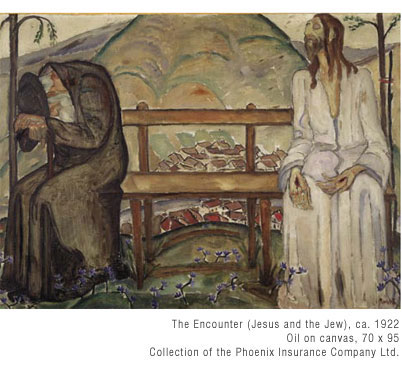
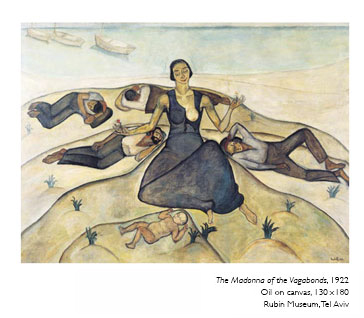
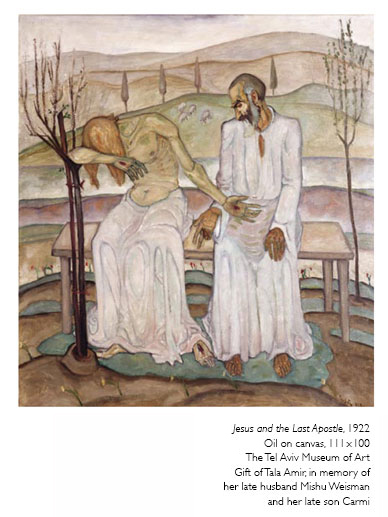
To comprehend what Rubin wishes to portray to his viewers in the painting The Encounter, we need to explore the identity of the elderly Jewish man, with head bowed, sitting at one end of the bench? Encountering Jesus, he evokes the legendary figure of *the Wandering Jew, sometimes referred to as Ashver.
*The Wandering Jew is a mythical immortal man whose legend began to spread in Europe in the 13th century. The original legend concerns a Jew who taunted Jesus on the way to the Crucifixion and was then cursed to walk the earth until the Second Coming. The exact nature of the wanderer’s indiscretion varies in different versions of the tale, as do aspects of his character; sometimes he is said to be a shoemaker, other tradesman, while sometimes he is the doorman at Pontius Pilate‘s estate.[https://en.wikipedia.org/wiki/Wandering_Jew].
Not only was this pitiful character depicted in Christian literature and art, but also some Jewish artist have portrayed him such as Maurycy Gottlieb, Samuel Hirszenberg, E.M. Lilien, and Marc Chagall.
Ashver is generally depicted as being constantly on the move. This is the cardinal feature of his punishment, haunted by the crucified figure of Jesus, reminding him of his sin of taunting Jesus during his Passion. If however, the old man in Rubin’s picture is the Wandering Jew, then it takes on a different meaning departing from the norm.
The frontal position of the seated figure on the bench, recalls Holder’s pictures of misery that he depicts, as well as poverty stricken figures of Jews in Rubin’s earlier works. Richard I. Cohen suggests that he painting represents a finale in an exhausted truce in which there are no victors. Carmela Rubin describes the painting as an encounter between two people, each fixed in his own world. This suffering isolated Jew represents the plight of Eastern European Jewry, representing Rubin’s protest against their dire situation. This led him to embrace Zionism and immigration to the Land of Israel in 1923 and he saw this as the solution to their plight (p 103).
In 1929 the Yiddish poet Itzik Manger, from Czernowitz, Romania where Rubin had lived published his first collection of poems (1922-1929). A important poem fitting for our theme of Man of Sorrows and Zionist Messiah. The poem is titled: “The Ballad of the Crucified and Verminous Man”: (p 104).

“This poem describes how a rejected, louse-ridden Jewish vagabond tells the crucified Jesus why his suffering is greater than Christ’s. In the end Jesus admits that the Jews’s pain in holier, and the wretched Jews, heartened by Jesus’ solidarity, makes his way to the village in search of bread and wine. The poem displays Manger’s characteristic wit, but also shares his indignation shared by Jewish thinkers and artists of the time, at the way Jesus’ name is invoked against the Jews. The admission by “the Crucified” indicts the Church for distorting his message in order to justify persecution and anti-Semitism…[I]t is interesting to think that Rubin might have been familiar with it. In any event, Manger’s poem reflects an engagement with the figure of Jesus that was characteristic of his generation of Yiddish poets and that was part of the Zeitgeist [from German: meaning ‘the general intellectual, moral, and cultural climate of an era’] in Jewish cultural centres such as Czernowitz” (p 104).
Returning to Rubin’s painting The Encounter, another interpretation may be offered. The painting contains an important detail that may be glossed over, namely the two trees:
The tree next to the figure of the straight backed seated Jesus is supported by a stick that grows up ward, while the tree next to the drooping Jew has its branches growing downwards.
What may the significance of these two images mean? An important example of the contrast of the Jew in the Diaspora being in exile, while the image of the fertile growth of the tree is associated with the upright Jew of Zionism. As we saw in E.M. Lilien’s image on his postcard of the Fifth Zionist Congress, shows on the left hand side an elderly bearded Jew with bowed head, seated among rolls of barbed wire, with his head leaning on his walking stick. At the right in contrast the image of a Jewish pioneer plowing a field in the direction of the rising sun. We should also note that there are stalks of wheat that symbolise the fruitfulness of the Land of Israel (p 104).
Rubin in his painting The Encounter, he may well have used similar imagery to that of E.M. Lilien, that the Zionist movement that sought to bring Jews back to life, an Jesus resurrected after his suffering on the cross, evidenced by the stigmata on his hands.
It would appear that Rubin had altered the relationship of the Jew and Jesus as portrayed in Manger’s poem. The figure of Jesus who encounters the miserable old Jew who is desperate to have his pain acknowledged in none other than Jesus who here symbolises the regenerated Jew destined to take his place and thereby heal the suffering of the Diaspora! (p 105).


We should be aware of the shift in Jewish perception of the Man of Sorrows, who is being transformed from one whose suffering is a symbols of Jewish suffering, to one of hope and healing. The significance of the return from exile in the Diaspora to the Land of Israel opened the way for a fresh appraisal of the person and work of Jesus.


This gallery contains 15 photos.
Originally posted on Shalom Radio UK:
Shalom Radio UK http://www.hotrodronisblog.com “A Celebration of Unity and Diversity is the space between Judaism and Christianity” – Roots & Shoots – The Martyrs of Kischinew by E M Lilien Jews fleeing from persecution…
At the Israel Museum, Jerusalem, December 2016 – April 2017 an exhibition was staged called: Behold the Man: Jesus in Israeli Art.
To quote from the foreword of the companion book – “For two millennia, the figure of Jesus has been such a fundamental part of Western culture – in the visual arts, in literature, and in music – that it is almost impossible to relate to cultural history without citing the story of his life and death. The progenitor of what become the world’s largest religion was a Jew who lived during the Second Temple period and was put to death by the Roman rulers of Judea. Jesus came to Jerusalem to preach the Kingdom of Heaven, and it was in Jerusalem that he was crucified, so that over the years the Via Dolorosa, the Church of the Holy Sepulchre, and other sites in the Holy City have become a world focus of Christian pilgrimage.”
You may recall the programme that I produced called The Different Faces of Jesus that I posted on Shalom Radio UK in November 8 2016.
In the programme I dealt with the exhibition of Chagall: Love, War, and Exile that the Curator Susan Tumarkin Goodman did , Senior Curator Emerita, and together with Bella Meyer, granddaughter of Marc Chagall produced, explored with NYC-ARTS! See it here: http://www.nyc-arts.org/showclips/show/id/87423


Part 1.
The work of some 40 artists dating from the late 19th century to the present time are considered. The is powerful symbolic imagery played by such subjects as the crucifixion and resurrection, sometimes reflecting the personal perspective of the artist and other times that of a collective national identity.
———————————–
Artistic portrayals of Jesus date back to the 3rd century of the common era (CE), and these became prevalent particularly after the Roman Empire adapted Christianity as its religion in the 4th century.
For Judaism the use of art was primarily for decorative purposes to intended to beautify texts and ritual paraphilia such as mezuzahs, the covers of torah scrolls, candelabras, etc., while for Christians artists images and portrayals of Jesus and the Saints, became and integral part of their religion. The incarnation of God in the person of Christ (Messiah), became incarnated in sculpture, painting, murals, mosaics and more recently in photographs as well. These portrayals exemplify what Paul calls “the image of the invisible God” (Colossians 1.15). And as a testimony of incarnation, art plays an important part depicting the word becoming flesh.
John of Damascus the great iconographer of the 8th century wrote:
Though there was great controversy and opposition to the portrayal of the image of Jesus by the iconoclastic controversy of the 8th-9th century, the icon ultimately prevailed. Once more the Protestant Reformation challenged the excessive devotion that the Catholic Church gave to the portrayal of the figure of Jesus and the Saints, including a vast array of depictions of the Virgin Mary and Modonna and Child.
The image of Christ on the Cross became the centre piece of the Western worlds Christian artistic expression together with many other aspects of the life and ministry of Jesus. This figure of Christ did not disappear from Modernist art, with Impressionist art being influenced by daily secular thinking, with many of its practitioners dealing with Christian themes and particularly the the figure of Christ.
As I previously said in The Different Faces of Jesus programme, Marc Chagall drew his portrayal of Jesus in his numerous painting of the crucified Christ, from his awareness of Russian icons that he had seen in during his formative years as well as other paintings of Jesus done by Gentile artist. While Chagall’s use of the figure of the crucifixion of Christ, became an image of Jewish persecution and suffering, it was Paul Gauguin saw Vincent van Gogh’s use of the Crucified Christ, as a paradigm of martyrdom, a man truly created in Jesus’ image (p 39). Gauguin himself was one of the first artists to apply religious themes to the depiction of his own personal situation. He cultivated the image of a suffering artist.
Numerous other European artist followed this trend of using Christ’s suffering as way of giving expression to their own rejection and suffering and that of others. “World War I provoked many European artists to portray Jesus as a victim of war, symbolising their vehement opposition to the slaughter and anguish it caused” (p 41).
In England the Jewish sculptor, Jacob Epstein frequently invoked Jesus as a symbol and protest against the war. Jesus has not lost his importance of bring to people’s awareness of the society’s failure and this saw evident from the contemporary sculptor Mark Wallinger whose figure of Jesus called Ecce Homo (Behold the Man) that was originally displayed on the 4th plinth on Trafalgar Square, London in 1999, demonstrating this point.
But how relevant is the image of Jesus to European Jewish and Israeli artist?
Jewish artist continue to display considerable interest in the figure of Jesus inspiring their work in a number of ways. “The European Jewish artist’ engagement with Jesus had a number of motivations:
The struggle for cultural integration; the need to combat entrenched religious ant-Semitism; the desire to present the Christian Saviour as an exceptional human being of Jewish origin, who did not set out to create a new religion; the introduction of a particularly pointed symbol of Jewish suffering; and the wish to show that the universal values had their roots in Judaism” (p 45).
The Haskalah (Enlightenment) movement specific goal of its depiction of Jesus was one of the elements to help Judaism of the European Enlightenment was to help modern Judaism to full integrate into a new European environment, modern, objective and enlightened (p 45). An example of a Russian Jewish sculptor, Mark (Mordechai) Antokolsky of Vilna born in 1843. His figures ranged from Jesus, John the Baptist to Socrates and Mephistopheles. He also depicted figures of Jewish artisans and other historical figures including the controversial Jewish philosopher Spinoza.
He became the first Jew to become a full member of the Imperial Academy of Arts and on two occasions he won the prestigious first prize at the Exposition Universalle in Paris in 1878 and 1900. His work Ivan the Terrible commissioned by Czar Alexander II for the Heritage collection in St Petersburg. He was not immune to anti-Semitic attack and suffered tension between his identity as a Jew and his desire to make his way as a Russian artist – especially in the field of sculpture, which until then was closed to Jews. The nationalist and anti-Semitic press called him an “insolent Yid,” unworthy to portray the heroes of Russian history and their Christian spirit, but his overwhelming success – in a period characterized by waves of anti-Semitism – overcame these attacks.
One of his most important pieces form our point of view is the sculpture Christ before the People’s Court made in 1873 (later copies were made by the artist). Jesus is portrayed as completely Jewish with skullcap and sidelocks, wearing a robe that suggests a prayer shawl. It was his desire to redress the injury done to the Jews by the church by portraying this Jewish Jesus. He believed in an ethical Jesus whose role model should inspire all (p 46).
Jesus “lived and died as a Jew for the truth and brotherhood, this is why I like to portray Jesus and a pure Jewish type and to represent him with a covered head (p 47). In a letter to a friend, he wrote, In the title… I mean also to refer to the present, I truly believe that if Christ would rise again and see how his ideas have been twisted and exploited by the Fathers of the Inquisition and others, he would rebel against them as he rebelled against the Pharisees and would agree to be crucified ten more times for his beliefs.”
He wrote to Stasov in 1873, while working on the sculpture, “Although Jews renounce and still renounce [Jesus], I solemnly believe that he was and died a Jew for truth and brotherhood. This is why I want to make of him a purely Jewish type… I imagine how Jews and Christians will rise against me. Jews will probably say, ‘How is it that you made Christ?’ and Christians will say, ‘What kind of Christ did he make?’ but I do not care for this” After he completed the sculpture , he wrote “I have finished ‘Christ’ yesterday… I myself am not able to evaluate my work because I expressed everything in my soul in this statue, and now I am tired and grow dull” (p 47).
Many praised the sculpture and acclaimed it as a masterpiece, while others criticized the sculpture when it was put on display in Paris in 1878. Vladimir Stastov’s anti-Semitic comments, “To these people, to imagine Christ as a Roman or an academic model was fine, but as a Jew – never!” (p 50).
A young Polish Jewish Artist, Mauryey Gottlieb (1856-1879) in his short life who died at the age of 23, made an outstanding contribution as a painter, he managed to create a remarkable body of work that united Polish Christian culture, the artist’s Jewish identity, and a universal message of reconciliation between the two religions. Jesus was the central character in two monumental and highly complex paintings that Gottlieb was still working on when he died: Christ before his Judges and Christ teaching in Capernaum. Both incorporate self-portraits, a further indication of how important these two ambitious works were to Gottlieb. They convey his personal, artistic, and political manifesto concerning Jesus the Jew and Jewish-Christian relations. Like his contemporaries, these paintings reflect the prevailing scholarly focus on the historical Jesus, which achieved artistic expression by such means as realistic depictions that were faithful to the period and the locale, an emphasis on Jesus’ humanity (p 50).
Gottlieb challenged the traditional Catholic iconography, and concentrated on the genre of history painting, depicting selected religious and literary themes in an academic orientalist style that he learned chiefly from his teacher Jan Matejko, the most important Polish artist of the time.
http://www.hotrodronisblog.com
 “A Celebration of Unity and Diversity is the space between Judaism and Christianity”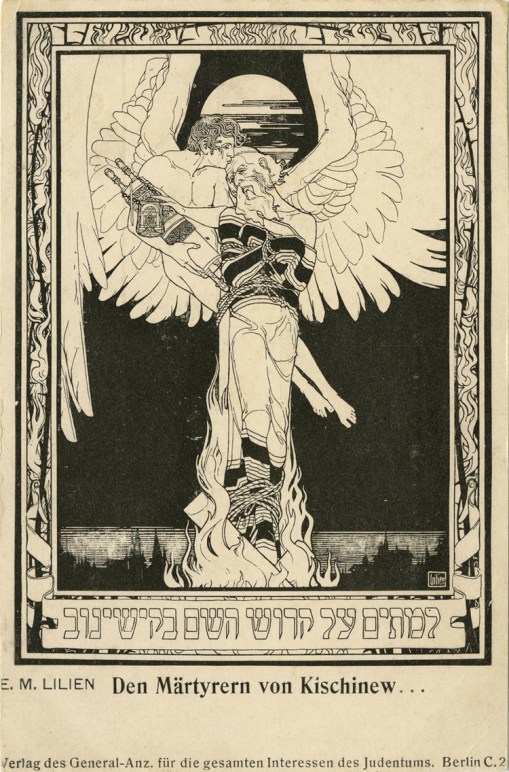
Jews fleeing from persecution in Eastern Europe sought places that were less hostile and more secure, with a number turning towards their ancient Biblical homeland as an option to settle. This led to the establishment of growing numbers of Jews moving to Ottoman occupied Palestine
(In the 3 part series of programmes on Joseph Rabinowitz we considered some of the issues surrounding the pogroms that were instigated against the Jews of the realm).
Part 1
Part 2
Part 3

These new European Jewish arrivals in Ottoman Palestine during the latter part of the 19th and early 20th centuries, were motivated by the Zionist ideal of the ingathering of the Jews from the diaspora to their ancient Jewish homeland and this idealism finds expression in artists among the new arrivals and is depicted in sculptures, pictures and paintings by them.
It is my desire to seek to clear up some misconceptions regarding what Zionism is and what Zionists believe.
The mere mention of the word “Zionist” or “Zionism” has taken on a negative meaning in the minds of many and this is due to a number of factors – the anti-Israel campaigners and lobbyists who pursue their propaganda war against modern Israel and the BDS (cultural, academic & economic boycotts) which questions Israel’s very right to exist as a sovereign nation state, and continues to be a challenge that needs to be countered.
Therefore, in the present anti-Semitic/anti-Zionist/anti-Israel/anti-Jewish climate, open and frank conversations are needed in an increasingly dangerous world in which we live, with its growing hostility to those who hold differing views to our own and this is particularly the case for Jews in general and Israel in particular.


Contrary to the UN Resolution 3379 – ZIONISM IS NOT RACISM –


While Arab nationalism is not considered racist, Jewish nationalism (Zionism) is called racist. Many Arab and Moslem nations discriminate and severely restrict religious freedom targeting Jews, Kurds, and Armenians, Christians, Druze, Baha’i, Ahmadiyyas, Yazidi, Zoroastrian and this includes either Shia or Sunni minorities depending on the particular country, yet the one democratic country, Israel, that allows religious freedom, is singled out as racist.
The prime reason for this accusation is the fact that the PLO, Hamas and Hezbollah have not succeeded in destroying Israel and replacing it with a Palestinian state that will be Judenrein (Jew-free) from which Jews are excluded – (originally with reference to organizations in Nazi Germany). For just as “the Nazis sought to make Germany ‘judenrein’” (Jew-free), so Israel’s enemies seek to do likewise.
While the PLO have in principal agreed to a two-state solution to solving the Arab-Israeli conflict, neither Hamas or Hezbollah with its Iranian backers, have agreed to any kind of peace accord or territorial accommodation, but continue to call for Israel’s destruction.
Zionism is nothing more than Jewish nationalism and stands for her right to exist as a sovereign national state like all other states.


Ephriam Moses Lilien, the first Zionist artist, helped Boris Schatz, to establish the Jerusalem Bezalel School of Art. Subsequently Ze’ev Raban (1890-1970) helped Boris Schatz to create the Bezalel style. However, it was Lilien who was responsible for creating the Zionist visual representation in those early years.
He was a leading painter, decorative artist and industrial designer and made a major contribution to the Bezalel style of Israeli art.

 The eclectic East-West style was named Judenstil
Lilien’s particular style of portrayal was in the Art Nouveau / Jugendstil school, with its combination of eroticism and fantasy with Zionist idealism. He created a unique fusion of the two, expressing the pathos of Jewish longing for Zion. His style of depiction achieved a harmonious partnership with Zionist imagery, Jewish and Christian symbols, Orientalism, Japanese art with influences of Egyptian and Assyrian together with a Renaissance influence. This eclectic East-West style was named Judenstil and this became Lilien’s hallmark (p 63).*
Lilien was born into a traditional Eastern European Jewish family and his artistic expression flourished in Austrian and German cultural centres. His art shows subtle Christian influences and the interaction between Zionism and the Christian world at the turn of the century. In those formative years of Zionism there was a keen Christian interest that influenced Theodore Herzl. The Christians saw the Jewish peoples’ return to its ancestral home in the Holy Land as the herald of the Second Coming of Christ.
Theodore Herzl


In 1902 Songs of the Ghetto by New York Yiddish poet, Morris Rosenfeld appeared in German translation with Lilien’s image the Jewish May showing an old man with his head entangled in thorns.
In 1905 Lilien together with Boris Schatz went on their first trip to Palestine, where they set up the Bezalel School of Arts and Crafts in Jerusalem. Lilien taught and worked as Schatz’s assistant in 1906 when the school opened. He spent 6 months at the school, but he and Schatz parted company after this period and Lilien subsequently no longer associated with the school. During this trip he also took many photographs in preparation for illustrations of a German Lutheran Bible commissioned by the Lutheran Church and its first volume was published in 1906. He made other trips to the Holy Land in 1910, 1914 and 1917 taking more photos to enable him to make further drawings and etchings to continue his work as an illustrator of religious subjects. He died in 1925 having made a considerable contribution to the early Zionist movement and saw his art as having a mission. (p 64-65).
The Influence of Christians on the fledgling Zionist Movement
A considerable time before the Jewish Zionist movement began to formulate its plans and desires to effect the return of the Jews to Palestine, a not insignificant number of Christians were showing an interest in the Holy Land. This was not just as a place of Christian pilgrimage,but these Christians in Britain, USA, Germany and other places, turned their attention to the subject of the return of the Jews to their ancient homeland. This also culminated with the first Zionist Congress in Basel, Switzerland in 1897,*
By the mid-nineteenth century, the Ottoman Empire was in severe decline, approaching its downfall. Britain in particular, showed a vital interest in the fate of the Empire, and Palestine together with the other Bible Lands was of great significance. With a growing Jewish awareness, a strategic alliance dawned.
Lord Palmerston, British Foreign Secretary, wrote to the British Ambassador in Constantinople, the Sultan’s seat:
“There exists at the present time among the Jews dispersed over Europe, a strong notion that the time is approaching when their nation is to return to Palestine…It would be of manifest importance to the Sultan to encourage the Jews to return and to settle in Palestine because the wealth which they would bring with them would increase the resources of the Sultan’s dominions; and the Jewish people if returning under the sanction and protection and at the invitation of the Sultan, would be a check upon any future evil designs of Mehemet Ali (of Egypt) or his successor…I have to instruct Your Excellency strongly to recommend (to the Turkish Government) to hold out every just encouragement to the Jews of Europe to return to Palestine” (p 43-44 – Faith & Fulfilment).*
On August 17, 1840, the London Times published an editorial entitled, “A plan to plant the Jewish people in the land of their fathers.” This plan was then under serious political consideration and people of significance like Lord Shaftsbury, a deeply committed Christian, joined forces with Lord Palmerston who was called “the sword” in a plan of active support for such a return by the Jews. The men studied the Scriptures earnestly giving special attention to those prophetic portions that pertained to the return of the Jews to their ancient Biblical homeland.
This strong Biblical conviction led them in the aiding of “God’s ancient people” and they felt that this would lead to the fulfilment of those Biblical prophecies that they had noted. Ashley (Lord Shafstsbury) never doubted that the Jews would return to their own land and he daily prayed, “Oh, pray for the peace of Jerusalem” and these words were engraved on a ring that he wore on his right hand (p 45).
We should add names like Oliphant and Blackstone to the list of those who actively promoted a Jewish return to Palestine. These two men responded to reports of pogroms against the Jews in Eastern Europe under Tsarist persecutions, and they added their advocacy on behalf of the Jews with pleas for their return. This concern continued unabated and Blackstone appealed to President Wilson of the USA sending him a memorandum in which he expressed his ideas on behalf of a Jewish return.
In 1885, William Hechler became Chaplain to the British Embassy in Vienna. He held his post until 1901 and witnessed the beginnings of the Zionist Movement. He personally befriended Theodore Herzl, who as a Jewish reporter at the Dreyfus affair. Herzl turned his attentions to solving the “Jewish Question.” He authored the book Das Judenstat (The Jewish State) published in 1896 in which he advocated the return of the Jews to Palestine.
Hechler was tireless in his efforts and penned these words,
Hechler went to great lengths to persuade the German Emperor to recognise the Zionist Movement. Finally his efforts produced fruit when in 1898 the Kaiser declared:
“I have been able to notice that the emigration to the land of Palestine of those Jews who are ready for it is being prepared extremely well and is even financially sound in every respect. Therefore I have replied to an enquiry by the Zionists as to whether I wish to receive a delegation from them in audience that I would be glad to receive a deputation on the occasion of our presence there (in Jerusalem). I am convinced that the settlement of the Holy Land by financially strong and diligent people of Israel will soon bring undreamt-of-prosperity and blessing to the land’’ (p 60).
To return to E M Lilien and his importance – “From the start, Christian motifs were woven into many of Lilien’s illustrations. His implicit allusions to Jesus demonstrated his engagement with a figure whose existence and significance he was unable to ignore. His use of Christian iconography played a clear role in the Zionist message that would be central to his oeuvre” ( i.e. the body of work of a painter, composer, or author) (p 65, Behold the Man).
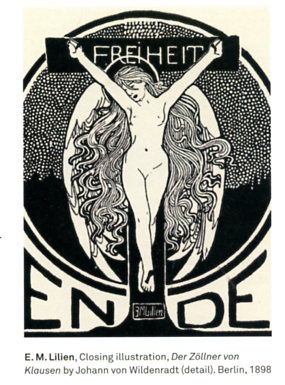
His work related to the image of Jesus as early as his days in Cracow and the final illustration in a book The Tax Collectors of Kluasen by Johann van Wildenradt, that deals with a peasant uprising of the 15th and 16th century and is about their struggle for freedom. The final illustration shows a nude woman crucified and the traditional inscription of INRI over the head of the crucified Christ, is replaced with the word FREIHEIT (freedom).
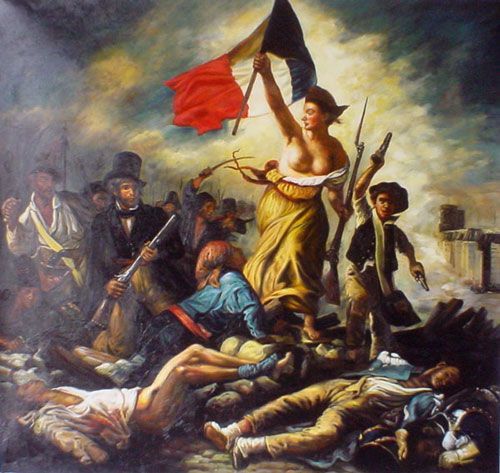
Considering that Lilien was only 18 years old when he did this illustration and several decades before Chagall’s Jewish Jesus on a cross, it is all the more amazing because Jewish artists did not depict the crucifixion. The fact that the figure was not of Jesus, but of a nude female, may reduce the theological problem from a Jewish perspective, but her liberated sexuality was no less a departure from usual Jewish art themes This illustration is clearly in the Art Nouveau / Jugendstil style that largely characterised his work. A nude women symbolised national freedom in numerous paintings and sculptures, the best example being that of Eugene Delacroix’s Liberty Leading the People.


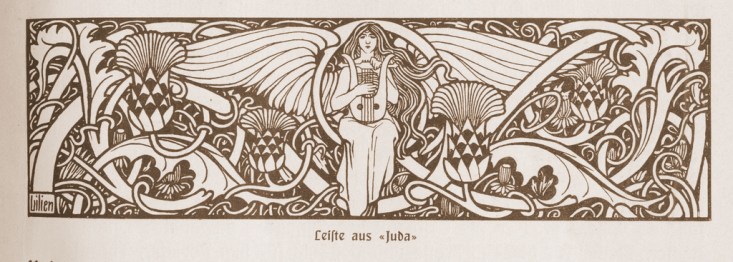
As Lilien’s work matured with his move to Germany, he came under the influence of Borries von Munchhausen. He was an advant-garde poet who showed Lilien his unpublished poems on Biblical themes. Lilien was so impressed that he decided to illustrate the poems and publish them. The joint project in 1901 was called Juda. This transformed Lilien into the dominant Zionist artist of his day. In Juda, ancient Jewish biblical history became relevant and vividly graphic.

Lilien gave dignity to Jewish themes instead of the Christian trope of Synagoga and Ecclesia which represents the Church’s triumph over Judaism. Now in Lilien’s work Judaism is depicted as a dignified and beautiful woman holding the Tablets of the Law or Torah Scroll, combining Christian iconography and Jewish symbols.

Sabbath Queen by E M Lilien
Another book of illustrations showing Christian motifs is Lilien’s well known cover of the Jewish cultural monthly Ost and West (East and West) from 1901 – 1906. It features the Daughter of Zion – a young woman with a star of David and a menorah, surrounded by a circle. Her skirt is also embellished with stars of David and her hand has a loop of thorns, resting on an altar and in her hand she is holding a flower called the Rose of Jericho. This plant belongs to the genus known as the “resurrection plants” because of their ability to come back to life after being shrivelled and dried up for months or even years.
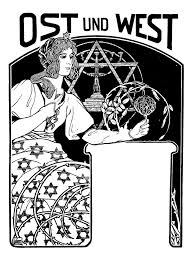
For Christians the Rose of Jericho symbolises the resurrection of Jesus and also the Virgin Mary’s pregnancy with Jesus. This flower was a prized memento brought back by pilgrims from visits to the Holy Land.
Like the Rose of Jericho, “so will Israel bloom in youthful splendour…” Lilien was the first to represent this plant artistically with a powerful Zionist message of the hope of Jewish restoration to their ancient homeland (p 74-75).
Ost and West is accompanied by Christian motifs that represent the Passion and Resurrection. Lilien has combined Christian and Jewish symbolism that has at the heart of it is a Christian concept of resurrection.
Lilien’s 1901 postcard from the Fifth Zionist Congress is one of his best known illustrations, and remains a central image on Zionist history.

At the right, the distant figure of the Jewish farmer plowing the land signifies national rebirth; at the left, a Jewish man with bowed head is caught in a tangle of thorns, symbolising the Jew trapped in the tangle of exile. Once again his work is infused with Christian iconography as in his Pesah with crown of thorns as well as the Art Nouveau / Jugendstil influence clearly evident. This use of such symbolism was used to create a Zionist message of revival and resurrection (p 76).

(see full image above)
Another important image that may well have influenced E M Lilien’s Moses was William Holman Hunt’s The Light of the World. This image of Jesus is a distinctly Protestant portrayal of him. Firmly based on Scripture, “Behold I stand at the door and knock…” (Revelation 3.20) Holman shows a regal full length figure of Jesus and this bears a resemblance to Lilien’s Moses. As in Hunt’s painting, so Moses has a halo of light with the Eastern sun from Zion shining behind him.


While Lilien was happy to use Christian iconography, his depictions of Jesus were primarily used to relate to the Jewish experience of suffering as was the case with other Jewish artists. His strong Zionist use of Christian themes such as resurrection and rebirth was to signify the hope of restoration and renewal of Jewish hope in their return to Zion.

Boris Schatz with whom E M Lilien collaborated in his early work in Palestine, is considered the father of Israeli art. He was born in Vilna (1867), in the Pale of Settlement, in Lithuania. He founded the Bezalel School of Arts and Crafts, Jerusalem in 1906 with the aim of what he called “Hebrew” art. He was a sculptor and his style was essentially academic. Like Atokolsky, Schatz was strongly affected by the tension between Judaism and Christian culture and felt the need to mediate between them.
Schatz directed the energy of his work towards the Zionist cause and like Lilien, he made use of Christian iconography that included allusions to Jesus. This was to continue to play a role in his national art. He dedicated himself to creating a uniquely Jewish iconography that would promulgate a new Hebrew culture. (p 86).
No longer was this the Jew of the dispersion and exile, but a new liberated Jew was emerging out of the bondage of the ghetto throwing off the shackles of the centuries. The basis of this “religion” consisted of set characters and motifs – some of which he derived from Renaissance Christian iconography (https://en.wikipedia.org/wiki/Boris_Schatz).
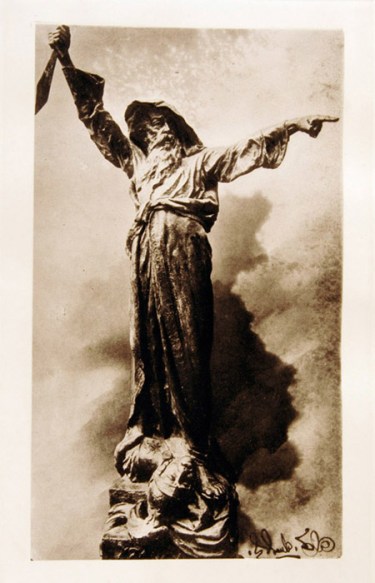
His masterpiece was Mattathias Maccabee (1894). The reason he chose to portray this figure of Jewish history had great significance because they rose up against the Seleucid Greeks in the second century BCE. He portrayed the man who shook off the yoke of pagan oppression. It reflects the spirit of the Zionist ideal in their auto-emancipation as a form of self- realisation and liberation, at the rebirth of a nation that was yet to be fully realised.

“Arise, Judah, come, let us go!”
Auto-Emancipation was the title of the book by Leon Pinsker.
As a Zionist thinker – he reflects,
“What a miserable role for a nation that descends from the Maccabees!”
This longing to be free from oppression and at the whims of the European nations, that at times carried out severe persecution of the Jews in their realm, they needed to strive for a return to Zion where they could enact Auto-Emancipation, a form of self-liberation. Pinsker together with Herzl and others Zionist thinkers gave birth to the modern Zionist movement.

A possible influence for the Maccabee sculpture was the maquette of a triumphant Christ by Mark Antokolsky (we considered his work in Part 1). Though this figure of Christ as a charismatic, spiritually powerful figure, is within the Christian tradition, it was not concerned with Jewish-Christian relations, whereas Christ before the People’s Court was clearly within the realm of inter-faith dialogue.

Christ before the People’s Court
Schatz’s statue of Mattithias Maccabee, portrayed a militant message, and is a befitting symbol of Jewish nationalism and rebellion (p 87). Schatz referring to his statue, said that he modled the figure after his grandfather’s likeness, who though physically weak, was spiritually strong.
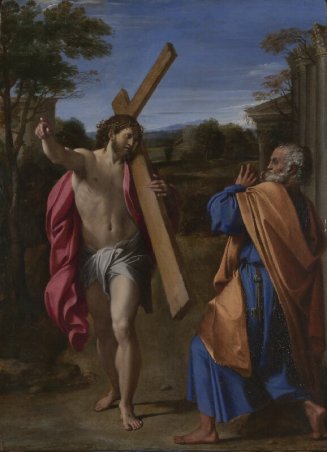
In Carracci’s Christ Jesus is pointing to Jerusalem indicating that he is to die by crucifixion. In contrast Mattathias is holding a sword pointing towards the Land of Israel, the focal point of Zionist redemption.
In conclusion, a figure of a Jewish hero raising the banner against the Greeks – Mattathias Maccabee with sword in hand, has combined a number of different elements. We see a fusion of mythological and Christian elements, directly and clearly connected to Jesus. Schatz and other Zionist visionaries show the Jew’s victory over anti-Semitic persecutors and resurrection in a Jewish homeland. (p 88-89).


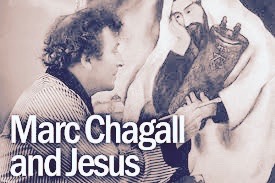
At the Israel Museum, Jerusalem, December 2016 – April 2017 an exhibition was staged called: Behold the Man: Jesus in Israeli Art.*
To quote from the foreword of the companion book –
You may recall the programme that I produced called The Different Faces of Jesus and I posted on Shalom Radio UK in November 8 2016:
In the programme I dealt with the exhibition of Marc Chagall: Love, War, and Exile that the Curator Susan Tumarkin Goodman did , Senior Curator Emerita, together with Bella Meyer, granddaughter of Marc Chagall produced – explore this at NYC-ARTS! And see it here: http://www.nyc-arts.org/showclips/show/id/87423
“Behold the Man: Jesus in Israeli Art approaches the figure of Jesus and related Christian themes from a different perspective, entering the complex realm of the relationship between Judaism and Christianity to examine for the first time the significance of Jesus through European Jewish and Israeli art.”

The work of some 40 artists dating from the late 19th century to the present time are considered. There is powerful symbolic imagery played by such subjects as the crucifixion and resurrection, sometimes reflecting the personal perspective of the artist and other times that of a collective national identity.
Christians come to the depiction of Jesus in European art through the lens of their shared faith and history, and European and Israeli Jews bring a different perspective to their view of Jesus. Rather than him being viewed as their Saviour and Lord, alas he has all too often been viewed as the one who has caused their suffering and death. A collective punishment visited upon them by Christians who blamed them for rejecting him and causing his death by crucifixion.
All the more surprising and refreshing is this exhibition of European Jewish and Israeli views of Jesus. The image changes and develops as European Jewish and Israeli artists give expression to the multifaceted aspects of their encounters with Jesus, from one of Jewish suffering in the diaspora at the hands of Christians, to one of hope reborn due to their return to the land of Israel.
Despite all that Jews have gone through, they are able to look at Jesus through Jewish eyes. The viewer will be delighted and given a window into the outlook of Jews who dare to look at Jesus for themselves.
“In the 19th century a change in attitude affected a small but significant number of European Jewry towards Jesus, this included thinkers, writers, and eventually artists began to draw attention of the historical Jesus and sought to reclaim him. This approach aimed at reconciliation and at enhancing the position of Judaism in the Christian world – but at the same time it underscored the injustice of anti-Semitism “ (p 15).

Jewish artists have been influenced by iconography of the surrounding cultures and this can be seen in the work of certain painters and sculptors of the 19th century. As the Jewish source of visual images is rather sparse due to the 2nd Commandment that forbids the making of graven images, Jewish artist naturally turned to Christian sources for inspiration and reference concerning the depiction of the person of Jesus and other Biblical themes. Though there is still a strong taboo for many Jews concerning the figure of Jesus, his presence is there at a deep veiled level.
The figure of Jesus in Hebrew literature has flourished in recent years. Also in the visual arts, Ziva Amishai-Maisels has pursued the most important research into his presence in modern Jewish art.
A major fault line that influences and divides the Jewish and Christian visual rendering of the subject of Jesus is the fact that none of the normal Jewish interpretations believe in his divinity. Jesus who Christians worship as the God made flesh, the figure of supreme importance in Christian art, displays a fundamental tension between his divinity and humanity. At the Council of Chalcedon in 451 Jesus was pronounced as “truly divine and truly human” – his human identity as the suffering Man of Sorrows exists alongside his identity as God almighty. It is this duality that informs the history of Christian visual art (p 17).
This belief in the two-fold identity from the 3rd century to the present continues to define Christian portrayals of Jesus. “While Israeli Jewish artists focus on the human figure of Jesus. For Israeli artists, identification with Jesus’ humanity overcame their lack of belief in his divinity. The figure of Jesus – Other but also brother – touched them as a way to express a host of thoughts, experiences, emotions, and aspirations” (p 17).
Artistic portrayals of Jesus date back to the 3rd century of the common era (CE), and these became prevalent particularly after the Roman Empire adapted Christianity as its religion in the 4th century.
For Judaism the use of art was primarily for decorative purposes to beautify texts and ritual paraphilia such as mezuzahs, the covers of torah scrolls, candelabras, etc., while for Christian artists images and portrayals of Jesus and the Saints, became and integral part of their religion. The incarnation of God in the person of Christ (Messiah), became incarnated in sculpture, painting, murals, mosaics and more recently in photographs as well. These portrayals exemplify what Paul calls “the image of the invisible God” (Colossians 1.15). And as a testimony of incarnation, art plays an important part depicting the word becoming flesh.
Though there was great controversy and opposition to the portrayal of the image of Jesus by the iconoclastic controversy of the 8th-9th century, the icon ultimately prevailed. Once more the Protestant Reformation (1517-1685) in the Western Christian realm challenged the excessive devotion that the Catholic Church gave to the portrayal of the figure of Jesus and the Saints, including a vast array of depictions of the Virgin Mary and Madonna and Child. The Eastern branch of the Christian faith as represented by the Russian and Greek Orthodox tradition was largely unaffected by the iconoclastic revolt in the West.
The image of Christ on the Cross became the centre piece of the Western worlds Christian artistic expression together with many other aspects of the life and ministry of Jesus. This figure of Christ did not disappear from Modernist art, though Impressionist art was influenced by daily secular thinking, many of its practitioners did deal with Christian themes and particularly the the figure of Christ.
As I previously said in The Different Faces of Jesus programme, Marc Chagall drew his portrayal of Jesus in his numerous painting of the crucified Christ, from his awareness of Russian icons that he had seen during his formative years in Russia, as well as other paintings of Jesus done by Gentile artist. While Chagall’s use of the figure of the crucifixion of Christ, became an image of Jewish persecution and suffering, it was Paul Gauguin who saw Vincent van Gogh’s use of the Crucified Christ, as a paradigm of martyrdom, a man truly created in Jesus’ image (p 39). Gauguin himself was one of the first artists to apply religious themes to the depiction of his own personal situation. He cultivated the image of a suffering artist.


Numerous other European artist followed this trend of using Christ’s suffering as way of giving expression to their own rejection and suffering and that of others. “World War I provoked many European artists to portray Jesus as a victim of war, symbolising their vehement opposition to the slaughter and anguish it caused” (p 41).
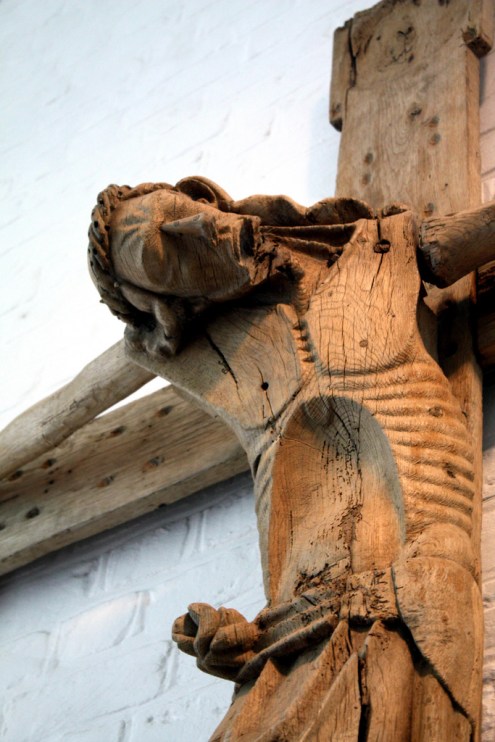
Epstein’s Christ in wood
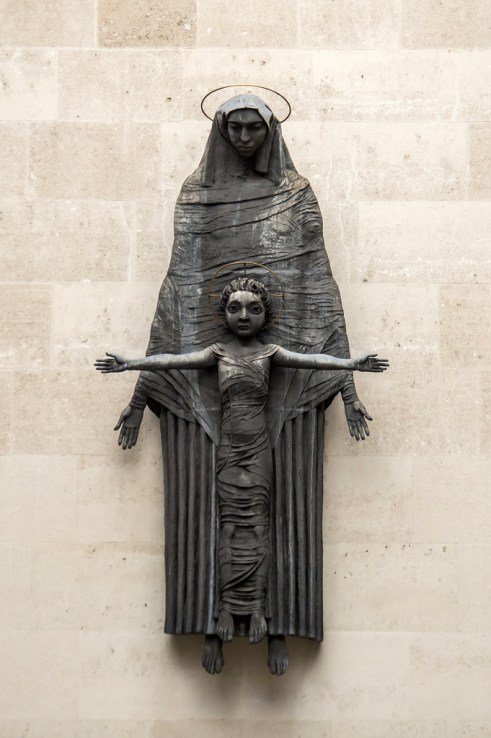
Epstein’s Madonna & Child
In England the Jewish sculptor, Jacob Epstein frequently invoked Jesus as a symbol and protest against the war. Jesus has not lost his importance of bringing to people’s awareness of society’s failure and this is evident from the contemporary sculptor Mark Wallinger, whose figure of Jesus called Ecce Homo (Behold the Man) that was originally displayed on the 4th plinth on Trafalgar Square, London in 1999, demonstrates this point.


But how relevant is the image of Jesus to European Jewish and Israeli artists?
Jewish artists continue to display considerable interest in the figure of Jesus inspiring their work in a number of ways. “The European Jewish artist’ engagement with Jesus had a number of motivations:
The struggle for cultural integration; the need to combat entrenched religious ant-Semitism; the desire to present the Christian Saviour as an exceptional human being of Jewish origin, who did not set out to create a new religion; the introduction of a particularly pointed symbol of Jewish suffering; and the wish to show that the universal values had their roots in Judaism” (p 45).
The Haskalah (Enlightenment) movement specific goal of its depiction of Jesus was one of the elements to help Judaism of the European Enlightenment period to help modern Judaism to fully integrate into a new European environment, with its modern objectives and progressive outlook.
An example of a Lithuanian Jewish sculptor, Mark (Mordechai) Antokolsky of Vilna born in 1843. His figures ranged from Jesus, John the Baptist to Socrates and Mephistopheles. He also depicted figures of Jewish artisans and other historical figures including the controversial Jewish philosopher Spinoza (p 45).
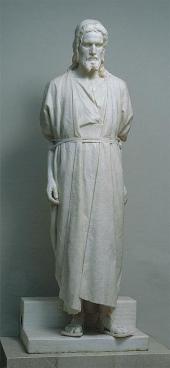
Christ before the People’s Court
He became the first Jew to become a full member of the Imperial Academy of Arts and on two occasions he won the prestigious first prize at the Exposition Universalle in Paris in 1878 and 1900. His work Ivan the Terrible commissioned by Czar Alexander II for the Heritage Collection in St Petersburg. He was not immune to anti-Semitic attack and suffered tension between his identity as a Jew and his desire to make his way as a Russian artist – especially in the field of sculpture, which until then was closed to Jews.
The nationalist and anti-Semitic press called him an “insolent Yid,” unworthy to portray the heroes of Russian history and their Christian spirit, but his overwhelming success – in a period characterized by waves of anti-Semitism – overcame these attacks.
One of his most important pieces form our point of view is the sculpture Christ before the People’s Court made in 1873 (later copies were made by the artist). Jesus is portrayed as completely Jewish with skullcap and sidelocks, wearing a robe that suggests a prayer shawl. It was his desire to redress the injury done to the Jews by the church by portraying this Jewish Jesus. He believed in an ethical Jesus whose role model should inspire all (p 46).
He wrote to Stasov in 1873, while working on the sculpture, “Although Jews renounce and still renounce [Jesus], I solemnly believe that he was and died a Jew for truth and brotherhood. This is why I want to make of him a purely Jewish type… I imagine how Jews and Christians will rise against me. Jews will probably say, ‘How is it that you made Christ?’ and Christians will say, ‘What kind of Christ did he make?’ but I do not care for this” After he completed the sculpture , he wrote “I have finished ‘Christ’ yesterday… I myself am not able to evaluate my work because I expressed everything in my soul in this statue, and now I am tired and grow dull” (p 47).
Many praised the sculpture and acclaimed it as a masterpiece, while others criticized the sculpture when it was put on display in Paris in 1878. Vladimir Stastov’s anti-Semitic comments, “To these people, to imagine Christ as a Roman or an academic model was fine, but as a Jew – never!” (p 50).
A young Polish Jewish Artist, Maurycy Gottlieb (1856-1879) in his short life (died at the age of 23), made an outstanding contribution as a painter, he managed to create a remarkable body of work that united Polish Christian culture, the artist’s Jewish identity, and a universal message of reconciliation between the two religions. Jesus was the central character in two monumental and highly complex paintings that Gottlieb was still working on when he died: Christ before his Judges and Christ teaching in Capernaum. Both incorporate self-portraits, a further indication of how important these two ambitious works were to Gottlieb. They convey his personal, artistic, and political manifesto concerning Jesus the Jew and Jewish-Christian relations. Like his contemporaries, these paintings reflect the prevailing scholarly focus on the historical Jesus, which achieved artistic expression by such means as realistic depictions that were faithful to the period and the locale, an emphasis on Jesus’ humanity (p 50).
Gottlieb challenged the traditional Catholic iconography, and concentrated on the genre of history painting, depicting selected religious and literary themes in an academic orientalist style that he learned chiefly from his teacher Jan Matejko, the most important Polish artist of the time.
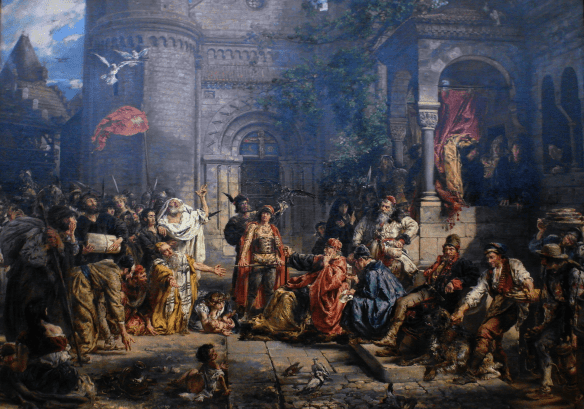
Jan Matejko – Reception of Jews in Poland
In a letter not long after painting the two works and just prior to his death Gottlieb wrote: “How deeply I wish to eradicate all prejudice against my people! How vividly I wish to uproot the hatred enveloping the oppressed and tormented nation and to bring peace between the Poles and the Jews, for the history of both people is a chronicle of grief and anguish!” (p 52). He left a legacy of a plea for tolerance and reconciliation.
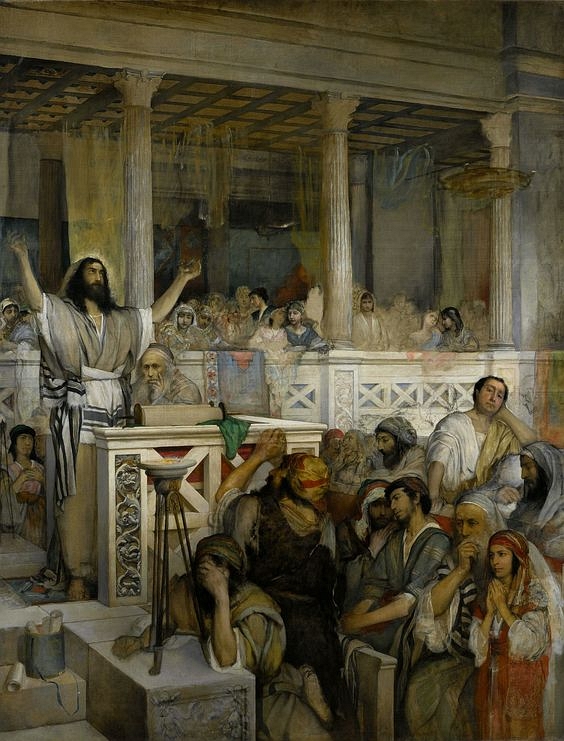
Maurycy Gottlieb – Christ preaching at Capernaum
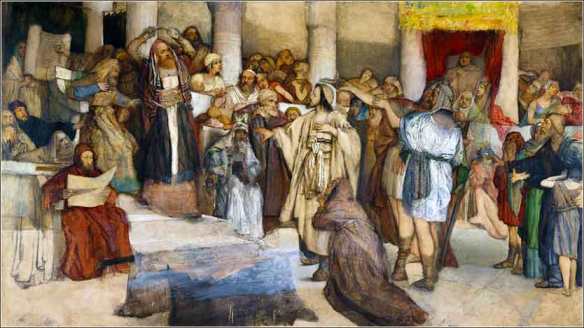
Christ before his Judges
Max Liebermann (1847-19350) – is one of the most important German Impressionists and the most celebrated Jewish painters of the late 19th-early 20th century. He painted The-Twelve-Old Jesus in the Temple and it was displayed at the 1879 International Art Exhibition in Munich’s Crystal Palace (Glaspalast), and the scandal it provoked demonstrates the unresolved conflict between Judaism and Christianity – and the power of Jesus even when depicted as a child, to inspire a crisis in Jewish-Christian relations, even during a period of relative calm (p 53).
The controversy centred around the depiction of the boy Jesus with his uncombed hair, bare feet, disheveled clothes, with him debating self-confidently with the sages who surrounded him. The amount of anger that this rendering of Jesus garnered was unexpected and surprised Liebermann who was forced to repaint the figure of Jesus in the face of the storm of anti-Semitic outrage that pervaded German culture. In response he gave the boy more conventional features, dressing him in smarter clothes and with brushed hair.
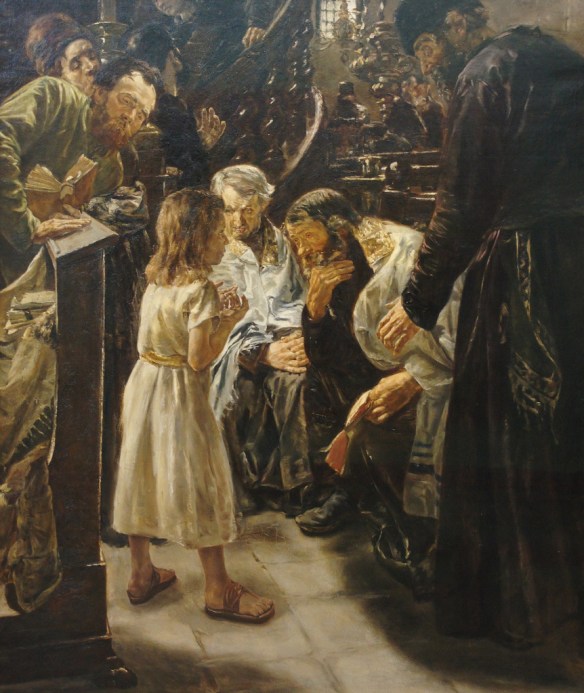
The-Twelve-Old Jesus in the Temple
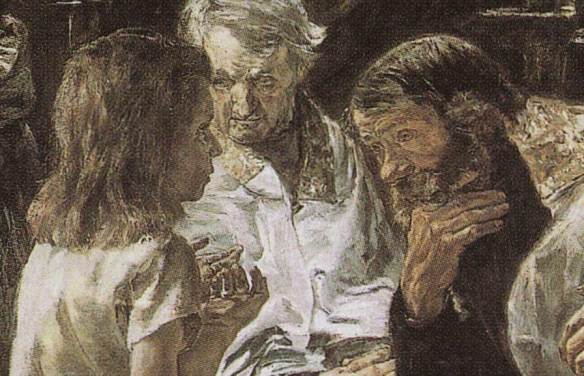
Detail of The Twelve Year Old Boy Jesus
Our final artist that I wish to cover in this Part 1, is Marc Chagall (1887-1985) as discussed in the introduction of this programme created the best known and most numerous depiction of Jesus of any other modern Jewish artist, particularly focussing upon the crucifixion of Jesus. This, he converted into an explicitly Jewish symbol; and subsequently a great many other Jewish artist were inspired to use this image of the crucifixion of Jesus, expressing the Jewish suffering during the Holocaust.
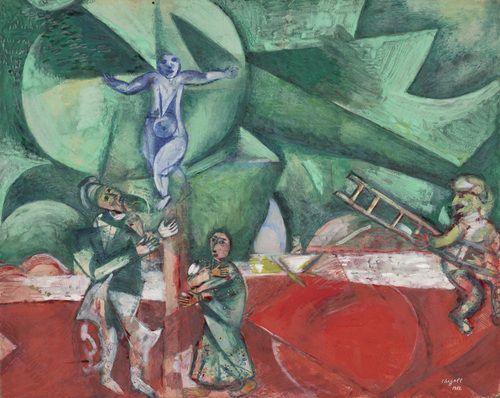
Calvary – The Crucifixion of Jesus as a Young Child


Chagall combined personal autobiographical, collective Jewish, and universal themes in his representation of Jesus, with over a 100 times using this symbolism of Jesus in his work.
To mention a few of his better known works, Calvary 1912 – he painted this shortly after his arrival in Paris and is the first of his crucifixion paintings in which Jesus is portrayed as a child, with Mary and John lamenting his death, with mary and John represented in the style of a Russian icon, the depiction is are based on his own parents, stressing the human side of the crucifixion, rather than the redemptive theme with its Christian implications.
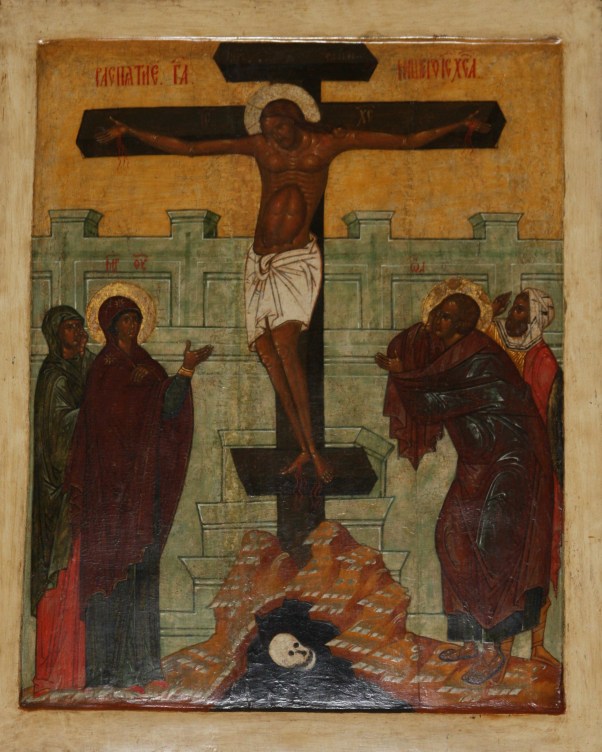
The motivation an desire to bring the painting down to the more human aspect of the crucifixion was prompted by a blood libel case brought against Menahem Mendel Beilis of Kiev in 1911. He was accused of ritually murdering a Christian child, a two year drama unfolded culminating in a court case and the acquittal of Beilis. None-the-less anti-Semitic ferment was stirred on the one hand and international protest on the other.
White Crucifixion (1938) which he painted just prior to the outbreak of WWII – this painting by Chagall symbolises Jewish suffering. The are images of Jews being attacked, a synagogue burning and Jews fleeing as inspired by the Munich and Nuremberg Nazi inspired persecution of Jews and their expelling of thousands of Polish Jews living in Germany in October, 1938 and finally the Kristsllnacht (Night of the Broken Glass) pogrom and foreshadowing what would happen through occupied Europe during the war.
These are but a few examples of the catalogue of paintings on the theme of Crucifixion that Chagall painted in which he identifies himself with Jesus’ suffering:
“I awake in pain / Of a new day with hopes / Not yet painted / Not yet daubed with paint / I run up stairs to my dry brushes / And I am crucified with Christ / With nails pounded in the easel” – A poem by Chagall and illustrated with his profound painting The Painter Crucified (1941-42).
This theme of the Jewish Jesus, living, ministering, rejected and crucified all reflect a common Jewish desire to claim Jesus as their own. The use of his image to challenge their viewers to realise that Jews, while the majority on the whole do not recognise his divinity and therefore embrace him as Messiah and Lord, never-the-less do see him as their brother and friend.
While the powerful symbolism of his crucifixion has become a image of Jewish personal and collective suffering and rejection, yet as we consider in Part 2: Jesus in Israeli Art, a shift in perception with a movement beyond the cross to other aspects of the life and person of the historic Jesus and his relevance for contemporary Israeli life today, not only effecting Jews, but Arabs too
In the late part of the 19th century and early 20th century, due to the continued political turmoil in Eastern Europe and resultant waves of anti-Semitic persecution with pogroms breaking out sporadically, an increasing number of Jews migrated to Western Europe, the United States and with some establishing a growing Jewish presence in Ottoman Occupied Palestine. These new arrivals included some Jewish artist that gave expression to their desire to live in their ancient Biblical homeland with visual images that continued to draw inspiration from the historical Jesus. Some of the work of these artists I will explore in the next programme of Behold the Man: Jesus in Jewish and Israeli Art .

During April 2017, while I was visiting Ruth Nessim of Nahariyah, Israel, together with her house guest, Betty (Betina) from Germany, a pastor friend Ralf also visiting from Germany called around and Ruth tells her story of how she came to faith. She relates of how she met Albert “her Jewish husband” and the amazing ministry that they shared in Israel together since the 1970’s.
Following Albert’s death nearly a decade ago, Ruth continues to share her faith, with Jews and Arabs in her beloved Israel. She actively promotes fellowship among the diverse communities in the land and this demonstrates how the dividing wall of hostility can be broken down through the sharing of the Good News. This is surely the basis of how a lasting peace may be achieved in not only Israel, but throughout the world?

Ruth’s example of how as a Jewish believer she heard the call of God, to following him, but also listen to how her life made a difference. She tells of the consequence of yielding to that call, and how many others experience God’s life-giving, life-changing power in their lives through her testimony.




Dear Listener
In this month’s programme I interview Fareed who comes from an Arab Christian background. It is always my intention that each person that appears on the programme is able to freely express their point of view.
At times you may feel challenged by what you hear as their viewpoint differs from your own, but do listen and engage with what is being said – open a dialogue with them in your head and ask yourself “why I am I feeling challenged by what they are saying?”

Please note that I have one aim only, that together we may discover the way forward with the objective of finding a lasting peace to be discovered for all who live in Israel.
The issue of how long will it take for peace to happen is not anything that anyone can definitely predict – the thought that Rob expresses that “peace will take generations to establish” has been expressed in a previous interview with Shai in The Chosen And The Choice – https://hotrodronisblog.com/2017/06/06/the-chosen-and-the-choice/ – Though it may take time for this to happen, that does not mean that one should not strive for it.


“The signing of the Oslo Accord in September 1993 was accompanied by exultant hopes. Seven years later, the failure to hammer out a final peace agreement resulted in the outbreak the bloody al-Aqsa Intifada, leading to the deepest despair… Palestinians and Israelis once again at a fateful juncture. The choice before them are a fight to the end for control of historic Palestine or a return to negotiations that will divide the land into two mutually accepted states.” (The Palestinian People, A History, B. Kimmering & J. S. Migdal, Preface xi, Harvard, 2003).
Many give lip service to the Two-State solution, yet that appears as the best prospect. However, the alternatives offer the engendering of more hatred, violence, death and destruction for both Arabs and Jews –
A Palestine with no Jews or an Israel with no Palestinians does not seem an option.
It will certainly not result in peace at all. But unless a true lasting peace is possible, based on mutual respect, trust, love and harmony, the conflict will be on going. Some may feel that this prospect of peace is wishful thinking, but wish and hope we must!
The choice between despair and hope face all who care about Israelis and Palestinians. Let us join our hearts in our efforts to discover the way that makes for peace for the diverse people of the Holy Land that they together will find solutions to their problems –
Fareed talks about his Easter experience in the land of the Bible as celebrated by Arab Christians (the interview followed Pesach/Passover & Easter, April 2017) and expresses his hope in a resurrected Jesus/Yeshua whom he sees as the Prince of Peace and a basis of hope for the hopeless – SHALOM!


Middle-Eastern Easter Celebration





Jewish believers face many hurdles to jump over in Israel. This is not only when considering to become a believer in Yeshua that one confronts many challenges, but also some have faced opposition to their profession of faith in Yeshua as Messiah and Lord, occasionally confronted with sever hostility, rejection and physical violence (this does not often happen).
Avraham a congregation leader near Jerusalem speaks to Roni about some of these issues facing those who choose to follow Yeshua.
In the second part of the programme Avraham shared an inspiring talk on how you may make the great discovery personally of what it means to accepting of Yeshua and how our age old rejection of him is overcome.

Avraham uses the symbolism (type) of Joseph, Jacob’s son, who was rejected by his brothers and sold into slavery to illustrate how Yeshua is also rejected by his own. It is through divine revelation that reconciliation takes place and we discover that he has the key to our understanding and gives us the ability to be embraced by him as we discover Yeshua as our brother.


This WordPress.com site is about Good News
