Originally posted on Shalom Radio UK: Shalom Radio UK http://www.hotrodronisblog.com “A Celebration of Unity and Diversity is the space between Judaism and Christianity” – Roots & Shoots – The Martyrs of Kischinew by E M Lilien Jews fleeing from persecution…
At the Israel Museum, Jerusalem, December 2016 – April 2017 an exhibition was staged called: Behold the Man: Jesus in Israeli Art.
To quote from the foreword of the companion book – “For two millennia, the figure of Jesus has been such a fundamental part of Western culture – in the visual arts, in literature, and in music – that it is almost impossible to relate to cultural history without citing the story of his life and death. The progenitor of what become the world’s largest religion was a Jew who lived during the Second Temple period and was put to death by the Roman rulers of Judea. Jesus came to Jerusalem to preach the Kingdom of Heaven, and it was in Jerusalem that he was crucified, so that over the years the Via Dolorosa, the Church of the Holy Sepulchre, and other sites in the Holy City have become a world focus of Christian pilgrimage.”
You may recall the programme that I produced called The Different Faces of Jesus that I posted on Shalom Radio UK in November 8 2016.
In the programme I dealt with the exhibition of Chagall: Love, War, and Exile that the Curator Susan Tumarkin Goodman did , Senior Curator Emerita, and together with Bella Meyer, granddaughter of Marc Chagall produced, explored with NYC-ARTS! See it here: http://www.nyc-arts.org/showclips/show/id/87423
About 20 of the paintings done by Chagall in the show depict Jesus
This new show Behold The Man: Jesus in Israel Art by Amitai Mendelsohn has a far broader scope and is equally challenging to its viewers, all the more as it was on display for 4 months at the Israel Museum, Jerusalem.
“Behold the Man: Jesus in Israeli Art approaches the figure of Jesus and related Christian themes from a different perspective, entering the complex realm of the relationship between Judaism and Christianity to examine for the first time the significance of Jesus through European Jewish and Israeli art.”
Part 1.
In this first section by way of introduction I will deal with the changing attitude of post-Enlightenment/ Haskalah European Jews and how their willingness to embrace the portrayal of Jesus in Painting and sculpture:
The work of some 40 artists dating from the late 19th century to the present time are considered. The is powerful symbolic imagery played by such subjects as the crucifixion and resurrection, sometimes reflecting the personal perspective of the artist and other times that of a collective national identity.
The inspiration behind this exhibition in Jesusalem is based upon the doctoral research of Amitai Mendelsohn, Senior Curator of the Museum’s David Orgler Department of Israeli Art.
Christians come to the depiction of Jesus in European art through the lens of their shared faith and history, and Israeli Jews bring a different perspective to their view of Jesus. Rather than him being viewed as their Saviour and Lord, alas he has all too often been viewed as the one who has caused their suffering and death. A collective punishment visited upon them by Christians who blamed them for rejecting him and causing his death by crucifixion.
All the more surprising and refreshing is this exhibition of an Israeli Jewish view of Jesus, despite all that Jews have suffered at the hands of Christians, they are able to look at Jesus through Jewish eyes. The viewer will be delighted and given a window into the outlook of Jews who dare to look at Jesus for themselves.
“In the 19th century a change in attitude affected a small but significant number of European Jewry towards Jesus, this included thinkers, writers, and eventually artists began to draw attention of the historical Jesus and sought to reclaim him. This approach aimed at reconciliation and at enhancing the position of Judaism in the Christian world – but at the same time it underscored the injustice of anti-Semitism ” (p 15).
———————————
Christians must beware of falling into the trap of thinking that they can separate anti-Zionism from anti-Semitism. Many Jewish and Christian leaders alike realise that the modern phenomena of anti-Zionism is just anti-Semitism repackaged. While Israel is not without fault in the ongoing Arab-Israeli conflict and while it is perfectly valid to criticise Israel for its violation of the human rights of Palestinians, it is quite another thing to seek to delegitimise Israel’s right to exist.
———————————–
Jesus came to serve as a symbol for suffering of the Jewish people, which reached its darkest hour during the Holocaust.
Jewish artists been influenced by iconography of the surrounding cultures and this can be seen in the work of certain painters and sculptors of the 19th century. As the Jewish source of visual images is rather sparse due to the 2nd Commandment that forbids the making of graven images, Jewish artist naturally turned to Christian sources for inspiration and reference concerning the depiction of the person of Jesus. Though there is still a strong taboo for many Jews concerning the figure of Jesus, though his presence is there at a deep veiled level.
The figure of Jesus in Hebrew literature has flourished in recent years. Also in the visual arts, Ziva Amishai-Maisels has pursued the most important research into his presence in modern Jewish art.
A major fault line that influences and divides the Jewish and Christian visual rendering of the subject of Jesus is the fact that none of the Jewish interpretations believe in his divinity. Jesus who Christians worship as the God made flesh, the figure of supreme importance in Christian art, displays a fundamental tension between his divinity and humanity. At the Council of Chalcedon in 451 Jesus was pronounced as “truly divine and truly human”– his human identity as the suffering Man of Sorrows exists alongside his identity as God almighty. It is this duality that informs the history of Christian visual art (p 17).
This belief in the two-fold identity from the 3rd century to the present continues to define Christian portrayals of Jesus. “While Israeli Jewish artists focus on the human figure of Jesus. For Israeli artists, identification withJesus’ humanity overcame their lack of belief in his divinity. The figure of Jesus – Other but also brother – touched them as a way to express a host of thoughts, experiences, emotions, and aspirations” (p 17).
The Jewish Jesus
Artistic portrayals of Jesus date back to the 3rd century of the common era (CE), and these became prevalent particularly after the Roman Empire adapted Christianity as its religion in the 4th century.
For Judaism the use of art was primarily for decorative purposes to intended to beautify texts and ritual paraphilia such as mezuzahs, the covers of torah scrolls, candelabras, etc., while for Christians artists images and portrayals of Jesus and the Saints, became and integral part of their religion. The incarnation of God in the person of Christ (Messiah), became incarnated in sculpture, painting, murals, mosaics and more recently in photographs as well. These portrayals exemplify what Paul calls “the image of the invisible God” (Colossians 1.15). And as a testimony of incarnation, art plays an important part depicting the word becoming flesh.
John of Damascus the great iconographer of the 8th century wrote:
“Because the one who by excellency of nature transcends all quantity and size and magnitude, who has his being in the form of God, has now, by taking upon himself the form of a slave, contracted himself into a quantity and size and has acquired a physical identity, do not hesitate any longer to draw pictures and to set forth, for all to see, him who has chosen to let himself be seen” (p 37).
Though there was great controversy and opposition to the portrayal of the image of Jesus by the iconoclastic controversy of the 8th-9th century, the icon ultimately prevailed. Once more the Protestant Reformation challenged the excessive devotion that the Catholic Church gave to the portrayal of the figure of Jesus and the Saints, including a vast array of depictions of the Virgin Mary and Modonna and Child.
The image of Christ on the Cross became the centre piece of the Western worlds Christian artistic expression together with many other aspects of the life and ministry of Jesus. This figure of Christ did not disappear from Modernist art, with Impressionist art being influenced by daily secular thinking, with many of its practitioners dealing with Christian themes and particularly the the figure of Christ.
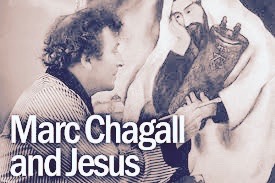
As I previously said in The Different Faces of Jesus programme, Marc Chagall drew his portrayal of Jesus in his numerous painting of the crucified Christ, from his awareness of Russian icons that he had seen in during his formative years as well as other paintings of Jesus done by Gentile artist. While Chagall’s use of the figure of the crucifixion of Christ, became an image of Jewish persecution and suffering, it was Paul Gauguin saw Vincent van Gogh’s use of the Crucified Christ, as a paradigm of martyrdom, a man truly created in Jesus’ image (p 39). Gauguin himself was one of the first artists to apply religious themes to the depiction of his own personal situation. He cultivated the image of a suffering artist.
Numerous other European artist followed this trend of using Christ’s suffering as way of giving expression to their own rejection and suffering and that of others. “World War I provoked many European artists to portray Jesus as a victim of war, symbolising their vehement opposition to the slaughter and anguish it caused” (p 41).
In England the Jewish sculptor, Jacob Epstein frequently invoked Jesus as a symbol and protest against the war. Jesus has not lost his importance of bring to people’s awareness of the society’s failure and this saw evident from the contemporary sculptor Mark Wallinger whose figure of Jesus called Ecce Homo (Behold the Man) that was originally displayed on the 4th plinth on Trafalgar Square, London in 1999, demonstrating this point.
But how relevant is the image of Jesus to European Jewish and Israeli artist?
Jewish artist continue to display considerable interest in the figure of Jesus inspiring their work in a number of ways. “The European Jewish artist’ engagement with Jesus had a number of motivations:
The struggle for cultural integration; the need to combat entrenched religious ant-Semitism; the desire to present the Christian Saviour as an exceptional human being of Jewish origin, who did not set out to create a new religion; the introduction of a particularly pointed symbol of Jewish suffering; and the wish to show that the universal values had their roots in Judaism” (p 45).
The Haskalah (Enlightenment) movement specific goal of its depiction of Jesus was one of the elements to help Judaism of the European Enlightenment was to help modern Judaism to full integrate into a new European environment, modern, objective and enlightened (p 45). An example of a Russian Jewish sculptor, Mark (Mordechai) Antokolsky of Vilna born in 1843. His figures ranged from Jesus, John the Baptist to Socrates and Mephistopheles. He also depicted figures of Jewish artisans and other historical figures including the controversial Jewish philosopher Spinoza.
He became the first Jew to become a full member of the Imperial Academy of Arts and on two occasions he won the prestigious first prize at the Exposition Universalle in Paris in 1878 and 1900. His work Ivan the Terrible commissioned by Czar Alexander II for the Heritage collection in St Petersburg. He was not immune to anti-Semitic attack and suffered tension between his identity as a Jew and his desire to make his way as a Russian artist – especially in the field of sculpture, which until then was closed to Jews. The nationalist and anti-Semitic press called him an “insolent Yid,” unworthy to portray the heroes of Russian history and their Christian spirit, but his overwhelming success – in a period characterized by waves of anti-Semitism – overcame these attacks.
One of his most important pieces form our point of view is the sculpture Christ before the People’s Court made in 1873 (later copies were made by the artist). Jesus is portrayed as completely Jewish with skullcap and sidelocks, wearing a robe that suggests a prayer shawl. It was his desire to redress the injury done to the Jews by the church by portraying this Jewish Jesus. He believed in an ethical Jesus whose role model should inspire all (p 46).
Jesus “lived and died as a Jew for the truth and brotherhood, this is why I like to portray Jesus and a pure Jewish type and to represent him with a covered head (p 47). In a letter to a friend, he wrote, In the title… I mean also to refer to the present, I truly believe that if Christ would rise again and see how his ideas have been twisted and exploited by the Fathers of the Inquisition and others, he would rebel against them as he rebelled against the Pharisees and would agree to be crucified ten more times for his beliefs.”
He wrote to Stasov in 1873, while working on the sculpture, “Although Jews renounce and still renounce [Jesus], I solemnly believe that he was and died a Jew for truth and brotherhood. This is why I want to make of him a purely Jewish type… I imagine how Jews and Christians will rise against me. Jews will probably say, ‘How is it that you made Christ?’ and Christians will say, ‘What kind of Christ did he make?’ but I do not care for this” After he completed the sculpture , he wrote “I have finished ‘Christ’ yesterday… I myself am not able to evaluate my work because I expressed everything in my soul in this statue, and now I am tired and grow dull” (p 47).
Many praised the sculpture and acclaimed it as a masterpiece, while others criticized the sculpture when it was put on display in Paris in 1878. Vladimir Stastov’s anti-Semitic comments, “To these people, to imagine Christ as a Roman or an academic model was fine, but as a Jew – never!” (p 50).
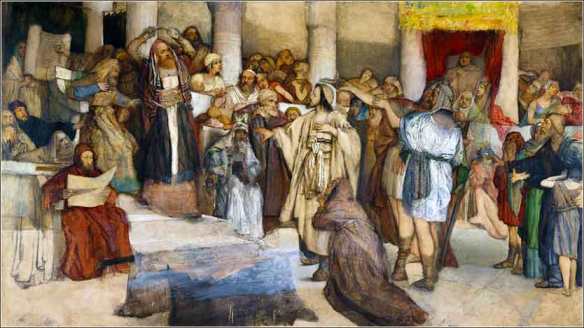
A young Polish Jewish Artist, Mauryey Gottlieb (1856-1879) in his short life who died at the age of 23, made an outstanding contribution as a painter, he managed to create a remarkable body of work that united Polish Christian culture, the artist’s Jewish identity, and a universal message of reconciliation between the two religions. Jesus was the central character in two monumental and highly complex paintings that Gottlieb was still working on when he died: Christ before his Judges and Christ teaching in Capernaum. Both incorporate self-portraits, a further indication of how important these two ambitious works were to Gottlieb. They convey his personal, artistic, and political manifesto concerning Jesus the Jew and Jewish-Christian relations. Like his contemporaries, these paintings reflect the prevailing scholarly focus on the historical Jesus, which achieved artistic expression by such means as realistic depictions that were faithful to the period and the locale, an emphasis on Jesus’ humanity (p 50).
Gottlieb challenged the traditional Catholic iconography, and concentrated on the genre of history painting, depicting selected religious and literary themes in an academic orientalist style that he learned chiefly from his teacher Jan Matejko, the most important Polish artist of the time.
“A Celebration of Unity and Diversity is the space between Judaism and Christianity”
– Roots & Shoots –
The Martyrs of Kischinew by E M Lilien
Jews fleeing from persecution in Eastern Europe sought places that were less hostile and more secure, with a number turning towards their ancient Biblical homeland as an option to settle. This led to the establishment of growing numbers of Jews moving to Ottoman occupied Palestine
(In the 3 part series of programmes on Joseph Rabinowitz we considered some of the issues surrounding the pogroms that were instigated against the Jews of the realm).
This is from the Archive:
Part 1
Part 2
Part 3
______________________________________________
This is the current programme – click below to listen:
Part 2
Behold the Man: Between Judaism, Zionism, and Christianity
These new European Jewish arrivals in Ottoman Palestine during the latter part of the 19th and early 20th centuries, were motivated by the Zionist ideal of the ingathering of the Jews from the diaspora to their ancient Jewish homeland and this idealism finds expression in artists among the new arrivals and is depicted in sculptures, pictures and paintings by them.
Zionism – what it is not and what it is!
It is my desire to seek to clear up some misconceptions regarding what Zionism is and what Zionists believe.
The mere mention of the word “Zionist” or “Zionism” has taken on a negative meaning in the minds of many and this is due to a number of factors – the anti-Israel campaigners and lobbyists who pursue their propaganda war against modern Israel and the BDS (cultural, academic & economic boycotts) which questions Israel’s very right to exist as a sovereign nation state, and continues to be a challenge that needs to be countered.
Therefore, in the present anti-Semitic/anti-Zionist/anti-Israel/anti-Jewish climate, open and frank conversations are needed in an increasingly dangerous world in which we live, with its growing hostility to those who hold differing views to our own and this is particularly the case for Jews in general and Israel in particular.
Say, “NO!” to hate speech and hate crimes
Contrary to the UN Resolution 3379 – ZIONISM IS NOT RACISM –
United NationsGeneral Assembly Resolution 3379, adopted on November 10, 1975 by a vote of 72 to 35 (with 32 abstentions), “determine[d] that Zionism is a form of racism and racial discrimination”. The vote took place approximately one year after UNGA 3237 granted the PLO “observer status”, following PLO president Yasser Arafat‘s “olive branch” speech to the General Assembly in November 1974. The resolution was passed with the support of the Soviet bloc and other then Soviet-aligned nations, in addition to the Arab and Muslim majority countries.
The determination that “Zionism is a form of racism and racial discrimination”, contained in the resolution, was revoked in 1991 with UN General Assembly Resolution
While Arab nationalism is not considered racist, Jewish nationalism (Zionism) is called racist. Many Arab and Moslem nations discriminate and severely restrict religious freedom targeting Jews, Kurds, and Armenians, Christians, Druze, Baha’i, Ahmadiyyas, Yazidi, Zoroastrian and this includes either Shia or Sunni minorities depending on the particular country, yet the one democratic country, Israel, that allows religious freedom, is singled out as racist.
The prime reason for this accusation is the fact that the PLO, Hamas and Hezbollah have not succeeded in destroying Israel and replacing it with a Palestinian state that will be Judenrein (Jew-free) from which Jews are excluded – (originally with reference to organizations in Nazi Germany). For just as “the Nazis sought to make Germany ‘judenrein’” (Jew-free), so Israel’s enemies seek to do likewise.
While the PLO have in principal agreed to a two-state solution to solving the Arab-Israeli conflict, neither Hamas or Hezbollah with its Iranian backers, have agreed to any kind of peace accord or territorial accommodation, but continue to call for Israel’s destruction.
Zionism is nothing more than Jewish nationalism and stands for her right to exist as a sovereign national state like all other states.
Zionist Artists
Ephriam Moses Lilien, the first Zionist artist, helped Boris Schatz, to establish the Jerusalem Bezalel School of Art. SubsequentlyZe’ev Raban (1890-1970) helped Boris Schatz to create the Bezalel style. However, it was Lilien who was responsible for creating the Zionist visual representation in those early years.
Ze’ev Raban (1890-1970) –
He was a leading painter, decorative artist and industrial designer and made a major contribution to the Bezalel style of Israeli art.
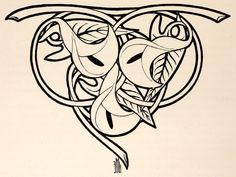
Lilien’s particular style of portrayal was in the Art Nouveau / Jugendstil school, with its combination of eroticism and fantasy with Zionist idealism. He created a unique fusion of the two, expressing the pathos of Jewish longing for Zion. His style of depiction achieved a harmonious partnership with Zionist imagery, Jewish and Christian symbols, Orientalism, Japanese art with influences of Egyptian and Assyrian together with a Renaissance influence. This eclectic East-West style was named Judenstil and this became Lilien’s hallmark (p 63).*
*[Amatai Mendelsohn, Behold the Man: Jesus in Israeli Art, Magnes Press, Jerusalem, 2017 –
ISBN 978 965 278 465 0]
Lilien was born into a traditional Eastern European Jewish family and his artistic expression flourished in Austrian and German cultural centres. His art shows subtle Christian influences and the interaction between Zionism and the Christian world at the turn of the century. In those formative years of Zionism there was a keen Christian interest that influenced Theodore Herzl. The Christians saw the Jewish peoples’ return to its ancestral home in the Holy Land as the herald of the Second Coming of Christ.
Theodore Herzl
Old Jewish man’s head entangled in thorns, looking up at the rising sun in the East
In 1902 Songs of the Ghetto by New York Yiddish poet, Morris Rosenfeld appeared in German translation with Lilien’s image the Jewish May showing an old man with his head entangled in thorns.
In 1905 Lilien together with Boris Schatz went on their first trip to Palestine, where they set up the Bezalel School of Arts and Crafts in Jerusalem. Lilien taught and worked as Schatz’s assistant in 1906 when the school opened. He spent 6 months at the school, but he and Schatz parted company after this period and Lilien subsequently no longer associated with the school. During this trip he also took many photographs in preparation for illustrations of a German Lutheran Bible commissioned by the Lutheran Church and its first volume was published in 1906. He made other trips to the Holy Land in 1910, 1914 and 1917 taking more photos to enable him to make further drawings and etchings to continue his work as an illustrator of religious subjects. He died in 1925 having made a considerable contribution to the early Zionist movement and saw his art as having a mission. (p 64-65).
The Influence of Christians on the fledgling Zionist Movement
A considerable time before the Jewish Zionist movement began to formulate its plans and desires to effect the return of the Jews to Palestine, a not insignificant number of Christians were showing an interest in the Holy Land. This was not just as a place of Christian pilgrimage,but these Christians in Britain, USA, Germany and other places, turned their attention to the subject of the return of the Jews to their ancient homeland. This also culminated with the first Zionist Congress in Basel, Switzerland in 1897,*
*( There was no secret Jewish cabal convened at Basel at which the Jews conspired for world domination and it was purported that they formulated a document that became known as The Protocols of the Elders of Zion– it is a horrid fabricated anti-Semitic lie that was concocted by the Russian secret police in 1903 and it perpetuates the myth that the Jews control the world and are behind every bad thing that happens – https://en.wikipedia.org/wiki/The_Protocols_of_the_Elders_of_Zion).
By the mid-nineteenth century, the Ottoman Empire was in severe decline, approaching its downfall. Britain in particular, showed a vital interest in the fate of the Empire, and Palestine together with the other Bible Lands was of great significance. With a growing Jewish awareness, a strategic alliance dawned.
Lord Palmerston, British Foreign Secretary, wrote to the British Ambassador in Constantinople, the Sultan’s seat:
“There exists at the present time among the Jews dispersed over Europe, a strong notion that the time is approaching when their nation is to return to Palestine…It would be of manifest importance to the Sultan to encourage the Jews to return and to settle in Palestine because the wealth which they would bring with them would increase the resources of the Sultan’s dominions; and the Jewish people if returning under the sanction and protection and at the invitation of the Sultan, would be a check upon any future evil designs of Mehemet Ali (of Egypt) or his successor…I have to instruct Your Excellency strongly to recommend (to the Turkish Government) to hold out every just encouragement to the Jews of Europe to return to Palestine” (p 43-44 – Faith & Fulfilment).*
On August 17, 1840, the London Times published an editorial entitled, “A plan to plant the Jewish people in the land of their fathers.” This plan was then under serious political consideration and people of significance like Lord Shaftsbury, a deeply committed Christian, joined forces with Lord Palmerston who was called “the sword” in a plan of active support for such a return by the Jews. The men studied the Scriptures earnestly giving special attention to those prophetic portions that pertained to the return of the Jews to their ancient Biblical homeland.
This strong Biblical conviction led them in the aiding of “God’s ancient people” and they felt that this would lead to the fulfilment of those Biblical prophecies that they had noted. Ashley (Lord Shafstsbury) never doubted that the Jews would return to their own land and he daily prayed, “Oh, pray for the peace of Jerusalem” and these words were engraved on a ring that he wore on his right hand (p 45).
We should add names like Oliphant and Blackstone to the list of those who actively promoted a Jewish return to Palestine. These two men responded to reports of pogroms against the Jews in Eastern Europe under Tsarist persecutions, and they added their advocacy on behalf of the Jews with pleas for their return. This concern continued unabated and Blackstone appealed to President Wilson of the USA sending him a memorandum in which he expressed his ideas on behalf of a Jewish return.
In 1885, William Hechler becameChaplain to the British Embassy in Vienna. He held his post until 1901 and witnessed the beginnings of the Zionist Movement. He personally befriended Theodore Herzl, who as a Jewish reporter at the Dreyfus affair. Herzl turned his attentions to solving the “Jewish Question.” He authored the book Das Judenstat (The Jewish State) published in 1896 in which he advocated the return of the Jews to Palestine.
Hechler was tireless in his efforts and penned these words,
“The Return of the Jews would become a great blessing to Europe, and put an end to the anti-Semitic spirit of hatred, which is most detrimental to the welfare of all our nations” (p 59).
Hechler went to great lengths to persuade the German Emperor to recognise the Zionist Movement. Finally his efforts produced fruit when in 1898 the Kaiser declared:
“I have been able to notice that the emigration to the land of Palestine of those Jews who are ready for it is being prepared extremely well and is even financially sound in every respect. Therefore I have replied to an enquiry by the Zionists as to whether I wish to receive a delegation from them in audience that I would be glad to receive a deputation on the occasion of our presence there (in Jerusalem). I am convinced that the settlement of the Holy Land by financially strong and diligent people of Israel will soon bring undreamt-of-prosperity and blessing to the land’’ (p 60).
(* Faith and Fulfilment,
Christians and the Return to the Promised Land,
Michael J Pragai, Mitchell, England, 1985 – ISBN 0-85303-210-6)
To return to E M Lilien and his importance – “From the start, Christian motifs were woven into many of Lilien’s illustrations. His implicit allusions to Jesus demonstrated his engagement with a figure whose existence and significance he was unable to ignore. His use of Christian iconography played a clear role in the Zionist message that would be central to his oeuvre” ( i.e.the body of work of a painter, composer, or author) (p 65, Behold the Man).
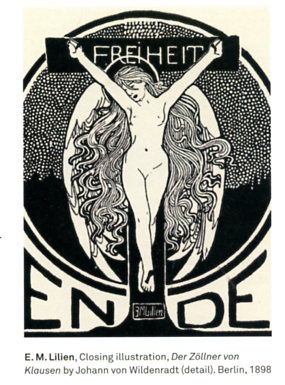
His work related to the image of Jesus as early as his days in Cracow and the final illustration in a book The Tax Collectors of Kluasen by Johann van Wildenradt, that deals with a peasant uprising of the 15th and 16th century and is about their struggle for freedom. The final illustration shows a nude woman crucified and the traditional inscription of INRI over the head of the crucified Christ, is replaced with the word FREIHEIT (freedom).
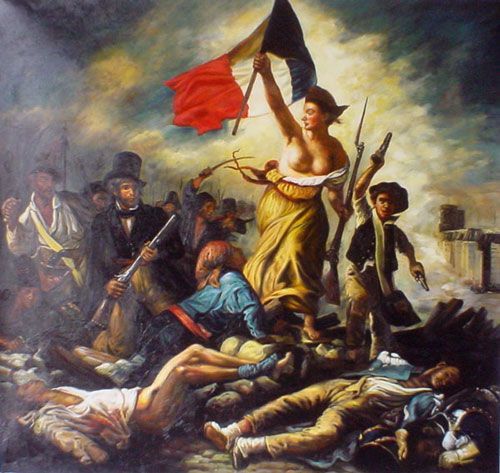
Considering that Lilien was only 18 years old when he did this illustration and several decades before Chagall’s Jewish Jesus on a cross, it is all the more amazing because Jewish artists did not depict the crucifixion. The fact that the figure was not of Jesus, but of a nude female, may reduce the theological problem from a Jewish perspective, but her liberated sexuality was no less a departure from usual Jewish art themes This illustration is clearly in the Art Nouveau / Jugendstil style that largely characterised his work. A nude women symbolised national freedom in numerous paintings and sculptures, the best example being that of Eugene Delacroix’s Liberty Leading the People.
Pesah (Passover), E M Lilien, illustration to Juda
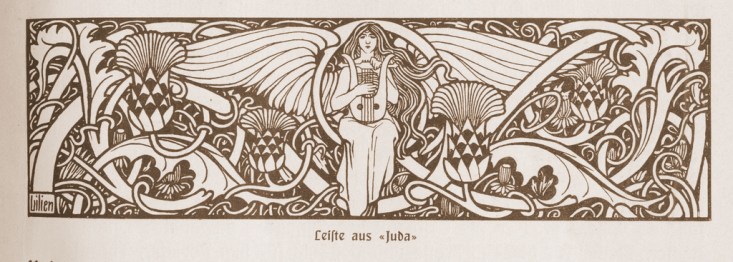
As Lilien’s work matured with his move to Germany, he came under the influence of Borries von Munchhausen. He was an advant-garde poet who showed Lilien his unpublished poems on Biblical themes. Lilien was so impressed that he decided to illustrate the poems and publish them. The joint project in 1901 was called Juda. This transformed Lilien into the dominant Zionist artist of his day. In Juda, ancient Jewish biblical history became relevant and vividly graphic.
Lilien gave dignity to Jewish themes instead of the Christian trope of Synagoga and Ecclesia which represents the Church’s triumph over Judaism. Now in Lilien’s work Judaism is depicted as a dignified and beautiful woman holding the Tablets of the Law or Torah Scroll, combining Christian iconography and Jewish symbols.
Sabbath Queen by E M Lilien
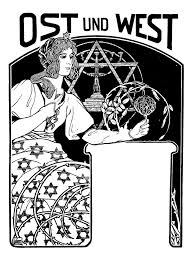
Another book of illustrations showing Christian motifs is Lilien’s well known cover of the Jewish cultural monthly Ost and West (East and West) from 1901 – 1906. It features the Daughter of Zion – a young woman with a star of David and a menorah, surrounded by a circle. Her skirt is also embellished with stars of David and her hand has a loop of thorns, resting on an altar and in her hand she is holding a flower called the Rose of Jericho. This plant belongs to the genus known as the “resurrection plants” because of their ability to come back to life after being shrivelled and dried up for months or even years.
For Christians the Rose of Jericho symbolises the resurrection of Jesus and also the Virgin Mary’s pregnancy with Jesus. This flower was a prized memento brought back by pilgrims from visits to the Holy Land.
Like the Rose of Jericho, “so will Israel bloom in youthful splendour…”Lilien was the first to represent this plant artistically with a powerful Zionist message of the hope of Jewish restoration to their ancient homeland (p 74-75).
Ost and West is accompanied by Christian motifs that represent the Passion and Resurrection. Lilien has combined Christian and Jewish symbolism that has at the heart of it is a Christian concept of resurrection.
Lilien’s 1901 postcard from the Fifth Zionist Congress is one of his best known illustrations, and remains a central image on Zionist history.
At the right, the distant figure of the Jewish farmer plowing the land signifies national rebirth; at the left, a Jewish man with bowed head is caught in a tangle of thorns, symbolising the Jew trapped in the tangle of exile. Once again his work is infused with Christian iconography as in his Pesah with crown of thorns as well as the Art Nouveau / Jugendstil influence clearly evident. This use of such symbolism was used to create a Zionist message of revival and resurrection (p 76).
Pesah (Passover) detail
(see full image above)
Another important image that may well have influenced E M Lilien’s Moses wasWilliam Holman Hunt’s The Light of the World. This image of Jesus is a distinctly Protestant portrayal of him. Firmly based on Scripture, “Behold I stand at the door and knock…” (Revelation 3.20) Holman shows a regal full length figure of Jesus and this bears a resemblance to Lilien’s Moses. As in Hunt’s painting, so Moses has a halo of light with the Eastern sun from Zion shining behind him.
William Holman Hunt’s The Light of the World
E M Lilien’s Moses
While Lilien was happy to use Christian iconography, his depictions of Jesus were primarily used to relate to the Jewish experience of suffering as was the case with other Jewish artists. His strong Zionist use of Christian themes such as resurrection and rebirth was to signify the hope of restoration and renewal of Jewish hope in their return to Zion.
Other Jewish Artists express Jewish hope and renewal
Boris Schatz with whom E M Lilien collaborated in his early work in Palestine, is considered the father of Israeli art. He was born in Vilna (1867), in the Pale of Settlement, in Lithuania. He founded the Bezalel School of Arts and Crafts, Jerusalem in 1906 with the aim of what he called “Hebrew” art. He was a sculptor and his style was essentially academic. Like Atokolsky, Schatz was strongly affected by the tension between Judaism and Christian culture and felt the need to mediate between them.
Schatz directed the energy of his work towards the Zionist cause and like Lilien, he made use of Christian iconography that included allusions to Jesus. This was to continue to play a role in his national art. He dedicated himself to creating a uniquely Jewish iconography that would promulgate a new Hebrew culture. (p 86).
No longer was this the Jew of the dispersion and exile, but a new liberated Jew was emerging out of the bondage of the ghetto throwing off the shackles of the centuries. The basis of this “religion” consisted of set characters and motifs – some of which he derived from Renaissance Christian iconography (https://en.wikipedia.org/wiki/Boris_Schatz).
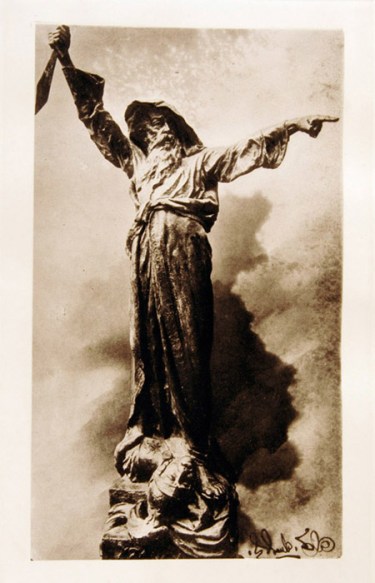
His masterpiece was Mattathias Maccabee (1894). The reason he chose to portray this figure of Jewish history had great significance because they rose up against the Seleucid Greeks in the second century BCE. He portrayed the man who shook off the yoke of pagan oppression. It reflects the spirit of the Zionist ideal in their auto-emancipation as a form of self- realisation and liberation, at the rebirth of a nation that was yet to be fully realised.
“Arise, Judah, come, let us go!”
Auto-Emancipation was the title of the book by Leon Pinsker.
As a Zionist thinker– he reflects,
“What a miserable role for a nation that descends from the Maccabees!”
This longing to be free from oppression and at the whims of the European nations, that at times carried out severe persecution of the Jews in their realm, they needed to strive for a return to Zion where they could enact Auto-Emancipation, a form of self-liberation. Pinsker together with Herzl and others Zionist thinkers gave birth to the modern Zionist movement.
A possible influence for the Maccabee sculpture was the maquette of a triumphant Christ by Mark Antokolsky (we considered his work in Part 1). Though this figure of Christ as a charismatic, spiritually powerful figure, is within the Christian tradition, it was not concerned with Jewish-Christian relations, whereas Christ before the People’s Courtwas clearly within the realm of inter-faith dialogue.
Christ before the People’s Court
Schatz’s statue of Mattithias Maccabee, portrayed a militant message, and is a befitting symbol of Jewish nationalism and rebellion (p 87). Schatz referring to his statue, said that he modled the figure after his grandfather’s likeness, who though physically weak, was spiritually strong.
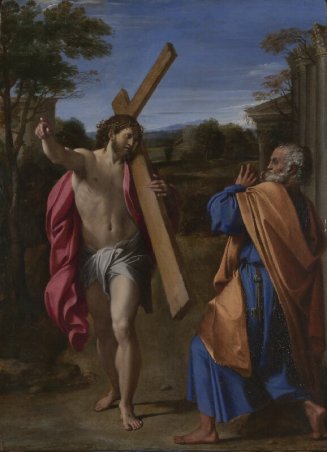
Annibale Carracci – Christ Appearing to St Peter on the Appian Way
In Carracci’sChrist Jesus is pointing to Jerusalem indicating that he is to die by crucifixion. In contrast Mattathias is holding a sword pointing towards the Land of Israel, the focal point of Zionist redemption.
In conclusion, a figure of a Jewish hero raising the banner against the Greeks – Mattathias Maccabee with sword in hand, has combined a number of different elements. We see a fusion of mythological and Christian elements, directly and clearly connected to Jesus. Schatz and other Zionist visionaries show the Jew’s victory over anti-Semitic persecutors and resurrection in a Jewish homeland. (p 88-89).
Shalom Radio UK is an independent internet based radio station sponsored
About 20 of the paintings done by Chagall in the show depict Jesus
At the Israel Museum, Jerusalem, December 2016 – April 2017 an exhibition was staged called: Behold the Man: Jesus in Israeli Art.*
*[Amatai Mendelsohn, Behold the Man: Jesus in Israeli Art, Magnes Press, Jerusalem, 2017 –
ISBN 978 965 278 465 0]
To quote from the foreword of the companion book –
“For two millennia, the figure of Jesus has been such a fundamental part of Western culture – in the visual arts, in literature, and in music – that it is almost impossible to relate to cultural history without citing the story of his life and death. The progenitor of what become the world’s largest religion [Christianity] was a Jew who lived during the Second Temple period and was put to death by the Roman rulers of Judea. Jesus came to Jerusalem to preach the Kingdom of Heaven, and it was in Jerusalem that he was crucified, so that over the years the Via Dolorosa, the Church of the Holy Sepulchre, and other sites in the Holy City have become a world focus of Christian pilgrimage.”
You may recall the programme that I produced called The Different Faces of Jesus and I posted on Shalom Radio UK in November 8 2016:
In the programme I dealt with the exhibition of Marc Chagall: Love, War, and Exile that the Curator Susan Tumarkin Goodman did , Senior Curator Emerita, together with Bella Meyer, granddaughter of Marc Chagall produced – explore this at NYC-ARTS! And see it here: http://www.nyc-arts.org/showclips/show/id/87423
This new show Behold The Man: Jesus in Israel Art by Amitai Mendelsohn has a far broader scope and is equally challenging to its viewers, all the more as it was on display recently for 4 months at the Israel Museum, Jerusalem.
“Behold the Man: Jesus in Israeli Art approaches the figure of Jesus and related Christian themes from a different perspective, entering the complex realm of the relationship between Judaism and Christianity to examine for the first time the significance of Jesus through European Jewish and Israeli art.”
Part 1.
In this first section by way of introduction I deal with the changing attitude of post-Enlightenment/ Haskalah European Jews and how their willingness to embrace the portrayal of Jesus in Painting and Sculpture occurred:
The work of some 40 artists dating from the late 19th century to the present time are considered. There is powerful symbolic imagery played by such subjects as the crucifixion and resurrection, sometimes reflecting the personal perspective of the artist and other times that of a collective national identity.
The inspiration behind this exhibition in Jesusalem is based upon the doctoral research of Amitai Mendelsohn, Senior Curator of the Museum’s David Orgler Department of Israeli Art.
Christians come to the depiction of Jesus in European art through the lens of their shared faith and history, and European and Israeli Jews bring a different perspective to their view of Jesus. Rather than him being viewed as their Saviour and Lord, alas he has all too often been viewed as the one who has caused their suffering and death. A collective punishment visited upon them by Christians who blamed them for rejecting him and causing his death by crucifixion.
All the more surprising and refreshing is this exhibition of European Jewish and Israeli views of Jesus. The image changes and develops as European Jewish and Israeli artists give expression to the multifaceted aspects of their encounters with Jesus, from one of Jewish suffering in the diaspora at the hands of Christians, to one of hope reborn due to their return to the land of Israel.
Despite all that Jews have gone through, they are able to look at Jesus through Jewish eyes. The viewer will be delighted and given a window into the outlook of Jews who dare to look at Jesus for themselves.
“In the 19th century a change in attitude affected a small but significant number of European Jewry towards Jesus, this included thinkers, writers, and eventually artists began to draw attention of the historical Jesus and sought to reclaim him. This approach aimed at reconciliation and at enhancing the position of Judaism in the Christian world – but at the same time it underscored the injustice of anti-Semitism “ (p 15).
Christians must beware of falling into the trap of thinking that they can separate anti-Zionism from anti-Semitism. Many Jewish and Christian leaders alike realise that the modern phenomena of anti-Zionism is just anti-Semitism repackaged. While Israel is not without fault in the ongoing Arab-Israeli conflict and while it is perfectly valid to criticise Israel for its violation of the human rights of Palestinians, it is quite another thing to seek to delegitimise Israel’s right to exist.
Jesus came to serve as a symbol for suffering of the Jewish people, which reached its darkest hour during the Holocaust.
Jewish artists have been influenced by iconography of the surrounding cultures and this can be seen in the work of certain painters and sculptors of the 19th century. As the Jewish source of visual images is rather sparse due to the 2nd Commandment that forbids the making of graven images, Jewish artist naturally turned to Christian sources for inspiration and reference concerning the depiction of the person of Jesus and other Biblical themes. Though there is still a strong taboo for many Jews concerning the figure of Jesus, his presence is there at a deep veiled level.
The figure of Jesus in Hebrew literature has flourished in recent years. Also in the visual arts, Ziva Amishai-Maisels has pursued the most important research into his presence in modern Jewish art.
A major fault line that influences and divides the Jewish and Christian visual rendering of the subject of Jesus is the fact that none of the normal Jewish interpretations believe in his divinity. Jesus who Christians worship as the God made flesh, the figure of supreme importance in Christian art, displays a fundamental tension between his divinity and humanity. At the Council of Chalcedon in 451 Jesus was pronounced as “truly divine and truly human”– his human identity as the suffering Man of Sorrows exists alongside his identity as God almighty. It is this duality that informs the history of Christian visual art (p 17).
This belief in the two-fold identity from the 3rd century to the present continues to define Christian portrayals of Jesus. “While Israeli Jewish artists focus on the human figure of Jesus. For Israeli artists, identification with Jesus’ humanity overcame their lack of belief in his divinity. The figure of Jesus – Other but also brother – touched them as a way to express a host of thoughts, experiences, emotions, and aspirations” (p 17).
The Jewish Jesus
Artistic portrayals of Jesus date back to the 3rd century of the common era (CE), and these became prevalent particularly after the Roman Empire adapted Christianity as its religion in the 4th century.
For Judaism the use of art was primarily for decorative purposes to beautify texts and ritual paraphilia such as mezuzahs, the covers of torah scrolls, candelabras, etc., while for Christian artists images and portrayals of Jesus and the Saints, became and integral part of their religion. The incarnation of God in the person of Christ (Messiah), became incarnated in sculpture, painting, murals, mosaics and more recently in photographs as well. These portrayals exemplify what Paul calls “the image of the invisible God” (Colossians 1.15). And as a testimony of incarnation, art plays an important part depicting the word becoming flesh.
John of Damascus the great iconographer of the 8th century wrote:
“Because the one who by excellency of nature transcends all quantity and size and magnitude, who has his being in the form of God, has now, by taking upon himself the form of a slave, contracted himself into a quantity and size and has acquired a physical identity, do not hesitate any longer to draw pictures and to set forth, for all to see, him who has chosen to let himself be seen” (p 37).
Though there was great controversy and opposition to the portrayal of the image of Jesus by the iconoclastic controversy of the 8th-9th century, the icon ultimately prevailed. Once more the Protestant Reformation (1517-1685) in the Western Christian realm challenged the excessive devotion that the Catholic Church gave to the portrayal of the figure of Jesus and the Saints, including a vast array of depictions of the Virgin Mary and Madonna and Child. The Eastern branch of the Christian faith as represented by the Russian and Greek Orthodox tradition was largely unaffected by the iconoclastic revolt in the West.
The image of Christ on the Cross became the centre piece of the Western worlds Christian artistic expression together with many other aspects of the life and ministry of Jesus. This figure of Christ did not disappear from Modernist art, though Impressionist art was influenced by daily secular thinking, many of its practitioners did deal with Christian themes and particularly the the figure of Christ.
As I previously said in The Different Faces of Jesus programme, Marc Chagall drew his portrayal of Jesus in his numerous painting of the crucified Christ, from his awareness of Russian icons that he had seen during his formative years in Russia, as well as other paintings of Jesus done by Gentile artist. While Chagall’s use of the figure of the crucifixion of Christ, became an image of Jewish persecution and suffering, it was Paul Gauguin who saw Vincent van Gogh’s use of the Crucified Christ, as a paradigm of martyrdom, a man truly created in Jesus’ image (p 39). Gauguin himself was one of the first artists to apply religious themes to the depiction of his own personal situation. He cultivated the image of a suffering artist.
Van Gogh – Peita
Gauguin – Yellow Cricifixion
Numerous other European artist followed this trend of using Christ’s suffering as way of giving expression to their own rejection and suffering and that of others. “World War I provoked many European artists to portray Jesus as a victim of war, symbolising their vehement opposition to the slaughter and anguish it caused” (p 41).
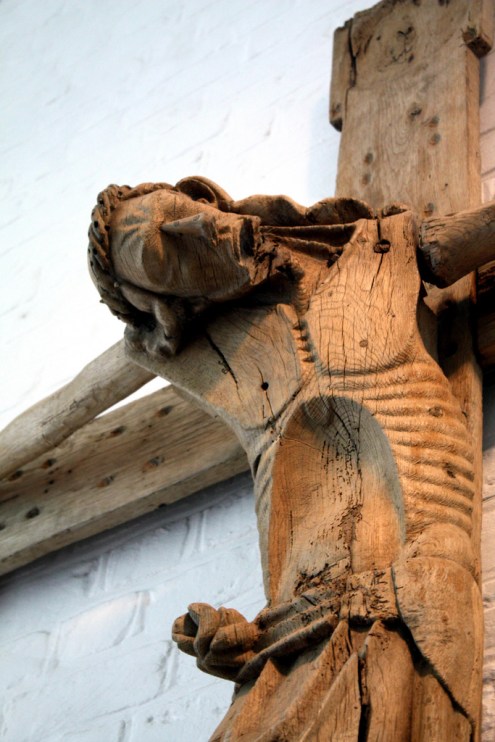
Epstein’s Christ in wood
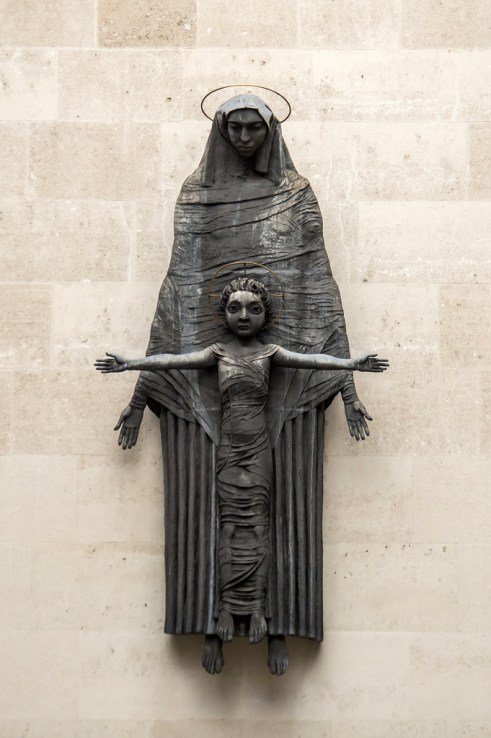
Epstein’s Madonna & Child
In England the Jewish sculptor, Jacob Epstein frequently invoked Jesus as a symbol and protest against the war. Jesus has not lost his importance of bringing to people’s awareness of society’s failure and this is evident from the contemporary sculptor Mark Wallinger, whose figure of Jesus called Ecce Homo (Behold the Man) that was originally displayed on the 4th plinth on Trafalgar Square, London in 1999, demonstrates this point.
Crown of Thorns – Gilded Barbed Wire
Ecce Homo
But how relevant is the image of Jesus to European Jewish and Israeli artists?
Jewish artists continue to display considerable interest in the figure of Jesus inspiring their work in a number of ways. “The European Jewish artist’ engagement with Jesus had a number of motivations:
The struggle for cultural integration; the need to combat entrenched religious ant-Semitism; the desire to present the Christian Saviour as an exceptional human being of Jewish origin, who did not set out to create a new religion; the introduction of a particularly pointed symbol of Jewish suffering; and the wish to show that the universal values had their roots in Judaism” (p 45).
The Haskalah (Enlightenment) movement specific goal of its depiction of Jesus was one of the elements to help Judaism of the European Enlightenment period to help modern Judaism to fully integrate into a new European environment, with its modern objectives and progressive outlook.
An example of a Lithuanian Jewish sculptor, Mark (Mordechai) Antokolsky of Vilna born in 1843. His figures ranged from Jesus, John the Baptist to Socrates and Mephistopheles. He also depicted figures of Jewish artisans and other historical figures including the controversial Jewish philosopher Spinoza (p 45).
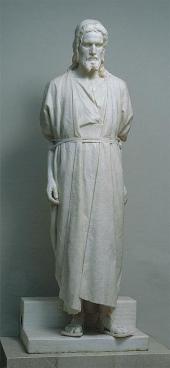
Christ before the People’s Court
He became the first Jew to become a full member of the Imperial Academy of Arts and on two occasions he won the prestigious first prize at the Exposition Universalle in Paris in 1878 and 1900. His work Ivan the Terrible commissioned by Czar Alexander II for the Heritage Collection in St Petersburg. He was not immune to anti-Semitic attack and suffered tension between his identity as a Jew and his desire to make his way as a Russian artist – especially in the field of sculpture, which until then was closed to Jews.
The nationalist and anti-Semitic press called him an “insolent Yid,” unworthy to portray the heroes of Russian history and their Christian spirit, but his overwhelming success – in a period characterized by waves of anti-Semitism – overcame these attacks.
One of his most important pieces form our point of view is the sculpture Christ before the People’s Courtmade in 1873 (later copies were made by the artist). Jesus is portrayed as completely Jewish with skullcap and sidelocks, wearing a robe that suggests a prayer shawl. It was his desire to redress the injury done to the Jews by the church by portraying this Jewish Jesus. He believed in an ethical Jesus whose role model should inspire all (p 46).
Jesus “lived and died as a Jew for the truth and brotherhood, this is why I like to portray Jesus and a pure Jewish type and to represent him with a covered head (p 47). In a letter to a friend, he wrote, In the title… I mean also to refer to the present, I truly believe that if Christ would rise again and see how his ideas have been twisted and exploited by the Fathers of the Inquisition and others, he would rebel against them as he rebelled against the Pharisees and would agree to be crucified ten more times for his beliefs.”
He wrote to Stasov in 1873, while working on the sculpture, “Although Jews renounce and still renounce [Jesus], I solemnly believe that he was and died a Jew for truth and brotherhood. This is why I want to make of him a purely Jewish type… I imagine how Jews and Christians will rise against me. Jews will probably say, ‘How is it that you made Christ?’ and Christians will say, ‘What kind of Christ did he make?’ but I do not care for this” After he completed the sculpture , he wrote “I have finished ‘Christ’ yesterday… I myself am not able to evaluate my work because I expressed everything in my soul in this statue, and now I am tired and grow dull” (p 47).
Many praised the sculpture and acclaimed it as a masterpiece, while others criticized the sculpture when it was put on display in Paris in 1878. Vladimir Stastov’s anti-Semitic comments, “To these people, to imagine Christ as a Roman or an academic model was fine, but as a Jew – never!” (p 50).
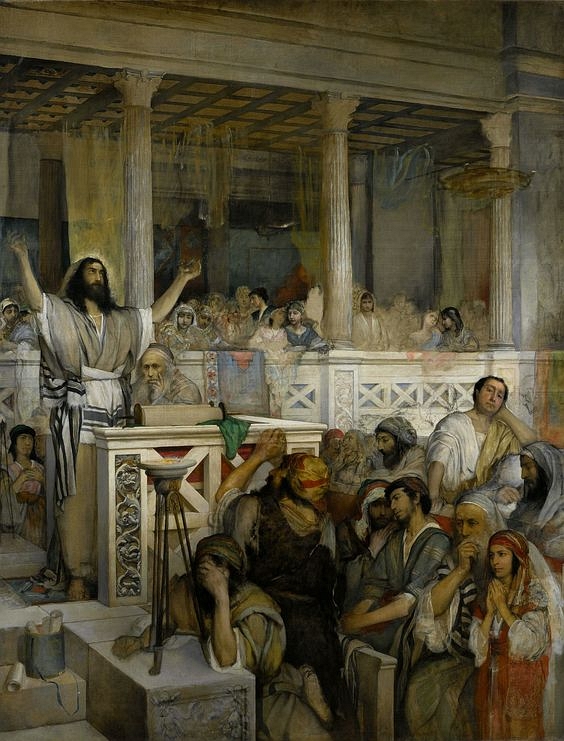
A young Polish Jewish Artist, Maurycy Gottlieb (1856-1879) in his short life (died at the age of 23), made an outstanding contribution as a painter, he managed to create a remarkable body of work that united Polish Christian culture, the artist’s Jewish identity, and a universal message of reconciliation between the two religions. Jesus was the central character in two monumental and highly complex paintings that Gottlieb was still working on when he died: Christ before his Judges and Christ teaching in Capernaum. Both incorporate self-portraits, a further indication of how important these two ambitious works were to Gottlieb. They convey his personal, artistic, and political manifesto concerning Jesus the Jew and Jewish-Christian relations. Like his contemporaries, these paintings reflect the prevailing scholarly focus on the historical Jesus, which achieved artistic expression by such means as realistic depictions that were faithful to the period and the locale, an emphasis on Jesus’ humanity (p 50).
Gottlieb challenged the traditional Catholic iconography, and concentrated on the genre of history painting, depicting selected religious and literary themes in an academic orientalist style that he learned chiefly from his teacher Jan Matejko, the most important Polish artist of the time.
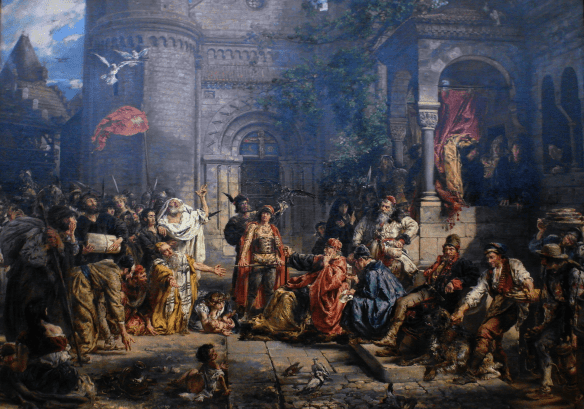
Jan Matejko – Reception of Jews in Poland
In a letter not long after painting the two works and just prior to his death Gottlieb wrote: “How deeply I wish to eradicate all prejudice against my people! How vividly I wish to uproot the hatred enveloping the oppressed and tormented nation and to bring peace between the Poles and the Jews, for the history of both people is a chronicle of grief and anguish!”(p 52). He left a legacy of a plea for tolerance and reconciliation.
Maurycy Gottlieb – Christ preaching at Capernaum
Christ before his Judges
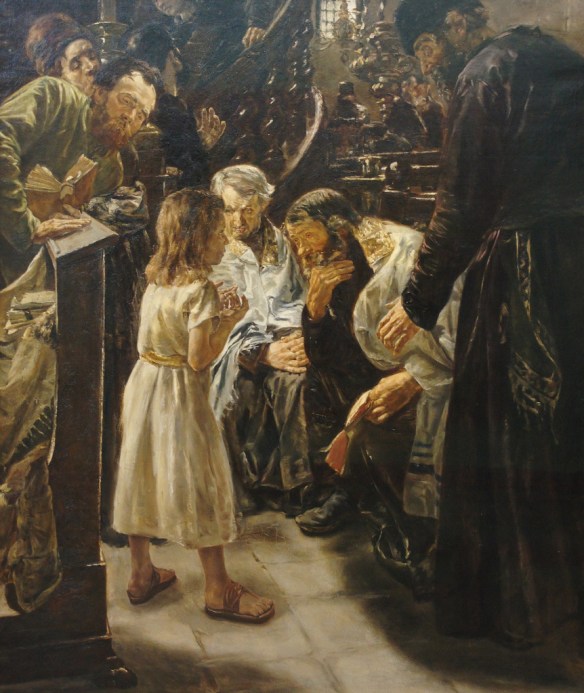
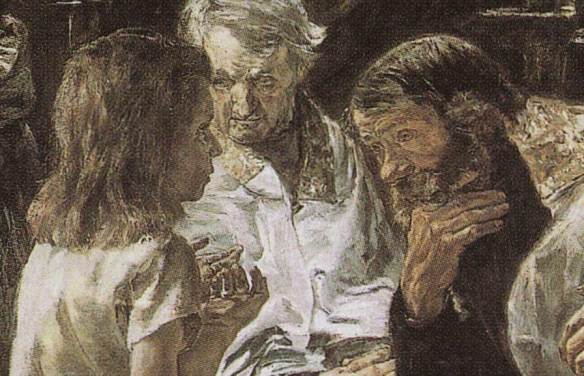
Max Liebermann (1847-19350) – is one of the most important German Impressionists and the most celebrated Jewish painters of the late 19th-early 20th century. He painted The-Twelve-Old Jesus in the Temple and it was displayed at the 1879 International Art Exhibition in Munich’s Crystal Palace (Glaspalast), and the scandal it provoked demonstrates the unresolved conflict between Judaism and Christianity – and the power of Jesus even when depicted as a child, to inspire a crisis in Jewish-Christian relations, even during a period of relative calm (p 53).
The controversy centred around the depiction of the boy Jesus with his uncombed hair, bare feet, disheveled clothes, with him debating self-confidently with the sages who surrounded him. The amount of anger that this rendering of Jesus garnered was unexpected and surprised Liebermann who was forced to repaint the figure of Jesus in the face of the storm of anti-Semitic outrage that pervaded German culture. In response he gave the boy more conventional features, dressing him in smarter clothes and with brushed hair.
The-Twelve-Old Jesus in the Temple
Detail of The Twelve Year Old Boy Jesus
Our final artist that I wish to cover in this Part 1, is Marc Chagall (1887-1985) as discussed in the introduction of this programme created the best known and most numerous depiction of Jesus of any other modern Jewish artist, particularly focussing upon the crucifixion of Jesus. This, he converted into an explicitly Jewish symbol; and subsequently a great many other Jewish artist were inspired to use this image of the crucifixion of Jesus, expressing the Jewish suffering during the Holocaust.
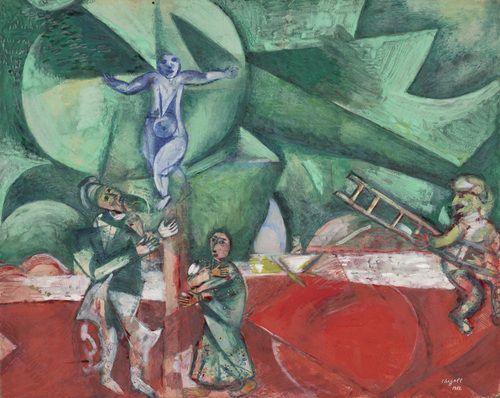
Calvary – The Crucifixion of Jesus as a Young Child
Chagall combined personal autobiographical, collective Jewish, and universal themes in his representation of Jesus, with over a 100 times using this symbolism of Jesus in his work.
To mention a few of his better known works, Calvary 1912 – he painted this shortly after his arrival in Paris and is the first of his crucifixion paintings in which Jesus is portrayed as a child, with Mary and John lamenting his death, with mary and John represented in the style of a Russian icon, the depiction is are based on his own parents, stressing the human side of the crucifixion, rather than the redemptive theme with its Christian implications.
The motivation an desire to bring the painting down to the more human aspect of the crucifixion was prompted by a blood libel case brought against Menahem Mendel Beilis of Kiev in 1911. He was accused of ritually murdering a Christian child, a two year drama unfolded culminating in a court case and the acquittal of Beilis. None-the-less anti-Semitic ferment was stirred on the one hand and international protest on the other.
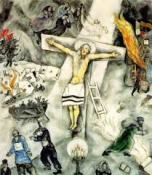
White Crucifixion (1938) which he painted just prior to the outbreak of WWII – this painting by Chagall symbolises Jewish suffering. The are images of Jews being attacked, a synagogue burning and Jews fleeing as inspired by the Munich and Nuremberg Nazi inspired persecution of Jews and their expelling of thousands of Polish Jews living in Germany in October, 1938 and finally the Kristsllnacht (Night of the Broken Glass) pogrom and foreshadowing what would happen through occupied Europe during the war.
These are but a few examples of the catalogue of paintings on the theme of Crucifixion that Chagall painted in which he identifies himself with Jesus’ suffering:
“I awake in pain / Of a new day with hopes / Not yet painted / Not yet daubed with paint / I run up stairs to my dry brushes / And I am crucified with Christ / With nails pounded in the easel” – A poem by Chagall and illustrated with his profound painting The Painter Crucified (1941-42).
This theme of the Jewish Jesus, living, ministering, rejected and crucified all reflect a common Jewish desire to claim Jesus as their own. The use of his image to challenge their viewers to realise that Jews, while the majority on the whole do not recognise his divinity and therefore embrace him as Messiah and Lord, never-the-less do see him as their brother and friend.
While the powerful symbolism of his crucifixion has become a image of Jewish personal and collective suffering and rejection, yet as we consider in Part 2:Jesus in Israeli Art, a shift in perception with a movement beyond the cross to other aspects of the life and person of the historic Jesus and his relevance for contemporary Israeli life today, not only effecting Jews, but Arabs too
In the late part of the 19th century and early 20th century, due to the continued political turmoil in Eastern Europe and resultant waves of anti-Semitic persecution with pogroms breaking out sporadically, an increasing number of Jews migrated to Western Europe, the United States and with some establishing a growing Jewish presence in Ottoman Occupied Palestine. These new arrivals included some Jewish artist that gave expression to their desire to live in their ancient Biblical homeland with visual images that continued to draw inspiration from the historical Jesus. Some of the work of these artists I will explore in the next programme of Behold the Man: Jesus in Jewish and Israeli Art .
During April 2017, while I was visiting Ruth Nessim of Nahariyah, Israel, together with her house guest, Betty (Betina) from Germany, a pastor friend Ralf also visiting from Germany called around and Ruth tells her story of how she came to faith. She relates of how she met Albert “her Jewish husband” and the amazing ministry that they shared in Israel together since the 1970’s.
Following Albert’s death nearly a decade ago, Ruth continues to share her faith, with Jews and Arabs in her beloved Israel. She actively promotes fellowship among the diverse communities in the land and this demonstrates how the dividing wall of hostility can be broken down through the sharing of the Good News. This is surely the basis of how a lasting peace may be achieved in not only Israel, but throughout the world?
Ruth’s example of how as a Jewish believer she heard the call of God, to following him, but also listen to how her life made a difference. She tells of the consequence of yielding to that call, and how many others experience God’s life-giving, life-changing power in their lives through her testimony.
Like Ruth and Albert you too can discover God’s LOVE for you personally whoever you are!
Shalom Radio UK is sponsored by MTMI
It is an independent internet based radio programme
If you would like further help in your desire to discover G-D’s love, please send me a message and I would love to be of assistance.
Roni speaks to Fareed an Arab Christian psycologist & pastor from Haifa, Israel. They talk about the prospects for achieving a lasting peace between Arabs & Jews in Israel today!
PEACE
Partners in Peace
Dear Listener
In this month’s programme I interview Fareed who comes from an Arab Christian background. It is always my intention that each person that appears on the programme is able to freely express their point of view.
At times you may feel challenged by what you hear as their viewpoint differs from your own, but do listen and engage with what is being said – open a dialogue with them in your head and ask yourself “why I am I feeling challenged by what they are saying?”
Please note that I have one aim only, that together we may discover the way forward with the objective of finding a lasting peace to be discovered for all who live in Israel.
Where would the world be if Israel had not been created? But it is – there’s no going back: peace will take generations to establish, just as a disunited United Kingdom took generations: (Rob Fallows from a post on my Facebook page).
The issue of how long will it take for peace to happen is not anything that anyone can definitely predict – the thought that Rob expresses that “peace will take generations to establish” has been expressed in a previous interview with Shai in The Chosen And The Choice – https://hotrodronisblog.com/2017/06/06/the-chosen-and-the-choice/ –Though it may take time for this to happen, that does not mean that one should not strive for it.
Peace is illusive, challenging, risky, costly, but not impossible –
“The signing of the Oslo Accord in September 1993 was accompanied by exultant hopes. Seven years later, the failure to hammer out a final peace agreement resulted in the outbreak the bloody al-Aqsa Intifada, leading to the deepest despair… Palestinians and Israelis once again at a fateful juncture. The choice before them are a fight to the end for control of historic Palestine or a return to negotiations that will divide the land into two mutually accepted states.” (The Palestinian People, A History, B. Kimmering & J. S. Migdal, Preface xi, Harvard, 2003).
Many give lip service to the Two-State solution, yet that appears as the best prospect. However, the alternatives offer the engendering of more hatred, violence, death and destruction for both Arabs and Jews –
A Palestine with no Jews or an Israel with no Palestinians does not seem an option.
It will certainly not result in peace at all. But unless a true lasting peace is possible, based on mutual respect, trust, love and harmony, the conflict will be on going. Some may feel that this prospect of peace is wishful thinking, but wish and hope we must!
The choice between despair and hope face all who care about Israelis and Palestinians. Let us join our hearts in our efforts to discover the way that makes for peace for the diverse people of the Holy Land that they together will find solutions to their problems –
Fareed talks about his Easter experience in the land of the Bible as celebrated by Arab Christians (the interview followed Pesach/Passover & Easter, April 2017) and expresses his hope in a resurrected Jesus/Yeshua whom he sees as the Prince of Peace and a basis of hope for the hopeless – SHALOM!
Easter procession
An empty tomb
Mid-East Easter Cakes
Middle-Eastern Easter Celebration
Shalom Radio UK is sponsored by MTMI
It is an independent internet based radio programme
Jewish believers face many hurdles to jump over in Israel. This is not only when considering to become a believer in Yeshua that one confronts many challenges, but also some have faced opposition to their profession of faith in Yeshua as Messiah and Lord, occasionally confronted with sever hostility, rejection and physical violence (this does not often happen).
Avraham a congregation leader near Jerusalem speaks to Roni about some of these issues facing those who choose to follow Yeshua.
In the second part of the programme Avraham shared an inspiring talk on how you may make the great discovery personally of what it means to accepting of Yeshua and how our age old rejection of him is overcome.
Joseph is a type of Yeshua
Avraham uses the symbolism (type) of Joseph, Jacob’s son, who was rejected by his brothers and sold into slavery to illustrate how Yeshua is also rejected by his own. It is through divine revelation that reconciliation takes place and we discover that he has the key to our understanding and gives us the ability to be embraced by him as we discover Yeshua as our brother.
An apology: Due to the poor recording quality in the second part of the interview, Roni tells of Avraham’s response and expressing his thoughts, hopes and dreams.
Shalom Radio UK is sponsored by MTMI
It is an independent internet based radio programme
Listen to the story of a Lebanese Christian, living in Nahariyah, Israel and how he found a new home in the Israel together with his family. He also experienced a renewal of faith and hope, together with love and acceptance from Israelis and particularly from Messianic Jews.
Shalom Radio UK
Once we were enemies and strangers, but now we are members of the same family where their is neither Jew nor Gentile, but we are ONE NEW PEOPLE, for the Messiah Yeshua has broken down the dividing wall of hostility when he died on the cursed tree, making peace!
(a loose paraphrase from Ephesians 2).
Shalom Radio UK is sponsored by MTMI
It is an independent internet based radio programme
During May 2017 I was in Israel and spent a week visiting the Hebrew University on Mount Scopus, doing research, attending a lecture hosted by the Department of Middle-Eastern Studies and visiting various Judaica bookshops looking for books of interest. I found this book called The Chosen And The Choice, by Jean Jacques Servan-Schreiber. I also met a young Israeli student who is studying at the Hebrew University in the Humanities and he agreed to be interviewed.
The content of this month’s programme considers some of the themes raised by Servan-Schreiber and I address questions to the student about his thoughts about the current Israeli-Palestinian impasse and on going conflict.
We all want instant results and live in a culture of wanting instant gratification and it is like having an instant coffee or a Pot-Noodle, pouring boiling water in and we think we have a meal. So with the very complex issues facing the Middle-East and Israel in particular, many international leaders expect instant results and hope for a quick fix to longstanding problems. We may feel very uncomfortable with the prospect that this current situation may take another 100 years to reslove.
A willing and a courageous leadership is needed and while there are people of great ability and talent on both sides of the divide between Israeli and Palestinian, these people are not centre stage at present, but are sitting on the sidelines, waiting and hoping that a true lasting peace may be found.
Optimism and pessimism are both emotions that are felt and expressed when considering the Israeli/Palestinian conflict, however, one does not want to give into despair and hopelessness, rather there is hope and this is given expression to in this programme.
When considering the Israeli and Palestinian conflict be slow to judge and exercise wisdom before you speak. Let us not fall into the trap of making quick judgments and particularly if we only know one side of the narrative. Both Jews and Palestinians each have their story to tell and having listened to both, still do not rush in where even angels fear to tread.
Be a peace maker and not a trouble maker – Shalom!
Shalom Radio UK is sponsored by MTMI
It is an independent internet based radio programme
On a recent visit to Haifa, Israel, Roni interviewed Najeeb, a Christian Arab from Haifa who established the Christian Arab Soldier’s Recruitment Centre that to date has signed up 80 young Arab Christian Men to serve in the Israeli Defence Force.
Roni was assisted by Ruth Nessim who translated the conversation between Roni and Najeeb. In a Middle-East that is in deep conflict and with many of Israel’s enemies accusing her of being an Apartheid State, it is refreshing to hear from an Israeli Arab, his perspective on life in Israel and why he wholeheartedly loves Israel and actively recruits young Arab Christian men to serve in the Israeli Defence Force.
Not only is Najeeb an enthusiastic supporter of Israel, but he also unashamedly gives witness to his faith in Yeshua the Messiah, who he believes is the Promised One of Israel’s hope, but is equally the Saviour of both Jews…




 “A Celebration of Unity and Diversity is the space between Judaism and Christianity”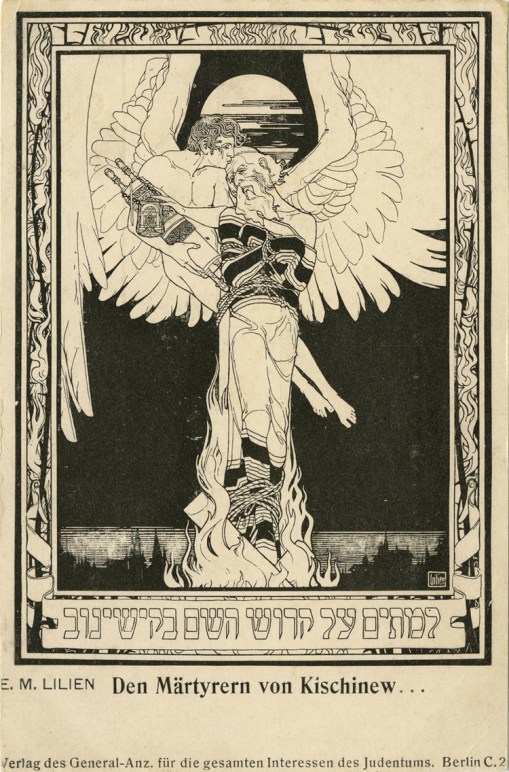


 The eclectic East-West style was named Judenstil






























 Shalom Radio UK