The Heart of the Matter – Rav Shaul Shares his Heart’s Desire!

hearts desire-1_edited-1a

listenButton

BELOW:


We continue in our studies in Romans 9 -11 to consider the matter of Israel and her salvation from the perspective of Rav Shaul/ Apostle Paul. This desire and prayer of Paul is the Heart of the Matter that rests very heavily upon Shaul as he considers the plight of Israel.

download (6)

A heart ablaze is a powerful image that like the sun, though burning with intense heat, yet it is not consumed. So this passion for the Jewish people that the great emissary of the faith expresses in this section of his letter to the Romans in chapter 10 is something that is of deep concern to him and his passion for Israel cannot be extinguished.

Paul-the-false-Apostle

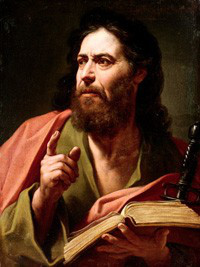
Icon of St. Paul


What does it mean to be saved?

This needs some explaing to those who are unfamiliar with biblical jargon. The word “salvation” [N] is one of the many Hebrew words used to signify G_d’s act in redeeming humankind:

It is important to establish the understanding of biblical terminology and particularly, both Hebrew and Greek words that effect our discussion on the subject of “What is salvation?”

 Yasa [yasha] (to save, help in distress, rescue, deliver, set free) appears most frequently in the Hebrew Scriptures. Commonly, this deliverance of which the Hebrew Scriptures speaks of is material in nature, though there are important exceptions. In contrast, the employment of soteria in the New Testament, though it may include material preservation, usually signifies a deliverance with special spiritual significance. In addition to the notion of deliverance in the Bible also uses salvation to denote health, well-being, and healing.

One might say that salvation is the overriding theme of the entire Bible. But since it is a multidimensional theme with a wide range of meaning, simple definitions are impossible. The biblical writers speak of salvation as a reality with both a spiritual and physical dimension. It has individual and communal aspects to it, with an objective and subjective application, as well as an eternal and historical dimension. Since the biblical writers view salvation as a historical reality, the temporal dimensions of past, present, and future further intensify and deepen the concept.

Salvation is a process with a beginning and an end. “We are being saved or we are being delivered.”

As has been previously said, salvation involves both human freedom and divine election. We are given freedom to serve G_d, but G_d chooses who will serve him. This is a biblical tension truth, or some may say it is a paradox?

The Bible constantly speaks about salvation in the context of concrete relationships between humans and G_d. It not only includes personal salvation, but it also has a redemptive concern for the world in which we live. G_d is the main initiator throughout the process and with the example of the deliverance of Noah and his family, through to the great multitude who shout “Salvation belongs to our G_d, who sits on the throne, and to the Lamb!”Rev 7:10 ). It is G_D who is acting and humans responding to him.

In the Hebrew Scriptures where individuals are singled out it seems to be for the good of the community. For example, the Genesis [story] narrative develops the theme of G_d’s blessing, and though resting on certain individuals, renders them agents for some greater work of G_d. Joseph’s rise to fame in Egypt preserves the lives of his entire family (Gen 45:4-7 ).

Through Noah’s faithfulness G_d brings salvation to his family as well as animal life and subsequently to all future generations of humankind (Gen. 7-9). And the blessing of the promise of nationhood and land for Abraham was not only for his descendants, but for all families on the earth ( Gen 12:1-3 ). And after 430 years in Egypt, an entire people is delivered through Moses (Exod. 1-12). Through Esther’s rise to power the Jewish people are spared annihilation under the decree of the wicked Haman( Esther 7).

Despite the importance of human agency, salvation is attributed above all to G_d. None but G_d can save ( Isa 43:14 ; Hosea 1:7 ). He is the keeper of his flock ( Eze 34 ) and on him alone one waits for a saving word to penetrate the silence ( Psalm 62 ). G_d is the warrior and not Moses who triumphs gloriously over Pharaoh’s armies at the sea ( Exod 15 ).

Salvation is something to stand and watch, for “The L_rd will fight for you; and you need only be still” ( Exod 14:13 ). “In repentance and rest is your salvation; in quietness and trust is your strength” summons Isaiah ( 30:15 ). The contents of G_d’s salvation includes personal and national deliverance from one’s enemies, deliverance from slavery ( Deut 24:18 ), ongoing protection and preservation from evil (Ps. 121), escape from death ( Psalm 68:19 ), healing ( Psalm 69:29 ; Jer 17:14 ), and inheritance of land, descendants, and long life are all part of the act of G_d’s salvation. This is not only towards his chosen people, but all humankind.

In Judaism Salvation from sin, though not a dominant concern, is by no means absent, especially in the prophets. As much as he is concerned for Israel’s national restoration, Ezekiel stresses the need for salvation from uncleanness, iniquity, and idolatry ( 36:22-32 ). Here salvation involves the gift of a new heart of flesh and new spirit, which will finally empower his people to keep the commandments, after which comes habitation in the land. In this passage, too, we encounter a common refrain: such salvation, when it comes, will be neither for the sake of Israel nor her deeds, but for G_d and his glory. Isaiah tells of a salvation still on the way, which will be achieved through the vicarious suffering of the Servant of the L_RD (chap. 53) who bears the sin of many. This salvation will last forever ( 51:6 ). The prophet Jeremiah in his famous chapter 31:31f  in which a new covenant is promised.

“The days are surely coming says the L_ORD when I will make a new covenant with the House of Israel and the House of Jacob. It will not be like the covenant that I made with their ancestors, when I took them by the hand to bring them out of the Land of Egypt, a covenant that they broke though I was their husband, says the L_RD. But this is the covenant that I will make with the House of Israel after those days says, the L_RD. I will put my law within them, and I will write it on their hearts and I will be their G_D, and they shall be my people.”

We should note that each of the prophetic writers express a similar notion that G_d is going to bring about a radical change, establishing a new covenant with the house of Israel.

The anticipated salvation of the prophetic writings manifests a tension similar to that which pervades the New Testament. While salvation is a fait accompli, G_d saved Israel from slavery in Egypt into a covenant relationship with himself. Israel still awaits G_d’s salvation. G_d had saved Israel in the past, and therefore G_d can be expected to deliver her in the future. Whatever else salvation may be from a biblical perspective, its dimensions of “settled past” and “anticipated future” show it in its widest scope to be an elongated reality covering the entire trajectory of history.

This recognition has helped recent biblical scholarship to avoid the earlier pitfall of relegating the role of the Hebrew Scriptures to that of mere preparation or precursor for the Gospel. One cannot escape the fact that for the Jews of the Hebrew Scriptures salvation was not an abstract concept, but a real and present experience. The psalms are replete with praise for G_d’s salvation, which is experienced as joy ( 51:12 ). It is a cup of thanksgiving lifted to G_d ( 116:13 ) and a horn ( 18:2 ). Elsewhere salvation is depicted as a torch ( Isa 62:1 ), a well ( Isa 12:3 ), and a shield ( 2 Sam 22:36 ).

maxresdefault copy

The New Testament.

The name “Immanuel, ” “God with us,” signifies momentous progress in the history of salvation. In Matthew’s Gospel the angel tells Joseph that Mary’s child is conceived of the Holy Spirit, and that he is “to give him the name Yeshua/ Jesus, because he will save his people from their sins”1:21-23 ). The name “Jesus” (derived from the Hebrew Joshua [Yeshua]) means salvation. The purpose for the Son of Man’s coming is to seek out and save the lost ( Luke 19:10 ). The New Testament continues the Hebrew Scriptures affirmation that salvation belongs to G_d alone, but with greater specificity. Now it is G_d’s presence in and to the man Jesus that proves decisive…

In Yeshua’s teaching salvation is linked to the advance of G_d’s kingdom, which finds expression in Yeshua’s own person. The advent of G_d’s kingdom became a synonym for salvation. Yeshua deepens the Hebrew Scriptures  conviction that salvation belongs to G_d, for it is in his Kingdom that the reality in which G_d reigns sovereign…That Jesus understood himself to be that harbinger of G_d’s kingdom, and is evident in the claim following his synagogue reading, “Today this scripture is fulfilled in your hearing” (Luke 4:21). Salvation belongs to those who follow Yeshua who is the embodiment of G_d’s kingdom.

Salvation is described as the mystery of G_d that is now revealed ( Eph 3:9 ; 6:19 ); a plan conceived before the foundations of the world ( Eph 1:3-14 ); a light for revelation to the Gentiles and for glory to your people Israel ( Luke 2:30-32 ). A transition from death to life takes place( John 5:24 ). It is a message especially for sinners ( Mark 2:17 ), and a gift of grace through faith not is not achieved through any human effort [of works] ( Eph 2:8-9 )…

henry-ossawa-tanner-xx-study-for-nicodemus-visiting-jesus-xx-private-collection

In response to Nicodemus’s question about how one can be born anew, Yeshua says, that salvation is a spiritual birth, a birth from above without which one cannot enter the kingdom of heaven ( John 3:1-11 ). Salvation means death to and freedom from sin ( Rom 6 ); a new perspective that transcends the human point of view and participation in a new creation ( Rom 5:16-17 ); it is peace with G_d is achieved ( Rom 5:1 ); and new life as adopted children of God is gained ( Gal 4:4)…

Salvation encompasses both the physical and spiritual dimensions of life, having relevance for the whole human person. On the physical side, entrance into the kingdom requires attention to earthly needs, especially those for the poor. Yeshua demands that a wealthy man give his riches to help the poor ( Mark 10:17-22 ).

We witness the salvation that came to Zacchaeus’ house inspired him to give half his possessions to the poor ( Luke 19:8-10 ). Care for the poor was a regular function of the earliest believing communities ( Acts 9:36 ; Acts 10:4 Acts 10:31 ; 24:17 ; Gal 2:10 ; James 2:1-7 ). But for Yeshua the physical and spiritual dimensions are held very close together. Forgiveness of sins and physical healing frequently coexist, as in the healing of the paralytic ( Mark 2:1-12 ). Other healings done in Yeshua’s name call attention to the intimate connection ( Acts 3:16 ; 4:7-12 ) among spirit, mind, and body effecting the whole person. In these examples salvation means not only forgiveness of sin but mitigation of its effects.


[In this song by Eurythmics, “I Saved the World Today,” the concept of salvation is explored in place of suffering and sadness. And this same salvation is what Yeshua desired to bring to this aching world. Jew and Gentile may experience healing, hope and restoration, together with true peace found only in and through Yeshua HaMashiach/ Jesus the Messiah.]


While Salvation’s history reaches a climax in the context of Judaism of the Second Temple era, we must remember that this is where the Messianic manifestation was realised.

portret

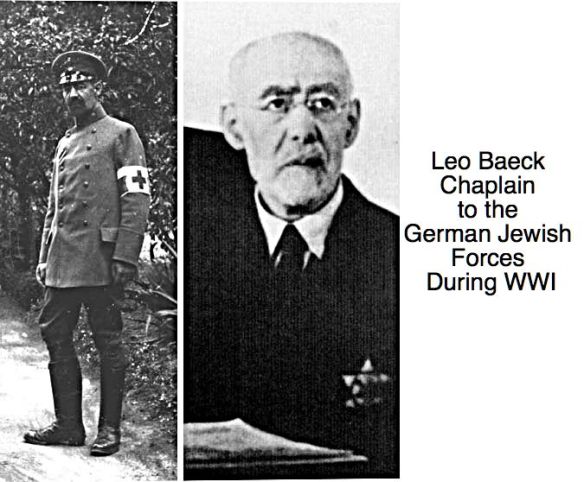
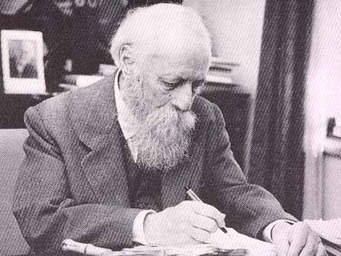
To quote Rabbi Doctor Leo Baeck, the famous German Jewish rabbi and theologian, in his desire to rescue Jesus for Judaism shows that the kernel of Jesus’ teaching lies in  its fidelity to the essence of Judaism and only there.

“In all his traits, Jesus is through and through a genuinely Jewish character. Such a man as he could only grow up on the soil of Judaism, only there and nowhere else. Jesus a genuine Jewish personality;  all his driving and acting, his bearing and feeling, his speech and his silence, all of it bears the Jewish stamp, the imprint of…the best that was found in Judaism. Indeed that time [prior to the gifts Judaism bestowed on the church] this was the best found only in Judaism…From no other people could such a man as he arisen, and in no other people could such a man have been able to work; and in no other people would he have found the apostles who believed in him” (Jewish Perspectives on Christianity, Rothschild, p 26).

However, the universality of the message of salvation could not be contained within the bounds of  Second Temple Judaism, for it was G_d’s intention as predicted through the Jewish prophets and Jesus himself  that the message must also extends beyond the parameters of national Jewish identity. On at least one occasions Yeshua corrects (or at least sidesteps) national expectations concerning the kingdom once in response to the disciples’ question ( Acts 1:6-8 ) and once on the Emmaus road ( Luke 24:25-26 ). Since Jesus’ death was for all people ( John 11:51 ), repentance and forgiveness of sins were to be proclaimed to all nations ( Luke 24:47 ). This gospel, says Paul, was given in advance in the form of G_d’s promise to bless all the nations through Abraham ( Gal 3:8 ).

65_2086L copyemmanuel-e1418498693717

The objective basis and means of salvation is G_d’s sovereign and gracious choice to be “G_d with us” in the person of Yeshua the Messiah, who is described as both author and mediator of salvation ( Heb 2:10 ; 7:25 ). But the movement of Yeshua’s life goes through the cross and resurrection. It is therefore “Messiah crucified” that is of central importance for salvation ( 1 Cor 1:23 ), for “Yeshua died for our sins according to the Scriptures” ( 1 Cor 15:3 ) and was handed to death for our trespasses ( Rom 4:25). What Jesus did in our name he also did in our place, giving “his life as a ransom for many” ( Matt 20:28 ). And if Yeshua demonstrated his love by dying when we were still sinners, how much more shall we now be saved by his life? ( Rom 5:8-10 ). So critical is the resurrection to the future hope of salvation that “If Yeshua has not been raised, your faith is futile; you are still in your sins” ( 1 Cor 15:17 ).

GettyImages-175517838-56c4f2b23df78c763fa04860

John the Baptiser preached a baptism of repentance for the forgiveness of sins ( Matt 3:2; Mark 1:4 ), and this message was echoed by the Apostle Peter ( Acts 2:38 ) and the Apostle Paul ( Acts 20:21 ). Yeshua said salvation required belief in him ( Mark 16:15 ; John 6:47 ).

Paul enjoined confession with the mouth that “Yeshua is Lord” and belief that G_d raised him from the dead ( Rom 10:8-9 ). The writer of Hebrews suggests that the hearing of the gospel is of no value unless combined with faith ( 4:1 ). And this is repeated in James’ epistle, were he says, that if you claim to have faith and you do not have works, your faith is dead and meaningless. Demonstrate your faith by the things that you do.

(Based on William T. Arnold’s article and modified and adapted by Roni Mechanic).

if-god-is-for-us copy

According to Rav Shaul two things need to initially happen to be saved:

Romans 10: 9 “…that if you acknowledge publicly with your mouth that Yeshua is Lord and trust in your heart that G_d raised him from the dead, you will be delivered. 10 For with the heart one goes on trusting and thus continues toward righteousness, while with the mouth one keeps on making public acknowledgement and thus continues toward deliverance.”

An outward verbal confession and an inward belief that Yeshua is L_rd and that G_d has raised him from the dead, these are the two vital components that are required to begin your journey into life.

The fact that one acknowledges him as L_rd involves submitting one’s life the leadership of the Messiah accepting his divine authority with of the full implications of that new reality as a member of his Messianic Kingdom. There are important consequences that will begin to transpire in one’s life and then one will need to answer the question:

“How shall we then live? Judaism speaks about this as Halacha [how shall we walk?]. how do we interpret the new messianic faith and live it out in our daily lives?

There are moral and ethical implications of seeking to follow the Messiah and this should deeply impact upon how we live. As we saw in the example of Zacchaeus, his thieving and self-centred life style was instantly transformed by his encounter with Yeshua. He repaid those who he had defrauded double and also gave way half his wealth to the poor.

John the Baptizer and Yehsua both have harsh words for those who make a profession of faith and whose lives are not transformed by G-d’s life giving Spirit.

The second part of one’s confession is a belief in the resurrection of Yeshua. Shaul says that if Yeshua did not rise from the dead, then we are the most miserable of all folk, and our faith is futile (see 1 Corinthians 15). This is because not only are we believing a lie, but we are propagating a falsehood and we are are surely, self-deceived and deceiving others too.

Without the resurrection factor the Messianic house falls down and we are are indeed very lost! But, Messiah has been raised and the tomb is empty – Hallelujah!

hallelujah-www.canichangemylife.com_


Last year while in Israel in 2017, I was visiting Akko (Acre) and while in the Old City in the shook, I went into a barbershop to have a haircut and in the chair next to me was an elderly gentleman and he said that he was the Catholic priest of the Akko congregation in the Old City. It was just after Paschal (Easter) and Peshach (Passover). On Easter Sunday the Arab Christian believers celebrate the resurrection of Jesus/ Yehsua and as he got up to leave he said to me “Christos Anesti”Christ is Risen [Latin: Christus resurrexit!/ Vere resurrexit! Hebrew: Ha-Mashiah qom!/ Be-emet qom! Arabic: Al Maseeh qam! Haqqan qam!]   – and I responded, “He is risen indeed, hallelujah!”

yeshua msheekha - Jesus Christ in Aramaic (“Χριστός ἀνέστη!” – “Christ is Risen!” in Greek)

Shalom Radio UK – sponsored by Messianic Teaching Ministry International – MTMI

d8cf06fdd0caed8d13bc0b4212aaa574

http://www.hotrodronisblog.com

MTMI

Rav Shaul/Paul – His Heart’s Cry for Israel: A Magnificent Obsession

Rav Shaul/Paul – His Heart’s Cry for Israel

listenButtonBELOW>
We all experience times in our lives when we are profoundly disturbed by a given situation and our first response is often one of grief or anger depending on what has happened. This is sometimes accompanied by a feeling of being powerless to do anything significant to influence or change the situation that is confronting us. Such was the situation faced two millennia ago by a Jewish rabbi called Rav. Shaul (Hebrew), also known as the Apostle Paul (his Greek name).

However he did not throw his hands up in despair and declare, “There is nothing that I can do!” He moved into action and using his influence, penned a lenghty letter to help clarify things.  In a section of his letter to the believers in Rome Paul gave an explanation as to how he understood the situation concerning his fellow Jews and what outcomes could be expected in helping to resolve the deep trauma that not only he, but others were confronting (Romans 9 – 11 – chapter divisions were added later ). He did not let things get the better of him and just give up. This same letter to the Romans is one of the key texts in our contemporary age in which we endeavour to understand the place and plight of the Jewish people and their relationship to G_D.

What were the issues that were causing this deep anxiety? 

Let me endeavour to explain:

In Romans chapters 9 – 11 Paul gives a powerful testimony to his on going love and concern for his fellow Jews and in this section of his letter to the Roman believers he gives very specific details about how that relationship between G_D and Israel, though fractured and interrupted is bound to be repaired and restored.

He continues, that with such a heritage as the Jewish people have, they can neither get away from the person of Yeshua/Jesus, nor will he forever be a stranger to them.

Paul is not alone in his concern as to how Jews and Jesus may rediscover their common origin and future destiny together.  This reality is demonstrated in the work of Jewish and Israeli artists, writers, poets and theologians who continue to grapple with the person of Jesus/ Yeshua and his Jewishness.


We have seen this fascination with the luminous figure of Jesus in the artistic work of Mark Antokolsky, Boris Schatz, Jacob Epstein (sculptors), Mauricey Gottlieb, Ephraim Moses Lilien, Ze’ev Raban, Reuven Rubin, and Marc Chagall (painters).


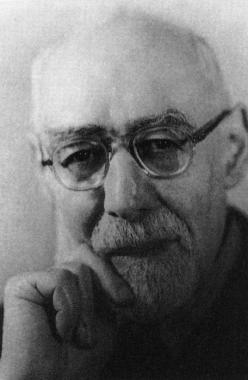
Martin Buber, Franzec Rosenzweig, Leo Beck (philosophers), Geza Vermes, Rabbi Pinchas Lapide and David Flusser (theologians), and Chaim Potok (writer), are just a few Jewish Artists and thinkers who have confronted the question of Jesus and the Jewish people.

A covenant can be broken and interrupted, however in Israel’s case even though that agreement has been damaged it will be restored. This has to do with the grace of G_D and not primarily Israel, yet there must be a response to that divine initiative and a willingness to say, “yes” to G_D.

MO_1a

Magnificent Obsession

Jewish obsession with Jesus is part of the fact that G_d’s desire for the restoration of Israel is a reality and his pursuit of Israel will lead to their ultimate full inclusion in the family of G_d. May I even call it magnificent obsession?

However, as Paul says, “What then are we to say? Is there injustice on G_d’s part? By no means! For he says to Moses: I will have mercy on whom I will have mercy, for I will have compassion on whom I will have compassion.”

So it depends not on human will or exertion, but on [G_d] who shows mercy…So then he has mercy on whomever he chooses, and he hardens the hearts of whomever he chooses (Romans 9.14-16 &18 ESV).

This growing interest and realization among Jews worldwide is part of the divine plan and no amount of human resistance to this glorious reality will thwart the divine will. The hardening and softening of human hearts is the hands of the divine potter who moulds and fashions the clay.

With this in mind, we must not underestimate the place of prayer. It is both important and of great value. Some have said, that prayer moves the hand of G_d, so together with the Apostle Paul in Romans 10.1 may we say,

“My brothers and sisters, my heart’s desire and prayer for them, is that they may be saved” (NRSV).

We may in fact go further and say at this point that the need for such a discussion has become urgent, because the very reliability of G_d’s plan for the Jewish people needs clarifying. It would appear that because the majority of the Jews have not embraced Yeshua/Jesus as Messiah and Lord, that G_d has failed to fulfil his covenant promises. For if the truth that G_d’s purpose for Israel has been frustrated, then what hope is there for all those who call themselves believers? This affects both Jewish and Gentile believers. And if G_d’s love of Israel has ceased, what reliance can be placed upon Paul’s conviction that nothing can separate us from G_d’s love in Messiah?

If the state of the Jewish people’s divine calling is at stake,  then how may we proceed in having a biblically sound approach in formulating our response? We discover that the Apostle Paul, having pondered this question long and hard has some insightful ideas to help us in our quest:

According to Paul’s reasoning, G_d chose Israel as a vessel to display his mercy and not his wrath. His long-suffering attitude towards her demonstrates this fact, despite her rebelliousness, for he has chosen to show lovingkindness and mercy towards Israel.

His ultimate purpose is for her salvation, but that does not let her off the hook cart-blanche. Israel must bear responsibility for her failure to acknowledge his chosen one, the Messiah Yeshua HaMashiach/Jesus the Messiah. G_d’s showing of his mercy is not based upon any glory of Israel’s own as though they deserved it. It is all of grace, i.e. that is his free unmerited favour towards humankind. Both Jews and Gentiles are included, however, in this context it is Israel that is the focus of our discussion.

In Ephesians 2:10 we read:

“For we are what he has made us, created in Messiah Yeshua/Christ Jesus for good works, which G_d prepared beforehand to be our way of life.”

This imagery of the divine craftsperson shaping and forming us into a vessel [people] for a particular purpose must not be missed.”

What is your destiny?

This question is discussed in this helpful article from a website jewishanswers:

[The writer’s response to an inquirer is done in the form of a dialogue (conversation) between himself and the other person].

Destiny – Beshert

Beshert means ‘meant to be’ (destiny)…fatalism. I thought Jews are not fatalists. I feel I am steering my own ship in life…”

“That’s one great question you ask (it’s even more impressive considering you asked it of your own volition and not because you were somehow predestined to).

You wrote that “Beshert means ‘meant to be’ (destiny)…fatalism.” Actually, beshert doesn’t imply fatalism at all. After consulting a language expert, I discovered that “Beshert” actually comes from the same root as ‘shern’, to shear (as in a beard) and in middle-high German, “bescheren” meant more or less “to give”.

So beshert in Yiddish means something that G_d has given you. According to Torah thought, all your natural intellectual and physical abilities are beshert for you, as are things like the parents to whom you were born and the country in which you were born. All these things are part of the unique potential with which G_d endowed you. From the dawn of creation ‘till the end of days, no other person will ever have exactly the same potential as you.

Of course, what we do with that potential is another matter. That’s our responsibility. Every human being possesses free will and each of us is responsible for developing our G_d given potential: this is one of the most important principles of Judaism; perhaps the most important.

The reason why G_d gave each of us a unique potential is because He has a unique position assigned for us to do our irreplaceable part in perfecting the world. Each of us receives exactly the inner potential we need in order to be equipped to meet the all the life challenges that G_d designed especially for us.

According to my encyclopaedia, fatalism [predestination] is the “doctrine that all events occur according to a fixed and inevitable destiny that individual will neither controls nor affects.”

Nothing could be farther from the Torah (Scriptural) truth. Our individual wills certainly control and affect things greatly. Our free willed moral decisions make us into who we really are. It can’t be our innate potential that makes us who we are, because that potential was, in a sense, predestined (at least we had nothing to do with it). But what we CHOOSE to do with our potential, every day and every moment, is who we truly are…”


In Jewish understanding “your destiny – Beshert” is particularly significant in who HaShem (G_D) has chosen for your life long marriage partner.

jewish-wedding-rings-posey-rings-fj01r


Returning to our theme, of G_d’s destiny for Israel and the Jewish people, while it certainly does involve the choices that that we make, he is a Sovereign L_rd and his divine purpose will be fulfilled.

So then, the calling of G_d, is not only to include Jews, but Gentiles as well. While Jewish choosiness was the original decision by the Almighty that he made, the Gentiles are also now included in his plan. These vessels of mercy are not only from among the Jews, but also the Gentiles.

The presence of Gentiles within the believing community is a sign and pledge that the realm of rejection, of Ishmael, Esau, Pharaoh and the unbelieving Jews themselves, is not finally shut out from the mercy of  G_d.

As previously said in our last Shalom Radio UK programme that Lord Sacks (former Chief Rabbi of the UK), answers the question of divine choice:

Why Isaac, not Ishmael? Why Jacob, not Esau? These are among the most searing questions in the whole of Judaism.

It is impossible to read Genesis 21, with its description of how Hagar and her son were cast out into the wilderness, how their water ran out, how Hagar placed Ishmael under a bush and sat at a distance so she would not see him die, without feeling intensely for both of them, mother and child. They are both crying. The Torah tells us that G_d heard Ishmael’s tears and sent an angel to comfort Hagar, show her a well of water, and assure her that G_d would make her son “a great nation” (Gen. 21:18) – the very promise he gave Abraham himself at the start of his mission (Gen. 12:2).

Likewise in the case of Esau. The emotional climax of the Scriptural [Torah portion: Toldot] occurs in Genesis 27, at the point when Jacob leaves Isaac’s presence, having deceived him into thinking that he was Esau. Then Esau enters, and slowly both father and son realize what has happened. This is what we read:

jacob-esau-520x245

Then Isaac trembled with a very great trembling, and said, “Who then was it who hunted game and brought it to me and I ate it before you came and I blessed him?—and he will be blessed.” When Esau heard his father’s words, he cried an intensely loud and bitter cry, and said to his father, “Bless me, me too, my father!” (Genesis 27:33-34)

These are among the most powerful descriptions of emotion in the whole of the Torah, and they are precisely the opposite of what we would expect. We would expect the Torah to enlist our sympathies for the chosen: Isaac and Jacob. Instead it almost forces us to empathise with the un-chosen: Hagar, Ishmael and Esau. We feel their pain and sense of loss.

So, why Isaac and not Ishmael? Why Jacob and not Esau? To this there are two types of answer. The first is given by midrash [Rabbinical commentary method – Christian hermeneutics approximates this]. On this reading Isaac and Jacob were righteous. Ishmael and Esau were not…

In the case of Esau, the most pointed verse is the one in which he agrees to part with his birthright in return for a bowl of soup (Gen. 25:34). In a staccato series of five consecutive verbs, the Torah says that he “ate, drank, rose, went and despised” his birthright.” Yet this tells us that he was impetuous, not that he was evil.

If we seek the “deep plain sense,” we must rely on the explicit testimony of the Torah itself – and what it tells us is fascinating. An angel told Hagar before Ishmael was born that he would be “a wild donkey of a man, his hand against everyone, and everyone’s hand against him” (Gen. 16:12). He became an expert archer (Gen. 21:20). Esau, red-haired, physically mature at a young age, was “a skilful hunter, a man of the field” (Gen. 25:27). Ishmael and Esau were at home in nature. They were strong, adroit, unafraid of the wild. In any other culture they might have emerged as heroes.

And that is the point. We will only understand the Torah if we recall that every other religion in the ancient world worshipped nature. That is where they found [g]od, or more precisely, the gods: in the sun, the moon, the stars, the storm, the rain that fed the earth and the earth that gave forth food.

Even in the twenty-first century, people for whom science has taken the place of religion still worship nature. For them we are physical beings. For them there is no such thing as a soul, merely electrical impulses in the brain. For them there is no real freedom: we are what we are because of genetic and epigenetic causes over which we have no real control. Freewill, they say, is an illusion. Human life, they believe, is not sacred, nor are we different in kind from other animals. Nature is all there is. Such was the view of Lucretius in ancient Rome and Epicurus in pre-Christian Greece, and it is the view of scientific atheists today.

The faith of Abraham and his descendants is different. G_d, we believe, is beyond nature, because He created nature. And because He made us in His image, there is something in us that is beyond nature also. We are free. We are creative. We can conceive of possibilities that have not yet existed, and act so as to make them real. We can adapt to our environment, but we can also adapt our environment to us. Like every other animal we have desires, but unlike any other animal we are capable of standing outside our desires and choosing which to satisfy and which not. We can distinguish between what is and what ought to be. We can ask the question “Why?” [Christianity accords with Judaism in its view of Creation and the Creator].

After the Flood God was reconciled to human nature and vowed never again to destroy the world (Gen. 8-9). Yet He wanted humanity to know that there is something beyond nature. That is why He chose Abraham and his descendants as His “witnesses.”

Not by accident were Abraham-and-Sarah, Isaac-and-Rebecca, and Jacob-and-Rachel, unable to have children by natural means. Nor was it mere happenstance that G_d promised the holy land to a landless people. He chose Moses, the man who said, “I am not a man of words,” to be the bearer of His word. When Moses spoke G_d’s words, people knew they were not his own.

G_d promised two things to Abraham, Isaac and Jacob: children and a land. Throughout history, most people at most times have taken children and a land for granted. They are part of nature. They constitute the two most basic natural drives: the Darwinian imperative and the territorial imperative. All animals have children, and many have their own territory that they mark and defend.

Jews – one of the world’s smallest people – have rarely been able to take children for granted. Abraham’s first recorded words to G_d were: “O L_rd G_d, what can you give me seeing that I go childless?” and even today we ask, Will we have Jewish grandchildren? Nor have they been able to take their land for granted. They were often surrounded by enemies larger and more powerful than themselves. For many centuries they suffered exile. Even today they find the State of Israel’s very right to be called into question in a way that applies to no other sovereign people. As David Ben-Gurion said, “In Israel, to be a realist you have to believe in miracles.”

Isaac and Jacob were not men of nature: the field, the hunt, the gladiatorial game of predator-and-prey. They were not Ishmael and Esau, people who could survive by their own strength and skill. They were men who needed G_d’s spirit to survive. Israel is the people who in themselves testify to something beyond themselves.

Jews have consistently shown that you can make a contribution to humanity out of all proportion to their numbers, and that a small nation can outlive every empire that sought its destruction. They have shown that a nation is strong when it cares for the weak, and rich when it cares for the poor. Jews are the people through whom G_d has shown that the human spirit can rise above nature, testifying that there is something real that transcends nature.

That is a life-changing idea. We are as great as our ideals. If we truly believe in something beyond ourselves, we will achieve beyond ourselves…”

         [Lord Sack’s full article – see: https://rabbisacks.org/isaac-jacob-toldot-5778/ ].


moi-paul

Paul continues to elaborate on the issue of Israel’s destiny by citing a passage from Hosea the Prophet, 

As indeed he says in Hosea chapter 1,

25“Those who were not my people I will call ‘my people,’
    and her who was not beloved I will call ‘beloved.’”

26 “And in the very place where it was said to them, ‘You are not my people,’
    there they will be called ‘sons of the living G_d.’”

Paul uses this passage to argue that the Gentiles are also to be included in the family of G_d.

27 And Isaiah cries out concerning Israel: “Though the number of the sons of Israel[c] be as the sand of the sea, only a remnant of them will be saved, 28 for the L_rd will carry out his sentence upon the earth fully and without delay.” 29 And as Isaiah predicted,

“If the L_rd of hosts had not left us offspring,
    we would have been like Sodom
    and become like Gomorrah.”

Israel’s Unbelief

30 What shall we say, then? That Gentiles who did not pursue righteousness have attained it, that is, a righteousness that is by faith; 31 but that Israel who pursued a law that would lead to righteousness did not succeed in reaching that law. 32 Why? Because they did not pursue it by faith, but as if it were based on works. They have stumbled over the stumbling stone, 33 as it is written,

“Behold, I am laying in Zion a stone of stumbling, and a rock of offence;
    and whoever believes in him will not be put to shame.”

Even so, while the majority of Israel, Paul’s contemporaries, had failed to embrace Yeshua as Messiah, in rabbinic thought, when reflecting upon the passage from Hosea says, ‘that G_d is rich in mercy towards his people even in the midst of his wrath against them’ (The International Critical Commentary, Romans vol. ii, p. 500).

While the vast majority of Israel, stumbles over the stumbling stone (rock of offence), Yeshua/Jesus, there is at the present time a remnant according to divine grace that are included in the Messianic kingdom.

Who are these Jews that are the remnant?

When we think of a remnant it usually refers to a piece of material at the end of the roll of cloth, so in the context of the Jewish people, we may assume that those who are called the remnant are not the majority, but a small portion of the Jews.

Who are this remnant? How have they been identified and what role and place do they play as part of the Jewish people?

maxresdefault (1)Jewish,_Judaism,_Messianic_Judaism,_Messiah,_Jesus,_Torah,_Tanakh,_Biblemessianicjudaism

They have severally been called, Hebrew Christians; Christian Jews, Jewish Christians; Hebrew Catholics; Completed Jews; Fulfilled Jews; and latterly, Messianic Jews or in Hebrew: Yehudim Mishachim.

I wish to focus on the name Messianic Jews and elaborate as to how one may explain what this means:

A Messianic Jew is a Jew who has embraced Yeshua/ Jesus as Messiah and L_rd, and still identifies himself or herself with being Jewish. I must stress this is a self-definition and is not universally accepted, though there is a growing trend even by some Jews who do not accept Jesus as their saviour to use this term and to recognise those who follow Yeshua as being Jewish.


150174122

stumbling-blocks-9

They have stumbled over the stumbling stone, 

Romans 9.33 “as it is written,

“Behold, I am laying in Zion a stone of stumbling, and a rock of offense; and whoever believes in him will not be put to shame.”

This passage from Romans correlates with Isaiah 28.16 ‘therefore thus saith the L_rd G_D, Behold, I lay in Zion for a foundation a stone, a tried stone, a precious corner stone of sure foundation: he that believeth shall not make haste’ (Isaiah 28.16 RV).

Instead of simply trusting in the security that the rulers of Jerusalem could offer, those who truly trusted in G_D, they would find a lasting and sure security in Jerusalem. Human intentions, even those meaning the very best for those who put their trust in them, may fail, but in trusting in G_D, it can never fail.


I am reminded of a poster that I saw in a Kosher Butcher shop in North London of a large US dollar bill with the words, “In G_d we trust.  All others pay cash.” 

In G_D we trust:

These words, “In G_D, we trust” written on every dollar bill, are noble intentions and the Founding Fathers of the United States of America did include many devout Christians who expressed their trust in the sovereign grace of G_d.

May all of us, Jews, Christians, and all people of true faith in whatever religion they adhere to, put their trust in the TRUE AND LIVING G_D, and make the joyous discovery that Yeshua is the true and living Messiah of Israel and Saviour of humankind.

Amen.


Shalom Radio UK 

sponsored by MTMI – Messianic Teaching Ministry International


MTMI


http://www.hotrodronisblog.com

d8cf06fdd0caed8d13bc0b4212aaa574-2

Toldot: Generations – G_D’s Plan for Israel & the Jewish People

Messianic Jewish Perspectives


Reuven-Rubin-Landscape-of-Galilee-70-90k-1885001

Pilgrims in the Land of Hope – Reuven-Rubin-Landscape-of-Galilee

Do Not Miss Out on G_D’s Blessing in Your Life

Toldot: Generations:

Genesis 25.19-28.9, Malachi 1.1-2.7 & Romans 9.1-13

listenButton


Jacob & Esau

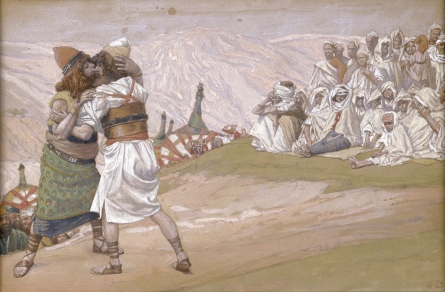
tissot-mess-of-pottage-445x353tissot-jacob-deceives-isaac-445x300tissot-the-meeting-of-esau-and-jacob-445x292

The Struggles and Reconciliation of Jacob & Esau

Introduction

1/It is important to state from the outset that when dealing with these verses from Romans 9 we must keep in mind the issue concerning the question of the gospel and the fact that the relationship between Yeshua and Israel is inseparable.

The Jews are God’s special people. Despite their stubbornness and at times rebellious attitude, this unique relationship will never change. This promised gospel of the Messiah’s advent, foretold in the Hebrew Scriptures, and its message become explicit in the words, ‘both for the Jew first and for the Greek (gentiles) later’ (cf. Romans 2.9-10).

It is plain that when thinking of God’s faithfulness, then the question of Jewish involvement cannot be ignored of glossed over. It became incumbent upon Paul to discuss this subject in some length in Romans chapters 9-11.


The Apostle Paul/ Rav Shaul in his letter to the believers in Roman wrote to them concerning their new life in the Messiah. The congregation in Rome was made up of Jews and Gentiles and Paul wanted to help establish their faith and clarify a number of issues that were causing confusion and needed clearing up.

Because of the rejection of Yeshua by the Judaea Temple leadership centred around the High Priest and his ruling council, as a consequence the believers were being persecuted.

The darkest hour had dawned with Israel’s failure to embrace Yeshua as Messiah and Lord.

What hope was left for the Jewish people? What was the consequences of this for Judaism that had chosen another path other than acknowledging Yeshua as Messiah and Lord? In Romans 9 Paul outlines some of his thinking about their destiny. Painful as it is, all hope was not lost.

A refreshing translation gives new insights: this‘magnificent prospect’ – missed by those who he came for…’their special privileges and their high destiny’ – a cause of great sorrow to Paul & he was willing to sacrifice his dearest hopes…

EPSON scanner image


2/ Our story begins much earlier and takes us back to the beginning of this formation of the Nation of Israel.

There is a good story worthy of our consideration concerning the Generations [Toldot]of Abraham, Ishmael, Isaac and Jacob and Esau and it is full of twits and turns. In this Parasha (portion) TOLDOT: Genesis 25.19-28.9 we are given the account of the struggle between Jacob and Esau. It began inside Rebecca’s womb and it continues down till this day as Jews and Arabs, the descendants of Isaac and Ishmael and Jacob and Esau are still locked in conflict about birthright and land.

The Birth and Youth of Esau and Jacob

Genesis 25.19 These are the descendants of Isaac, Abraham’s son: Abraham was the father of Isaac, 20 and Isaac was forty years old when he married Rebekah, daughter of Bethuel the Aramean of Paddan-aram, sister of Laban the Aramean. 21 Isaac prayed to the Lord for his wife, because she was barren; and the Lord granted his prayer, and his wife Rebekah conceived. 22 The children struggled together within her; and she said, “If it is to be this way, why do I live?”[c] So she went to inquire of the Lord23 And the Lord said to her,

“Two nations are in your womb,
    and two peoples born of you shall be divided;
the one shall be stronger than the other,
    the elder shall serve the younger.”

24 When her time to give birth was at hand, there were twins in her womb. 25 The first came out red, all his body like a hairy mantle; so they named him Esau. 26 Afterward his brother came out, with his hand gripping Esau’s heel; so he was named Jacob.[d] Isaac was sixty years old when she bore them.

27 When the boys grew up, Esau was a skillful hunter, a man of the field, while Jacob was a quiet man, living in tents. 28 Isaac loved Esau, because he was fond of game; but Rebekah loved Jacob.

Esau Sells His Birthright

29 Once when Jacob was cooking a stew, Esau came in from the field, and he was famished. 30 Esau said to Jacob, “Let me eat some of that red stuff, for I am famished!” (Therefore he was called Edom.[e]31 Jacob said, “First sell me your birthright.” 32 Esau said, “I am about to die; of what use is a birthright to me?” 33 Jacob said, “Swear to me first.”[f] So he swore to him, and sold his birthright to Jacob. 34 Then Jacob gave Esau bread and lentil stew, and he ate and drank, and rose and went his way. Thus Esau despised his birthright.

Isaac Blesses Jacob

Genesis 27 1 Isaac was old and his eyes were dim so that he could not see, he called his elder son Esau and said to him, “My son”; and he answered, “Here I am.” He said, “See, I am old; I do not know the day of my death. Now then, take your weapons, your quiver and your bow, and go out to the field, and hunt game for me. Then prepare for me savory food, such as I like, and bring it to me to eat, so that I may bless you before I die.”

Now Rebekah was listening when Isaac spoke to his son Esau. So when Esau went to the field to hunt for game and bring it, Rebekah said to her son Jacob, “I heard your father say to your brother Esau, ‘Bring me game, and prepare for me savory food to eat, that I may bless you before the Lord before I die.’ Now therefore, my son, obey my word as I command you. Go to the flock, and get me two choice kids, so that I may prepare from them savory food for your father, such as he likes; 10 and you shall take it to your father to eat, so that he may bless you before he dies.” 11 But Jacob said to his mother Rebekah, “Look, my brother Esau is a hairy man, and I am a man of smooth skin. 12 Perhaps my father will feel me, and I shall seem to be mocking him, and bring a curse on myself and not a blessing.” 13 His mother said to him, “Let your curse be on me, my son; only obey my word, and go, get them for me.” 14 So he went and got them and brought them to his mother; and his mother prepared savory food, such as his father loved. 15 Then Rebekah took the best garments of her elder son Esau, which were with her in the house, and put them on her younger son Jacob; 16 and she put the skins of the kids on his hands and on the smooth part of his neck. 17 Then she handed the savory food, and the bread that she had prepared, to her son Jacob.

18 So he went in to his father, and said, “My father”; and he said, “Here I am; who are you, my son?” 19 Jacob said to his father, “I am Esau your firstborn. I have done as you told me; now sit up and eat of my game, so that you may bless me.” 20 But Isaac said to his son, “How is it that you have found it so quickly, my son?” He answered, “Because the Lord your God granted me success.” 21 Then Isaac said to Jacob, “Come near, that I may feel you, my son, to know whether you are really my son Esau or not.” 22 So Jacob went up to his father Isaac, who felt him and said, “The voice is Jacob’s voice, but the hands are the hands of Esau.” 23 He did not recognize him, because his hands were hairy like his brother Esau’s hands; so he blessed him. 24 He said, “Are you really my son Esau?” He answered, “I am.” 25 Then he said, “Bring it to me, that I may eat of my son’s game and bless you.” So he brought it to him, and he ate; and he brought him wine, and he drank. 26 Then his father Isaac said to him, “Come near and kiss me, my son.” 27 So he came near and kissed him; and he smelled the smell of his garments, and blessed him, and said,

“Ah, the smell of my son
    is like the smell of a field that the Lord has blessed.
28 May God give you of the dew of heaven,
    and of the fatness of the earth,
    and plenty of grain and wine.
29 Let peoples serve you,
    and nations bow down to you.
Be lord over your brothers,
    and may your mother’s sons bow down to you.
Cursed be everyone who curses you,
    and blessed be everyone who blesses you!”

Esau’s Lost Blessing

30 As soon as Isaac had finished blessing Jacob, when Jacob had scarcely gone out from the presence of his father Isaac, his brother Esau came in from his hunting. 31 He also prepared savory food, and brought it to his father. And he said to his father, “Let my father sit up and eat of his son’s game, so that you may bless me.” 32 His father Isaac said to him, “Who are you?” He answered, “I am your firstborn son, Esau.” 33 Then Isaac trembled violently, and said, “Who was it then that hunted game and brought it to me, and I ate it all[a] before you came, and I have blessed him?—yes, and blessed he shall be!” 34 When Esau heard his father’s words, he cried out with an exceedingly great and bitter cry, and said to his father, “Bless me, me also, father!” 35 But he said, “Your brother came deceitfully, and he has taken away your blessing.” 36 Esau said, “Is he not rightly named Jacob?[b] For he has supplanted me these two times. He took away my birthright; and look, now he has taken away my blessing.” Then he said, “Have you not reserved a blessing for me?” 37 Isaac answered Esau, “I have already made him your lord, and I have given him all his brothers as servants, and with grain and wine I have sustained him. What then can I do for you, my son?” 38 Esau said to his father, “Have you only one blessing, father? Bless me, me also, father!” And Esau lifted up his voice and wept.

39 Then his father Isaac answered him:

“See, away from[c] the fatness of the earth shall your home be,
    and away from[d] the dew of heaven on high.
40 By your sword you shall live,
    and you shall serve your brother;
but when you break loose,[e]
    you shall break his yoke from your neck.”

_____________________________________

This conflict is no where more apparent than in modern day Israel and its impact is felt by all. Messianic believers from both Jewish and Arab backgrounds share in this struggle of land and of identity and also how to square this up with their faith. The historic and present reality of life in Israel and the Middle-East in particular is a constant challenge.  Some may even say, ‘it is an existential challenge’ with those of Israel’s enemies threatening to annihilate her.

Many Arab and Middle-Eastern Christians may well have descended from the Jewish believers of the early first two centuries of the Common Era. The notion has both historic validity as-well-as a strong tradition held by numbers of Arab, Kudish and Iranian believers that I have met over the year. This claim is often partly based on their family names.

Returning to our story of the Generations of Abraham, some may want to sanitise their ancestry, while others delight in discovery all kinds of juicy bits about whom they descended from: Brigands on the high sea, Popes, Cohenim, Levites, the other tribes of Israel, a long line of rabbis, etc.

The problem of infertility on the part of both the patriarchs wive’s, Sarah and Rebecca was followed by prayers and holding onto the promises of God, (if at times falteringly). This led to the birth of Isaac after Abraham’s failure to trust God with the birth of Ismael to Hagar, and with Isaac and Rebecca, Jacob and Esau were conceived and born.

Isaac’s life was pretty uneventful, except for the intrigue that resulted from the birth of the twins to his beloved Rebecca. They struggled in the womb and at birth Jacob came out of the womb following Esau grasping onto his brother’s heal – Jacob means he who grasps the heal or he who supplants.

Scoundrel or cheat are possible synonyms for one who supplants. And Jacob with his mother’s encouragement conspired to get Esau’s birth right and patriarchal blessing just before Isaac’s death. Yet despite it all G_D chose to bless him and make him the father of the 12 tribes of Israel.

Does God favour cheats and cheating? In this case it would appear so! Look at what Malachi 12-3 says,

The Lord’s love for Israel: a“I have loved you,” says the Lord. bBut you say, “How have you loved us?” “Is not Esau cJacob’s brother?” declares the Lord. “Yet dI have loved Jacob but Esau I have hated. eI have laid waste his hill country and left his heritage to jackals of the desert.”

This is repeated by Paul/ Rav Shaul,13 As it is written, “Jacob I loved, but Esau I hated.”

3/ Why, why?

It is a Jewish tradition to ask many questions and these include the difficult ones, and some of the issues appear to be contradictions and even out of character with that of a holy God. So, “Why, why?”

(A useful Jewish resource: THE GUIDE FOR THE PERPLEXED BY MOSES MAIMONIDES) – https://en.wikipedia.org/wiki/The_Guide_for_the_Preplexed

This has to do with  God’s election of Israel to fulfil his purpose for Israel and the nations. Jacob and Esau, the twin sons of Isaac and Rebecca had the same parents, and at birth Esau came out first. The purpose of God was to demonstrate his free choice and by selecting Jacob over Esau shows the Divine call. This choice was not based on merit or human convention of the first born being the favoured son. Before they were born neither had done good of evil, however, a selection was made by God.

In Genesis 2523 Rebecca was told that two nations were in her womb, and that the elder should serve the younger. God is not bound by human convention.

A word from Lord Sacks (the former Chief Rabbi of Great Britain), is helpful concerning the descendants of Ishmael and Esau, the Arabs: Just because God chose Isaac and not Ishmael and Jacob and not Esau, that does not mean that their descendants, the Arab people are under a curse and do not have a blessing from God.  We see that Isaac though unable to give Esau the blessing reserved for the first born, non-the-less, he did give him a blessing too.

Isaac and Ishmael buried their father  Abraham in the Machpela cave at Hebron. Both Isaac and Ishmael laid their father Abraham to rest at this site (Genesis 25:9).

Their diverging lines of descendants share a common lineage to Abraham —but today they struggle to share even the same site that commemorates him. As a result the unpredictable—and even volatile—tensions between the Muslims and Jews who share this holy site does flare up sporadically.

A Lesson From Abraham’s Act

When thinking of Hebron, and reflect on Abraham’s willingness to walk away from everything comfortable and familiar and to trust God for an unknown future. When Abraham acquired the small piece of land in which to bury Sarah, he demonstrated his faith in the Lord’s covenant to give him all the land one day.

Abraham’s purchase at Machpelah showed that we lose nothing of God’s promises in death, because those promises extend beyond the grave.

4/ This hardening that came up Israel is only partial and nor is it permanent – In every age there are those Jewish people that have come to faith through Messiah Yeshua and this once again has to do God’s divine purpose.

Romans 9-6-13

EPSON scanner image

A breakdown in the relationship between Israel and her God is not final or irrevocable – Paul’s sigh over the fall is sign of deep personal anguish, yet the fall is not so absolute as to imply a nullification of God’s purpose for Israel.

The promises made to Israel, though they have been severely disrupted does not mean that there is no way back or hope of restoration.

Divine sovereignty in the Hebrew Scriptures makes it clear that God is not unjust when he selects one person or group to fulfil his plan and purpose. One may be chosen for a high purpose, while another for a lowly one.

God’s sovereignty allows him to respond to human initiative as he chooses: “[Humankind]/ man proposes and God disposes!”

Therefore in the Jewish response to Yeshua, God does what he wants, while a hardening came upon Israel in part, so that the Gentiles may be included in the family of God – the natural branches were cut off and the wild ones were grafted in! (See Romans 11.11-24).

However, both Jews and Gentiles are personally held accountable for their response to God’s initiative in his plan of salvation.

Examples of God’s choice are displayed, he chose Israel and not Edom; Moses to display his mercy and Pharaoh his anger; he will select some Jews and some Gentiles of being members of his Messianic Kingdom.

Let us be clear, while God’s choice of some for his favour, it does not imply that therefore he has chosen to damn some. Paul does not say this here. Nothing is said in chapter 9 about eternal life or death. God uses his judgement and compassionate mercy as he sees fit to fulfil is divine plan.

God is not unjust – he is both righteous and a just judge and always responds with fairness.

5/ Our Response What are we to say then about the purposes of God? What is your calling? Are you called to lead or follow? Are you a Jew or Gentile? Have you been included in Messiah Yeshua?

Have you let the challenges of life lift you up or put you down?

The choice is up to you as to hope as you respond to the grace and light of God that you have received.

 A Prayer: Aba, Father, thank you for the light I have received, give me greater light and clarity, so that I may recognise that in Yeshua’s name there is salvation and deliverance, AMEN.

The Hospitality of Abraham


d8cf06fdd0caed8d13bc0b4212aaa574-2

Shalom Radio UK

Sponsored by

MTMI – Messianic Teaching Ministry International

http://www.hotrodronisblog.com

Behold the Man: …and the Zionist Messiah (Part B)

Reuven in Israel

Shalom Radio UK – http://www.hotrodronisblog.com

Listen Below>

images (10)


Due to the great significance of the artistic work of Reuven Rubin in the development of the visual arts and painting in particular in the Land of Israel, it is my intention to continue to look at his work, that he contributed..

Part 3B: Behold the Man:…and the Zionist Messiah*

*[AMATAI MENDELSOHN, BEHOLD THE MAN: JESUS IN ISRAELI ART, MAGNES PRESS, JERUSALEM, 2017,                                                                  ISBN 978 965 278 465 0].


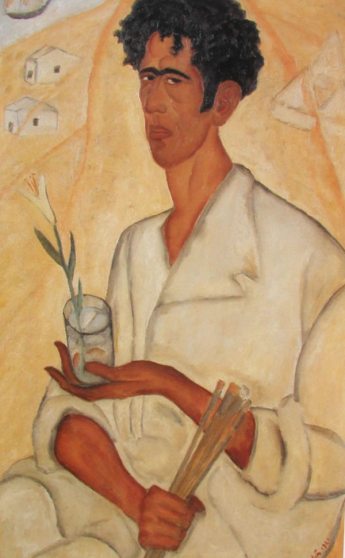
Rubin’s engagement with the luminous figure of Jesus in three of his paintings and in particular, will be considered: The Madonna of the Vagabonds; Self-Portrait with a Flower; and The Prophet in the Desert.

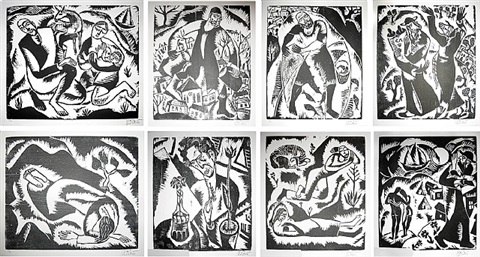
reuven-rubin-godseekers,-portfolio,- Rubin, Reuven, The prophet in the desert- B87_1119

“The God-Seekers” – A woodcut of Jesus with stigmata in his hands

The Prophet in the Desert


Rubin’s spiritual quest was tied up with his interest in the Jewish Scriptural heritage of his people. From a series of woodcut prints that Rubin produced that he entitled,The God-Seekers,” he interprets the theme that Jesus is a symbol of the regenerated Jew who is destined to take his place and therefore heals the suffering of the Diaspora (p 105). This picture of Jesus (The Prophet in the Desert) bearing stigmata in the outstretched palms of his hands in a gesture of blessing that gave expression to that sentiment.


Rubin, Reuven, First Fruits, 1923

First Fruits


fd7f1830-3a23-41d8-84d7-6254e0a09ee6

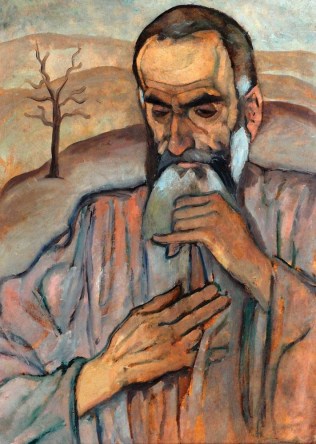
Prophet

is (1)

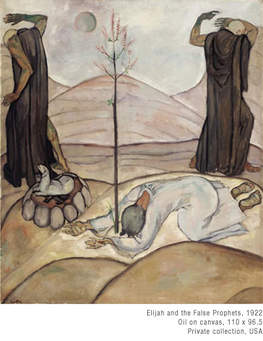
Elijah the Prophet


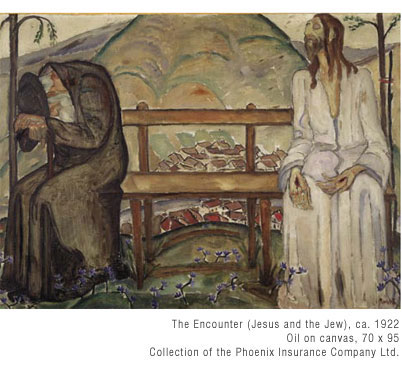
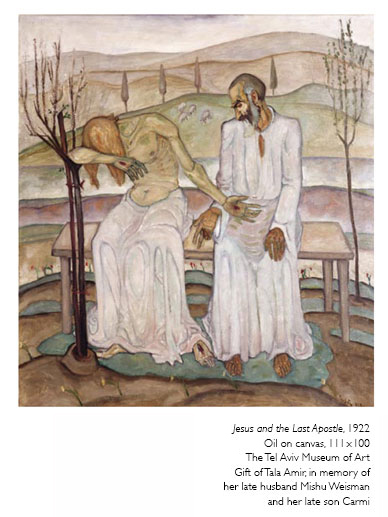
There is considerable similarity between Rubin’s two painting  Jesus and the Last Apostle  and The Encounter.

 Jesus and the Last Apostle  is a large canvas (1 – 1.10 meters) that he painted shortly before his immigration to the Land of Israel (British Mandated Palestine). On inspection the similarity between the between the two pantings is apparent (p 106).


In 1922 Rubin wrote to his friend Bernard Weinberg:

“[I am working] in agony with my very lifeblood, my own and no one else’s,” …”In this last work, I have put all my anguish of my soul, with no understanding from any side and without a ray of light. The nails in the hand and feet of Jesus are burning me, and no one can grasp my suffering” (p 106, Behold).

We recall the words and painting that Marc Chagall did:

These are but a few examples of the catalogue of paintings on the theme of Crucifixion that Chagall painted in which he identifies himself with Jesus’ suffering:

“I awake in pain / Of a new day with hopes / Not yet painted / Not yet daubed with paint / I run upstairs to my dry brushes / And I am crucified with Christ / With nails pounded in the easel” – A poem by Chagall and illustrated with his profound painting The Painter Crucified (1941-42); (p 56, Behold the Man).

EPSON scanner image

The Painter Crucified – Marc Chagall

Chagall expressed similar anguish to what Rubin had experienced, some twenty years earlier. Like many creative people, these two Jewish artists gave expression to their sense of anguish, foreboding and even its manifestation in personal physical pain. That deep emotional turmoil is often induced by the suffering that they witness around them. Rubin’s sense of pain is related to the plight of his fellow Jews in Eastern Europe and Chagall in 1942 must have had some knowledge of the huge catastrophe that was engulfing European Jewry during WWII.

The Meaning of Jesus and the Last Apostle

What is the hidden meaning behind Rubin’s painting of Jesus and the Last Apostle?

In this painting, Rubin has not depicted a known scene from the life of Jesus such as his Temptation in the Desert (Matthew 4:1-11), but this is a piece of fiction bearing a powerful message that needs to be examined.

Like other artists and intellectuals of the late 19th and early 20th century, a number of Jewish thinkers began to focus upon the person of Jesus as a Jew. This should not come as a surprise, for according to his human nature Jesus is  Jewish. However, if we consider that for two millennia the persecution and suffering heaped upon the hapless Jew in the name of Christ, then it is a surprise and all the more amazing that such a change was taking place despite the bad history of Jews and Jesus.

Bob Dylan’s song, The Times They Are A Changing, adequately gives expression to this change that was happening. Jesus became a symbol of Jewish suffering. We have explored this on numerous occasion in previous Shalom Radio UK, programmes. This Jewish action was a response to hostile attitudes adopted by the Church though engaged in worshipping Jesus, persecuted and showed hatred toward Jews (p 106, Behold).

From the Encounter to the painting of Jesus and the Last Apostle, it appears that Jesus underwent a metamorphosis. For in the Encounter, Jesus sits upright, head held high, displaying his wounds for all to see, with face showing pride and pain.

However, in Jesus and the Last Apostle, the situation to that of Jesus and the Wandering Jew are reversed: Jesus is seated on the left, where the Jew previously sat, his head is bowed with his face completely hidden.

What is the message that Rubin wants to communicate to his viewers?

The key to our understanding is held by the second figure of the Last Apostle! Who is he? For just as Jesus had communicated with his listeners in parables, so Rubin too had a deeper meaning to the imagery that he painted in this compositions.


Gala Galaction

In his letter to  Bernard Weinberg, Rubin named a well-known individual called Gala Galaction, a Romanian Orthodox priest as the person upon whom the figure of the Last Apostle is based. Galaction sincere love of the Jewish people of Romania, and he helped mediate between Christians and Jews in a very hostile environment that was anti-Semitic and dangerous for Jews. In addition, this philo-Semitic priest encouraged Zionism and he saw that Jewish immigration to the Land of Israel would be a solution to their plight in Europe.

Because of Galaction’s love of Jewish people, Rubin placed this figure of him as the Last Apostle at the side of Jesus, with Jesus showing his wounds to the Last Apostle. “Jesus seems to be expressing his grief [or] perhaps remorse, at the suffering endured by the Jewish people on his account” (p 106, Behold).

By his depicting Galaction as the Last Apostle, Rubin may have intended to convey a historic reconciliation and a reversal of roles. “Jesus has been transformed: no longer the long-suffering victim for which the Jews are blamed. He hangs his head and asks to be forgiven for the persecution of the Jews [that took place in his name]. The conciliatory figure of Galaction portrays a new kind of apostle, the Last Apostle, who will inspire mutual understanding between the two religions” (p 106, Behold).

Alas, this message of reconciling love expressed by this philo-Semite, Galaction proved to be among an isolated few voices in a Europe that were to carry out its greatest outrage against the Jewish people ever witnessed. With the rise of National Socialism (Nazism) in Germany that began its rise to power in 1933, resulting in the mass murder of 6,000,000 Jews during WWII.


20090331_1525645058_gwiazdy,oHuCn6impHCVqcKHZpY

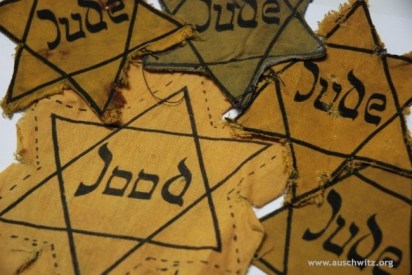
On July 18th, 1925 Adolf Hitler wrote his pernicious book of hate, Mein Kampf  (My Struggle) in which he formulated his ideas that resulted in Nazi Germany carrying out the Final Solution resulting in the extermination of two-thirds of the Jews of Europe. Hitler describes his pathological hatred and loathing of the Jews in his book.


Romania, despite the wonderful work of Galaction, also became a killing field of its Jews under the direction of the occupying Nazi’s. A third of its Jewish population perished under Nazi persecution.


As we have seen other Jewish artists such as Anotokolsky, and Marc Chagall shared a similar desire to Rubin, using Jesus’ image in their work as a bridge between Christians and Jews, as was Gottlieb’s intention. Additionally to the message of religious reconciliation, Jesus and the Last Apostle, Rubin to his friend Weinberg expressed his personal identification of his own anguish with that of Jesus the man. This was particularly the case in his painting The Temptation in the Desert, where this Jesus seeks to heal the suffering the Jewish people and he also embodies the artist’s own pain (p 106 & 109, Behold).

In 1922 Rubin exhibited a number of his painting in New York, USA. This included the picture The Suffering of Christ and a sculpture and sketch as Christ Homesick. The record of these “lost and undocumented works offer additional evidence of Rubin’s great interest in the figure of Jesus, and perhaps (in the case of Christ Homesick) in linking him to Zionism” (p 109, Behold). EPSON scanner imageThe Meal of the Poor painted by Rubin in Bucharest and on display at the New York exhibition in 1922, has strong Christian overtones: “Seven despondent, lowly people sit at the foreshortened oval table. At the head of the table is an elderly Rabbi-like figure, (dressed in a coat resembling a kapote worn by traditional Eastern European Jews) breaks the bread. Everyone present is enveloped in a halo-like aura this especially visible around the rabbi and the man seated at the right. On the table are foods are eaten by the poor, slices of watermelon, bread and a solitary fish on a plate – and a glass carafe holding a white lily, the attribute of the Virgin Mary found in many depictions of the Annunciation. Rubin’s works from this period contain the flower motif as a symbol of rebirth, and a white lily features prominently in his well-known work soon after his arrival in Ertez Israel” (p 109)

.painting1.jpg

Mariotto di Nardo’s Last Supper

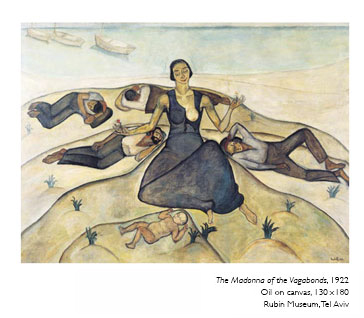
Madonna_Vagabonds

The Madonna and the Vagabonds

The Madonna and the Vagabonds exhibited at the exhibition of Rubin’s work in Bucharest. Like the Encounter painting, with New Testament referencing Jesus is shown as an infant. This use of an infant Jesus symbolises “a pioneer reborn in the Land of Israel” (p 111, Behold).

A number of significant changes should be noted, namely Rubin’s palette is brighter and his new Eretz Israel style witnesses a change from a suffering Jesus to a newborn baby. This change was brought about by his new optimism linked to his immigration to the Land of Israel (p 111, Behold).

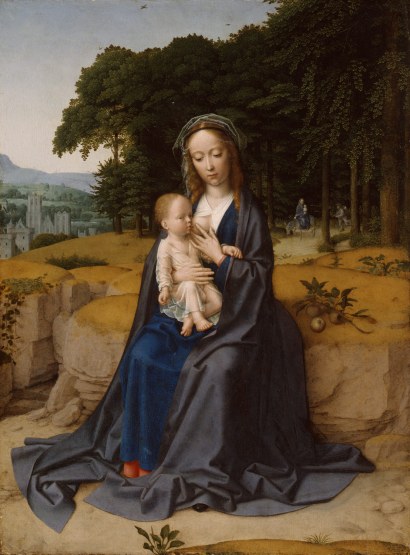
The Nursing Madonna was a popular theme with European artist from the Middle-Ages,  with Rubin’s conflation (to fuse into one entity; merge) of this image taken from Christian iconography. The example of the Madonna and Adoring Child first appeared in the 13th century. Sometimes Mary is alone shown worshipping the infant, while other times Joseph is also depicted alongside her.

Rubin may well have been exposed to some of these paintings in his native Romanic or some of the neighbouring countries such as Moldova, where painted images of the Madonna and Adoring Child. These paintings were rendered in a Neo-Byzantine style, like this painting by Jean Fourquet’s Madonna Surrounded by Cherubim and Seraphim (1452).

fouquet_madonna_melun_grt

Jean Fourquet’s Madonna Surrounded by Cherubim and Seraphim (1452).

The Meaning of the Madonna and the Vagabonds

Rubin’s interpretation of the Madonna and the Vagabonds may well represent four apostles in this very unusual representation, with the four figures that surround the Madonna together with the infant Jesus all lying on the ground.

What was behind his thinking in doing this portrayal like that?

In this picture by Rubin, the day is dawning, with signifies an expression of hope on the threshold of a new era. As discussed previously, the work and style of Ferdinand Holder profoundly influenced Rubin’s work. The image of the young child in a symbolic sense is an image of regeneration. This image of the young child has been used in two of Holder’s paintings, namely, Adoration (1893), and The Consecrated One (1893-1894).

the-consecrated-one

Adoration

Holders Adoration-art-paintings-art-nouveau

The Consecrated One

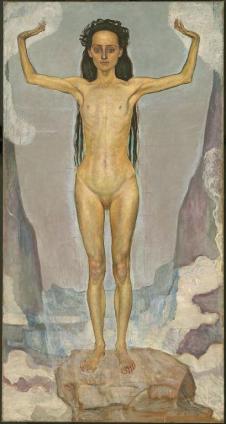
A clear link to Madonna and Child is evident in Holder’s work and Rubin’s portrayal of the Madonna. In the painting Day (1899), Holder painted five nude female figures  seated on the ground in a semi-circle, warmed by the pale light that welcomes the new day, with the central figure with upraised hands.

the-day-1900


hodler  Ferdinand Holder

day

This issue of a nude female with raised hands in the picture the Orant                                    (a representation of a female figure, with outstretched arms and palms up in a gesture of prayer, is an image in ancient and early Christian art). This image of the woman with upraised hands is also seen in Holder’s picture, Truth II (1903). The hands of Rubin’s Madonna are seen in a similar pose. But Rubin’s Madonna,  the woman she holds flowers as a sign of the future suffering of the new-born Messiah (p 112, Behold).

We are reminded of Simeon’s prayer the Nunc Dimittis [from the opening words (Vulgate Latin Bible ): now let depart] :

Luke 2:29-12:42 (NRSV)

“Master, now you are dismissing your servant (now let depart) in peace, according to your word; for my eyes have seen your salvation, which you have prepared in the presence of all peoples, a light for revelation to the Gentiles and for glory to your people Israel.” And the child’s father and mother were amazed at what was being said about him.  Then Simeon blessed them and said to his mother Mary, “This child is destined for the falling and the rising of many in Israel, and to be a sign that will be opposed so that the inner thoughts of many will be revealed–and a sword will pierce your own soul too.”

The words, “…and a sword will pierce your own soul too.” anticipated the fact that the infant Jesus was destined to suffer and die and this would affect Mary profoundly.

Purvis de Chavannes’ masterpiece, The Poor Fisherman (1881), that was exhibited at the Louvre while Rubin was in Paris, France. There is also a connection between this painting and Rubin’s Madonna and the Vagabonds. The image of an infant on the ground and a fishing boat are significant as they recall the words of Jesus to the Apostles Peter and Andrew as they were casting their nets, “Come ye after me, and I will make you to become fishers of men” (Mark 1.17).

the-poor-fishermanPurvis de Chavannes’ masterpiece, The Poor Fisherman
Madonna_Vagabonds

In the background of Rubin’s of the painting the Sea of Galilee can be seen, is the setting of The Madonna of the Vagabonds, and many other scriptural scenes take place.

The Sea of Galilee is also the place where Jesus walked on the water and he is the fisher of souls. The three empty boats in the water, belonging to the fishermen asleep on the shore viewed in this picture. Are they waiting to be summoned by the Redeemer that has been born? (p 112, Behold).

si-102643.jpg_ihcm-33_iwcm-90_fid-880214_fwcm-2.5_maxdim-1000

Rubin’s early works that he did in the Land of Israel, have been compared to Gauguin’s portrayals of Tahiti, both wishing to visually portray that which is primodal and pure. It is very likely that Rubin had seen ‘s work on show in New York, USA, while he was there. The figure of Mary has been regarded as the second ‘Eve’, an untainted and noble savage like the women of Tahiti, who were untainted in contrast to the women of Europe who were considered to be decadent and seductive. This was the type of figure shown in the Madonna of the Vagabonds.

Unlike many portrayals of Madonna and Child the woman is not engaged in adoring the baby, but represents a figure with bared breast as a symbol of fertility, with her being seated conveying the message of simplicity and rootedness, rather than a traditional Christian portrayal of her seated on a throne attended by heavenly beings as in Jean Fourquet’s Madonna Surrounded by Cherubim and Seraphim (1452).

The men asleep behind her, the vagabonds are pioneers who have come to build the Land. However, having said that it is still imbued with Christian symbolism. This is not about suffering and death, but hope and renewal, though this is not without pain, hinted by the red flower in the woman’s palm that can just be seen. In it Rubin relates to Jesus in a different guise, as the child will bring redemption and vanquish death, through his resurrection (p 112, Behold).

Some Observations

Though there is a similarity of the composition of the two painting by Rubin, The Madonna of the Vagabonds is diametrically opposed to the Temptation in the Desert.

The tortured figure of Jesus in the Temptation, is replaced by the smiling figure of the Madonna, for she is the antithesis of the Temptation’s  femme fatale. The Madonna’s bared breast suggests health and fecundity (the ability to produce young in great numbers), where as the temptress in the Temptation has very different connotations.

“Jesus as a representative of Zionism’s New Jew in the Encounter reappears more powerfully The Madonna of the Vagabonds. The baby Jesus symbolises rebirth in the homeland as well as resurrection after the death of exile” (p 113, Behold). In some ways it can be viewed as a self-portrait of the artist, Rubin, who was about to begin a new life in the Land of Israel.

Reuven Rubin in Jerusalem

In April, 1923 Rubin realised his dream of moving to the Land of Israel, and this move brought mixed emotions. Though he was glad to be in the sunshine under clear blue skies, yet he was particularly saddened by the state of art in the country at the time.

He penned these words in his autobiography:

“Now I am in Jerusalem, I tread on the same stones that I first touched eleven years ago, and I roam in the very places where so many God-seekers cried out their anguish and affliction. I came here to spend Tisha Be-Av, the day of sadness over our destruction [the destruction of the Temple], in order to experience it to the full. I should like to stand, quaking, before this immense destruction etched on our backs through the generations, in order to leave here a stronger man, so that I many convince. Whom? Of what? How can I convince? Nonsense, nonsense…

No one has the courage to get up and sweep away all the merchants and pedlars from within the Temple. The Temple must be cleansed! I promise you the day will come when I will pluck up courage and my fist will be strong and my voice reverberate, and then the time will come for me to be the man who will sweep away. But in that case better I should decide to die[?] young. Other wise it won’t work” (p 113, Behold).

Rubin clearly associated himself with Jesus in his cleansing of the Temple, viewing himself as one who had a new message to share, even as a prophet of the Messiah had. His mission was to cleanse the temple of the art world from all that was rotten and old. One the one hand he is excited and enthusiastic by a sense of the spirit  of renewal, but on the other hand he feels deeply frustrated and troubled. With this in mind it is easy to understand why he identified with the prophets and Jesus.

bg

Rubin’s Self-Portrait with a Flower

In the painting of Rubin’s Self-Portrait with a Flower, he is wearing the white shirt of a chalutz (pioneer), against a background of sand dunes, tents and houses and a boat is also visible in the corner by the sea. He self-confidently gazes at the viewer out of the corner of his eyes that seem to penetrate one’s eyes. In the one hand he holds a glass with a white flower in it, while in the other, he clutches a number of his artist’s paint brushes.

The most striking feature is the picture is the white lily in the glass, which is a symbol of the Annunciation given to the Virgin Mary concerning the Holy Child that she will bear. Once again this message of renewal in the homeland is stressed. These hands unlike another self-portrait done by Rubin, communicate the importance of the Annunciation  to the viewer, and do not bear stigmata as was the case in other paintings (p 113-114).

is

Albert Durer’s – Self-Portrait: Man of Sorrows

In Albert Durer’s – Self-Portrait: Man of Sorrows in both hands he is holding the instruments of torture, a Birch and Scouge (1522), and as Rubin so often spoke and also portrayed himself as a tortured man, there are echos of Durer’s picture. While there is no evidence that Rubin knew of the work, very interesting parallels exist, the unhappy man with a possible accusatory look from the corner of the eyes of both, and in the left hand Durer’s Jesus holds a reed-scepter, while Rubin holds a hand full of paintbrushes.

These two paintings show victims of two different kinds. Durer’s Jesus sacrificing himself for the sake of humanity, while Rubin’s sacrifices himself as a artist-pioneer for the sake of the Jewish nation. The hand holding the paintbrushes may be equated to Rubin’s instruments of torture and suffering and the while the white lily the hope of redemption (p 115, Behold).

Once more in a letter to his friend Bernard Weinberg, Rubin wrote, “Today I passed through the valley [The Jezreel Valley] and this day I saw our crucified of the present time” (p 116, Behold).

Our final painting that we consider in this programme is Rubin’s First Seder in Jerusalem (1949).
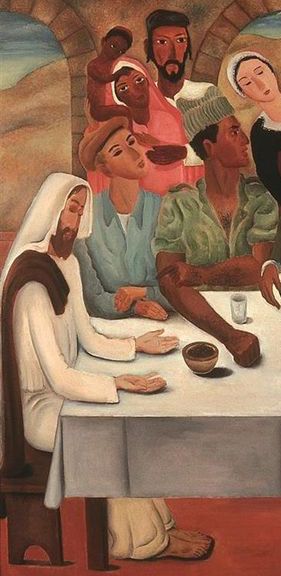
d47921d1640892929f3b90cc9860e567--jewish-art-rubinRubin’s First Seder in Jerusalem (1949).

Nearly 30 years after Rubin painted, the painting Meal of the Poor and The Madonna of the Vagabonds, and nearly two years after the founding of the State of Israel, Jesus takes his place at the Passover table in Jerusalem. This ritual meal celebrating deliverance and redemption (p 118, Behold)

A Description of the First Seder in Jerusalem

Seated and standing around the table are people from various ethnic and cultural backgrounds, The one thing they all have is common is that they are all in the Land of Israel, no longer British Mandated Palestine, but the new sovereign nation of Israel. These are Jews who have gathered from many nations.

There are Six figures that we should note in particular: a Yemenite looking elderly Jewish man (who could be a rabbi) holding the Passover cup that is raised in one hand and a Seder plate in the other; next to the rabbi is a good looking dark complexioned  couple: the man with his wife and she is holding a baby boy (wearing a scull cap) that she is nursing (an echo of a Madonna and Child) and the child’s father is gently touching the babies head, symbolising blessing and also according to Rubi’s imagery, fertitlty; then there is a self-portrait of  a seated older grey haired Reuven Rubin with his arm around the shoulder of a young boy who is standing next to him (this could be his son, a native born first generation child born in the Land of Israel who may now be correctly called an Israeli).

REUVEN_RUBIN_PAINTING_HIS_SON_IN_HIS_STUDIO_IN_TEL_AVIV._הצייר_ראובן_רובין_מצייר_את_בנו_בסטודיו_שלו_בתל_אביב 2.D22-115

The final figure that I wish to consider is at the other end of the table: Jesus

It is the seated figure of Jesus wearing a white robe, with his open hands bearing the stigmata and placed on the table and with his bowed in prayer. His image in the First Seder in Jerusalem suggests one who is resting in a peaceful state of composure. There are no signs of conflict as viewed in some of Rubin’s other depictions of Jesus, thinking particularly of the Encounter and Jesus and the Last Apostle, in which both portrayals are full of contrition, pain and sorrow. This painting  is in some measure the crowning glory of Rubin’s work dealing with the person of Jesus and may be considered a masterpiece!

Traditionally on a Seder night, those living in the Diaspora say: “Next year in Jerusalem,” which is filled with the hope of return to the Land of Israel! But this group at this the First Seder in Jerusalem may proclaim: “This year in Jerusalem,” and I wish to add the words, “Hallelujah!” [Praise the L_rd], because Jesus (Yeshua) is with them too.

Croped--jewish-art-rubinDetail of the Figure of Jesus at the First Seder in Jerusalem 


“And I will pour out on the house of David and the inhabitants of Jerusalem a spirit of grace and pleas for mercy, so that, when they look on me, on him whom they have pierced,* they shall mourn for him, as one mourns for an only child, and weep bitterly over him, as one weeps over a firstborn (Zechariah 12.10 – ESV).


*This relates to the crucifixion of Jesus, and to his being pierced by the Roman soldier’s spear, and this interpretation agrees with the opinion of some ancient Jewish sources, who interpret it as to referring to Messiah the Son of David.


Encounter and Jesus and the Last Apostle


What Kind of Messiah?

There are two doctrines of the Messiah held within the Judaism of Jesus time. In two millennia this view of the Messiah of Judaism has not drastically altered.

Firstly, a political Messiah, and secondly, the suffering spiritual Messiah:

Initially Rubin’s Messiah that he featured in his early paintings was the Suffering Messiah. However, Rubin also held to a Political Messiah who as liberator sets the Jews of the Diaspora free from persecution, suffering and exile. He heals and regenerates them in their return to the Land of Israel.

This reminds us that Jesus is a changed multivalent  figure (having various meanings) and links to the revival of the Jewish people in their homeland, in Reuven Rubin’s work (p 118, Behold).


Our final two programmes in this series from Behold the Man: Jesus in Israeli Art is entitled: From Personal Experience to National Identity. This will also be a two part programme (Part A and Part B).


Shalom Radio UK is an independent audio-visual blog site that promotes Good News.

Sponsored by Messianic Teaching Ministry International – MTMI

http://www.hotrodronisblog.com

*Behold the Man: Man of Sorrows and Zionist Messiah (Part A)

*[AMATAI MENDELSOHN, BEHOLD THE MAN: JESUS IN ISRAELI ART, MAGNES PRESS, JERUSALEM, 2017 – ISBN 978 965 278 465 0]


http://www.hotrodronisblog.com

Shalom Radio UK – This month’s programme:listenButton

self-portrait_1921_p46


Behold the Man: Man of Sorrows and Zionist Messiah

(Song: Man of Sorrows: Man of Sorrows, what a name).

1 “Man of Sorrows,” what a name
For the Son of God who came
Ruined sinners to reclaim!                                                                                                      Hallelujah! what a Saviour!

2 Bearing shame and scoffing rude,                                                                                                In my place condemned He stood;                                                                                             Sealed my pardon with His blood;                                                                                        Hallelujah! what a Saviour!

3  Guilty, vile, and helpless, we,
Spotless Lamb of God was He;
Full redemption—can it be?                                                                                                    Hallelujah! what a Saviour!

4  Lifted up was He to die,
“It is finished!” was His cry;
Now in heaven exalted high;
Hallelujah! what a Saviour!

5  When He comes, our glorious King,
To His kingdom us to bring,
Then anew this song we’ll sing,                                                                                            Hallelujah! what a Saviour!

Part 3: Man of Sorrows and Zionist Messiah

Man of Sorrows – Suffering Jesus

In the continued development of our theme of Behold the Man, this programme focuses upon how Jewish and Israeli artists give expression to the Man of Sorrows and how this motif expresses the personality of the Zionist Messiah.

In the hymn “Man of Sorrows, what a man…” we are given the classic Christian interpretation of the rejection and crucifixion of Jesus, however, the Jewish and Israeli approach while using this image of Jesus as that man of sorrows, he becomes a symbol of Jewish suffering both individually and corporately. This will become apparent as we consider this portrayal by Jewish and Israeli artists.

Invite-Reuven-Rubin-Christies-Ed 1

Reuven Rubin (ראובן רובין‎‎, 1893 – 1974) was a Romanian-born Israeli painter and Israel’s first ambassador to Romania.

Rubin Zelicovici (later Reuven Rubin) came from a poor Romanian Jewish Chasidic family. In 1912, he left for Ottoman-ruled Palestine to study art at Bezalel Academy of Art and Design in Jerusalem. Finding himself at odds with the artistic views of the Academy’s teachers, he left for Paris, France in 1913 to pursue his studies at the École Nationale Supérieure des Beaux-Arts. At the outbreak of World War I, he was returned to Romania, where he spent the war years.

In 1923, Rubin emigrated to Mandate Palestine.

The history of Israeli art began at a very specific moment in the history of international art, at a time of Cezannian rebellion against the conventions of the past, a time typified by rapid stylistic changes. Thus Jewish national art had no fixed history, no canon to obey. Rubin began his career at a fortunate time.


He rejected the neo-classical style of the late 19th and early 20th century fully embracing the impressionistic style of painting and is sometimes referred to as the father of modern art.

In Palestine, Rubin became one of the founders of the new Eretz-Yisrael style. Recurring themes in his work were the biblical landscape, folklore and people, including Yemonite and Chasidic Jews as well as Arabs. Many of his paintings are sun-bathed depictions of Jerusalem and the Galilee.

Other Jewish painters together with Rubin depicted the country’s landscapes in the 1920s rebelled against Bezalel school’s style. They sought current styles in Europe that would help portray their own country’s landscape, in keeping with the spirit of the time. Rubin’s Cezannesque landscapes from the 1920s were defined as both modern and a naive, portraying the landscape and inhabitants of Israel in a sensitive fashion. His landscape paintings in particular paid special detail to a spiritual, translucent light.


Rubin might have been influenced by the work of Henri Rousseau whose style combined with Eastern nuances, as well as with the neo-Byzantine art to which Rubin had been exposed in his native Romania. In accordance with his integrative style, he signed his works with his first name in Hebrew and his surname in Roman letters. [https://en.wikipedia.org/wiki/Reuven_Rubin].

s0085537-010


In his early years he was still searching for an artistic voice and the influence of Eugene Delacroix, Paul de Chavannes a symbolist and together with Jewish artists such as Hirzenberg, Lilien and Schatz is apparent in his early work as a painter as well as the Romanian artist Lucian Grigoreseu (p 96, Beold the Man).

For the purpose of this programme we will focus upon the portrayal of Jesus and other related scenes of suffering involving Israelites and Jews.

1520059

Rubin’s painting – By the River of Babylon

Eduard_Bendemann_-_Jeremia_seated_in_the_ruins_of_Jerusalem

By the River of Babylon is a complex allegorical portrayal of Jewish suffering in exile, as was the case of the depiction by Eduard Bendemann, E M Lilien in his illustration for the Lutheran Bible. Rubin would have been aware of these two works, but his painting makes a departure from most works on this subject.

history1-riversofbabylon

An analysis of the picture by Rubin shows the group of human figures against the background of a massive rock and surrounded by water. This group of five people are gathered, with the centrepiece of a seated woman feeding an infant. Her breasts are bared and she gazes down at the infant with a sad expression. Of the five figures only one is fully clad and including the infant the four are completely naked. The standing image of a naked bearded man is clutched by an elderly man who is wearing a cloak. What may be the reason for this depiction of figures in the way that Rubin painted them?

An explanation of the figures is that each represents a stage in the cycle of life and has a symbolic meaning. Alongside the obvious biblical Jewish theme of those who look downcast due to their exile by the River of Babylon, the painting relates to Christian iconography. The core of the scene is the nursing mother with infant child from a traditional representation of Madonna and child. An example of this classic portrayal by Gerard David’s painting The Rest on the Flight into Egypt. The naked by with sling shot alludes to David, forefather of the messianic dynasty in Christianity as well as Judaism. “This is the most active figure in the picture: in the struggle for self-preservation, he takes destiny into his own hands” (p 97). Also the baby is a symbol of hope for the future and the rider on the camel points East to some place across the water, that is beyond the frame of the painting. The focusing upon the mother and infant is reminiscent of Gerard David’s The Rest on the Flight into Egypt. This may allude to the Jewish people’s enduring exile that began in Babylon millennia ago and the hoped return to their ancient homeland. We should note that the mother and child motif reoccurs in Rubin’s work in a number of paintings (p 97).

hb_49.7.21 (1)

From 1919 Rubin’s paintings found its voice with a new expression that acquired a destructive religious overtone. He depicted prophets and ascetics as well as na intriguing preoccupation with the figure of Jesus (p 97).

He drew inspiration from such artists as El Greco, Schiele, Picasso (in his Blue Period), and particularly Ferdinand Holder who Rubin met in 1915.


Rubin’s Temptation in the Desert

EPSON scanner image

Holder’s style influenced Rubin’s style


Rubin’s painting Temptation in the Desert which he did in 1921 is a key work. It is a complex painting of personal identification with the figure of Jesus (p 98). An analysis of the picture reveals five figures in various poses on the parched desert sand dunes at dawn. In the centre is an emaciated kneeling man with his upper torso naked clutching  himself. A faint white halo can be seen surrounding the head of the figure. He is in profound concentration with eyes closed.

“The New Testament story of the temptation in the desert (or wilderness) relates that Jesus spent forty days in the desert, steadfastly affirming his faith when he was challenged in various ways by Satan (Matthew 4:1-11; Luke 4:1-13) – (p 99).

Anon_st-anthony

St. Anthony (ca. 251-356), viewed as the one who established Christian monasticism, was subjected to a long series of tortures by Satan. These included temptations of the flesh during his time as a hermit living in the desert. The story of St. Anthony inspired many European Masters to do portrayals of his temptations.

Rubin’s encounters with these paintings of the late nineteenth century during his studies in Paris, France, “…[W]hen the destructive femme fatale* became a prevalent literary and artistic motif, female temptresses and erotic imagery featured strongly in depictions of St. Anthony” (p 99).

le_num__ro_de_mars_2014_de_vogue_paris_lara_stone_664_north_499x_white

*A femme fatale (French: [fam fatal]) is a stock character of a mysterious and seductive woman whose charms ensnare her lovers, often leading them into compromising, dangerous, and deadly situations. She is an archetype of literature and art. Her ability to entrance and hypnotise her victim with a spell was in the earliest stories seen as being literally supernatural; hence, the femme fatale today is still often described as having a power akin to an enchantress, seductress, vampire, witch, or demon, having power over men (https://en.wikipedia.org/wiki/Help:IPA/French).

EPSON scanner image

Returning to the Temptation in the Desert, Rubin comments, “That the figure in the middle is myself…it is I resisting temptation, continuing on my way of suffering in spite of the hands that reach out to grasp me…she [the woman] is trying to hold me back, but i am going on. I shall go on!” It is as if Rubin is telling the woman in the foreground o the painting, not to impede his artistic mission (p 101).

The fervent supplication of a self-sacrificing holy man, while around him sleep, and the idea of resisting earthly temptation come together in the Temptation in the Desert to identify Rubin with Jesus. On analysing this painting the viewer is presented with an depth of understanding that Romantics felt that their devotion to art entailed suffering and abstinence, joining their lot to Jesus, saints and other ascetics (p 101).

Rubin was profoundly influenced by his brother Baruch’s death, who died from an epidemic during WWI while they were living in Romania. While Baruch died through disease, Rubin regarded his death as a casualty of war. This led to a period of deep depression and Rubin recounts of his brother, that he was “closest to me in age and sympathy” (p 102). In this way Rubin fussed his brother and himself into a single figure who he directly linked to the figure of Jesus.


Rubin joins the ranks of his contemporary artists such as Max Beckman and the sculptor Jacob Epstein, who both depicted Jesus in the context of the horrors of the WWI as an indictment of human evil and in humanity.

The Suffering Jesus

Jewish writers, poets and artists have a clear insight and understanding of the suffering Jesus, however, there is much more to the person and work of Jesus that needs to be grasped. Thomas F. Torrance in his book, Atonement, the Person and Work of Christ, explains,

Jesus is firstly, a Prophet, i.e. [the foretelling of the] Word made flesh, the advocate, corresponds to the incarnation or goel aspect of redemption.

Jesus is secondly, Priest, i.e. this corresponds to the cultic-forensic or kipper aspect of redemption.

Jesus is thirdly, King, this corresponds to Christus Victor, Christ the victor, or the padah aspect of redemption, salvation through the mighty act of God (p 59).

To make sense of this we need to explore the meaning of the three Hebrew theological terms, goel, kipper, and padah.

Goel [Prophet/Go-Between-G_D(stress on the nature of the redeemer), indicate that Jesus is a Kinsman-redeemer. By his incarnation and becoming a human being, he fully identifies with our humanity, and as Son of GodAs if that was not enough, he establishes a New Covenant by laying down his life in atoning sacrifice.

He became the Kipper (expiatory and substitutionary) covering for sin by the shedding of his life blood on the cruel Roman execution stake (cross) or to use Jewish Biblical terminology he was hanged on the Cursed Tree. This fulfils the Day of Atonement sacrifices, with the death of the sacrificial goat’s blood that is sprinkled upon the altar and the scape goat (akidah), that carries away the sin of the people of God into the wilderness and dies outside the camp. Jesus was crucified outside the city walls of Jerusalem.

cbe65ae21a3ca0f3fa199b02386811bc--biblical-art-contemporary-paintings

He was hanged on the Cursed Tree

Padah (the dramatic act), this signifies that this act of redemption is accomplished by the Mighty hand of God. It is a sheer act of grace setting free not only Israel, but all humanity. This was accomplished by Jesus obedience unto death, that he freely did because of God’s great love for all (p 48-51).

In the Hagaddah (The Telling of the Passover Story) Jewish people every year hold a Seder Meal at which the story of Israels’ redemption from the land of Egypt is retold. How did this deliverance take place? A Padah: It was wrought through a dramatic act the Mighty hand of G_D, and with signs and wonders and his judgment upon Pharaoh and all of Egypt, because of their refusal to let the Israelites leave the land of bondage!

Falling into a Trap

We, as the reader and listener, must beware least we fall into the trap of reducing Jesus into a mere symbol of Jewish, Black, Hispanic, Native American Indians (First Nation), Asian, Kurdish, Gypsy, Armenian, Arab, Rohingya people, and human suffering  in general, with whom we can identify. We need to stress that he is much more than an exemplar, role model  or symbol of a Man of Sorrows.

Artists, beginning with Vincent van Gogh and Paul Gauguin onwards have used the image of the Suffering Jesus as a symbol and motif of their own personal suffering; Marc Chagall as a symbol of Jewish persecution and suffering and Reuven Rubin exemplifies an artist that identifies with the Suffering Jesus, seeing him as a symbol of his own personal suffering as in the painting the Temptation in the Desert.

It is not my intention to diminish the profundity of Rubin’s work in which he depicts Jesus, but I am motivated by a strong desire to show the fuller implication of the person and work of the Suffering Jesus.

Zionist Messiah

Reuven Rubin like other European Jewish artists was struck by the appalling circumstances that faced the Jews of Eastern Europe at the turn of the 19th century and early 20th century.

“After returning to Romania in early 1922, on the eve of his move to Palestine, Rubin began to associate Jesus with the Jewish plight in the Diaspora and with Zionism. That year he produced three important paintings while living in Bucharest: The Encounter (Jesus and the Jew), Jesus and the Last Apostle and the Madonna of the Vagabonds. The Encounter is one of the most fascinating and enigmatic of Rubin’s early works”       (p 103).

Encounter_P58

Madonna_Vagabonds

jesus_p62

To comprehend what Rubin wishes to portray to his viewers in the painting The Encounter, we need to explore the identity of the elderly Jewish man, with head bowed, sitting at one end of the bench? Encountering Jesus, he evokes the legendary figure of *the Wandering Jew, sometimes referred to as Ashver.

*The Wandering Jew is a mythical immortal man whose legend began to spread in Europe in the 13th century. The original legend concerns a Jew who taunted Jesus on the way to the Crucifixion and was then cursed to walk the earth until the Second Coming. The exact nature of the wanderer’s indiscretion varies in different versions of the tale, as do aspects of his character; sometimes he is said to be a shoemaker, other tradesman, while sometimes he is the doorman at Pontius Pilate‘s estate.[https://en.wikipedia.org/wiki/Wandering_Jew].

Not only was this pitiful character depicted in Christian literature and art, but also some Jewish artist have portrayed him such as Maurycy Gottlieb, Samuel Hirszenberg, E.M. Lilien, and Marc Chagall.

Ashver is generally depicted as being constantly on the move. This is the cardinal feature of his punishment, haunted by the crucified figure of Jesus, reminding him of his sin of taunting Jesus during his Passion. If however, the old man in Rubin’s picture is the Wandering Jew, then it takes on a different meaning departing from the norm.

The frontal position of the seated figure on the bench, recalls Holder’s pictures of misery that he depicts, as well as poverty stricken figures of Jews in Rubin’s earlier works. Richard I. Cohen suggests that he painting represents a finale in an exhausted truce in which there are no victors. Carmela Rubin describes the painting as an encounter between two people, each fixed in his own world. This suffering isolated Jew represents the plight of Eastern European Jewry, representing Rubin’s protest against their dire situation. This led him to embrace Zionism and immigration to the Land of Israel in 1923 and he saw this as the solution to their plight (p 103).

In 1929 the Yiddish poet Itzik Manger, from Czernowitz, Romania where Rubin had lived published his first collection of poems (1922-1929). A important poem fitting for our theme of Man of Sorrows and Zionist Messiah. The poem is titled: “The Ballad of the Crucified and Verminous Man”: (p 104).

EPSON scanner image

“This poem describes how a rejected, louse-ridden Jewish vagabond tells the crucified Jesus why his suffering is greater than Christ’s. In the end Jesus admits that the Jews’s pain in holier, and the wretched Jews, heartened by Jesus’ solidarity, makes his way to the village in search of bread and wine. The poem displays Manger’s characteristic wit, but also shares his indignation shared by Jewish thinkers and artists of the time, at the way Jesus’ name is invoked against the Jews. The admission by “the Crucified” indicts the Church for distorting his message in order to justify persecution and anti-Semitism…[I]t is interesting to think that Rubin might have been familiar with it. In any event, Manger’s poem reflects an engagement with the figure of Jesus that was characteristic of his generation of Yiddish poets and that was part of the Zeitgeist [from German: meaning ‘the general intellectual, moral, and cultural climate of an era’] in Jewish cultural centres such as Czernowitz” (p 104).


Take Note

We must take note of the reason for Manger’s anger at the Church and the way that he portrays it in his poem. For the Church was all to often guilty of persecuting the Jews and of being one of the main sources of Christian anti-Semitism and hatred of them. Jesus’ message to Israel and all humanity is a message of universal love and forgiveness and that is God’s intention. Any deviation from that theme is a betrayal of the Man of Sorrows.


Returning to Rubin’s painting The Encounter, another interpretation may be offered. The painting contains an important detail that may be glossed over, namely the two trees:

The tree next to the figure of the straight backed seated Jesus is supported by a stick that grows up ward, while the tree next to the drooping Jew has its branches growing downwards.

What may the significance of these two images mean? An important example of the contrast of the Jew in the Diaspora being in exile, while the image of the fertile growth of the tree is associated with the upright Jew of Zionism. As we saw in E.M. Lilien’s image on his postcard of the Fifth Zionist Congress, shows on the left hand side an elderly bearded Jew with bowed head, seated among rolls of barbed wire, with his head leaning on his walking stick. At the right in contrast the image of a Jewish pioneer plowing a field in the direction of the rising sun. We should also note that there are stalks of wheat that symbolise the fruitfulness of the Land of Israel (p 104).

Rubin in his painting The Encounter, he may well have used similar imagery to that of E.M. Lilien, that the Zionist movement that sought to bring Jews back to life, an Jesus resurrected after his suffering on the cross, evidenced by the stigmata on his hands.

It would appear that Rubin had altered the relationship of the Jew and Jesus as portrayed in Manger’s poem. The figure of Jesus who encounters the miserable old Jew who is desperate to have his pain acknowledged in none other than Jesus who here symbolises the regenerated Jew destined to take his place and thereby heal the suffering of the Diaspora! (p 105).


We should be aware of the shift in Jewish perception of the Man of Sorrows, who is being transformed from one whose suffering is a symbols of Jewish suffering, to one of hope and healing. The significance of the return from exile in the Diaspora to the Land of Israel opened the way for a fresh appraisal of the person and work of Jesus.

In our next programme, Part B: we will continue to look at the work of Reuven Rubin and how this relates to the theme of the Zionist Messiah. The work of other Jewish and Israeli artist will also be considered.


Shalom Radio UK

Sponsored by

MTMI – Messianic Teaching Ministry International

d8cf06fdd0caed8d13bc0b4212aaa574-2

Behold the Man: Jesus in Israeli Art

At the Israel Museum, Jerusalem, December 2016 – April 2017 an exhibition was staged called: Behold the Man: Jesus in Israeli Art.

To quote from the foreword of the companion book – “For two millennia, the figure of Jesus has been such a fundamental part of Western culture – in the visual arts, in literature, and in music – that it is almost impossible to relate to cultural history without citing the story of his life and death. The progenitor of what become the world’s largest religion was a Jew who lived during the Second Temple period and was put to death by the Roman rulers of Judea. Jesus came to Jerusalem to preach the Kingdom of Heaven, and it was in Jerusalem that he was crucified, so that over the years the Via Dolorosa, the Church of the Holy Sepulchre, and other sites in the Holy City have become a world focus of Christian pilgrimage.”

You may recall the programme that I produced called The Different Faces of Jesus that I posted on Shalom Radio UK in November 8 2016.

In the programme I dealt with the exhibition of Chagall: Love, War, and Exile that the Curator Susan Tumarkin Goodman did , Senior Curator Emerita, and together with Bella Meyer, granddaughter of Marc Chagall produced, explored with NYC-ARTS! See it here: http://www.nyc-arts.org/showclips/show/id/87423

white-crucixion1-6jHJhpecEENOw63THlXx8gexodus_marc_chagall

About 20 of the paintings done by Chagall in the show depict Jesus


This new show Behold The Man: Jesus in Israel Art by Amitai Mendelsohn has a far broader scope and is equally challenging to its viewers, all the more as it was on display for 4 months at the Israel Museum, Jerusalem.
Behold the Man: Jesus in Israeli Art approaches the figure of Jesus and related Christian themes from a different perspective, entering the complex realm of the relationship between Judaism and Christianity to examine for the first time  the significance of Jesus through European Jewish and Israeli art.”

Part 1. 

In this first section by way of introduction I will deal with the changing attitude of post-Enlightenment/ Haskalah European Jews and how their willingness to embrace the portrayal of Jesus in Painting and sculpture:

The work of some 40 artists dating from the late 19th century to the present time are considered. The is powerful symbolic imagery played by such subjects as the crucifixion and resurrection, sometimes reflecting the personal perspective of the artist and other times that of a collective national identity.

The inspiration behind this exhibition in Jesusalem is based upon the doctoral research of Amitai Mendelsohn, Senior Curator of the Museum’s David Orgler Department of Israeli Art.
Christians come to the depiction of Jesus in European art through the lens of their shared faith and history, and Israeli Jews bring a different perspective to their view of Jesus. Rather than him being viewed as their Saviour and Lord, alas he has all too often been viewed as the one who has caused their suffering and death. A collective punishment visited upon them by Christians who blamed them for rejecting him and causing his death by crucifixion.
All the more surprising and refreshing is this exhibition of an Israeli Jewish view of Jesus, despite all that Jews have suffered at the hands of Christians, they are able to look at Jesus through Jewish eyes. The viewer will be delighted and given a window into the outlook of Jews who dare to look at Jesus for themselves.
“In the 19th century a change in attitude affected a small but significant number of European Jewry towards Jesus, this included thinkers, writers, and eventually artists began to draw attention of the historical Jesus and sought to reclaim him. This approach aimed at reconciliation and at enhancing the position of Judaism in the Christian world – but at the same time it underscored the injustice of anti-Semitism ” (p 15).
———————————

Christians must beware of falling into the trap of thinking that they can separate anti-Zionism from anti-Semitism. Many Jewish and Christian leaders alike realise that the modern phenomena of anti-Zionism is just anti-Semitism repackaged. While Israel is not without fault in the ongoing Arab-Israeli conflict and while it is perfectly valid to criticise Israel for its violation of the human rights of Palestinians, it is quite another thing to seek to delegitimise Israel’s right to exist.

———————————–

Jesus came to serve as a symbol for suffering of the Jewish people, which reached its darkest hour during the Holocaust.

Jewish artists been influenced by iconography of the surrounding cultures and this can be seen in the work of certain painters and sculptors of the 19th century. As the Jewish source of visual images is rather sparse due to the 2nd Commandment that forbids the making of graven images, Jewish artist naturally turned to Christian sources for inspiration and reference concerning the depiction of the person of Jesus. Though there is still a strong taboo for many Jews concerning the figure of Jesus, though his presence is there at a deep veiled level.
The figure of Jesus in Hebrew literature has flourished in recent years. Also in the visual arts, Ziva Amishai-Maisels has pursued the most important research into his presence in modern Jewish art.
A major fault line that influences and divides the Jewish and Christian visual rendering of the subject of Jesus is the fact that none of the Jewish interpretations believe in his divinity. Jesus who Christians worship as the God made flesh, the figure of supreme importance in Christian art, displays a fundamental tension between his divinity and humanity. At the Council of Chalcedon  in 451 Jesus was pronounced as “truly divine and truly human” – his human identity as the suffering Man of Sorrows exists alongside his identity as God almighty. It is this duality that informs the history of Christian visual art (p 17).
This belief in the two-fold identity from the 3rd century to the present continues to define Christian portrayals of Jesus. “While Israeli Jewish artists focus on the human figure of Jesus. For Israeli artists, identification withJesus’ humanity overcame their lack of belief in his divinity. The figure of Jesus – Other but also brother – touched them as a way to express a host of thoughts, experiences, emotions, and aspirations” (p 17).

The Jewish Jesus

Artistic portrayals of Jesus date back to the 3rd century of the common era (CE), and these became prevalent particularly after the Roman Empire adapted Christianity as its religion in the 4th century.

For Judaism the use of art was primarily for decorative purposes to intended to beautify texts and ritual paraphilia such as mezuzahs, the covers of torah scrolls, candelabras, etc., while for Christians artists images and portrayals of Jesus and the Saints, became and integral part of their religion. The incarnation of God in the person of Christ (Messiah), became incarnated in sculpture, painting, murals, mosaics and more recently in photographs as well. These portrayals exemplify what Paul calls “the image of the invisible God” (Colossians 1.15). And as a testimony of incarnation, art plays an important part depicting the word becoming flesh.

John of Damascus the great iconographer of the 8th century wrote:

“Because the one who by excellency of nature transcends all quantity and size and magnitude, who has his being in the form of God, has now, by taking upon himself the form of a slave, contracted himself into a quantity and size and has acquired a physical identity, do not hesitate any longer to draw pictures and to set forth, for all to see, him who has chosen to let himself be seen” (p 37).

Though there was great controversy and opposition to the portrayal of the image of Jesus by the iconoclastic controversy of the 8th-9th century, the icon ultimately prevailed. Once more the Protestant Reformation challenged the excessive devotion that the Catholic Church gave to the portrayal of the figure of Jesus and the Saints, including a vast array of depictions of the Virgin Mary and Modonna and Child.

The image of Christ on the Cross became the centre piece of the Western worlds Christian artistic expression together with many other aspects of the life and ministry of Jesus. This figure of Christ did not disappear from Modernist art, with Impressionist art being influenced by daily secular thinking, with many of its practitioners dealing with Christian themes and particularly the the figure of Christ.

As I previously said in The Different Faces of Jesus programme, Marc Chagall drew his portrayal of Jesus in his numerous painting of the crucified Christ, from his awareness of Russian icons that he had seen in during his formative years as well as other paintings of Jesus done by Gentile artist. While Chagall’s use of the figure of the crucifixion of Christ, became an image of Jewish persecution and suffering, it was Paul Gauguin saw Vincent van Gogh’s use of the Crucified Christ, as a paradigm of martyrdom, a man truly created in Jesus’ image (p 39). Gauguin himself was one of the first artists to apply religious themes to the depiction of his own personal situation. He cultivated the image of a suffering artist.

Numerous other European artist followed this trend of using Christ’s suffering as way of giving expression to their own rejection and suffering and that of others. “World War I provoked many European artists to portray Jesus as a victim of war, symbolising their vehement opposition to the slaughter and anguish it caused” (p 41).

In England the Jewish sculptor, Jacob Epstein frequently invoked Jesus as a symbol and protest against the war. Jesus has not lost his importance of bring to people’s awareness of the society’s failure and this saw evident from the contemporary sculptor Mark Wallinger whose figure of Jesus called Ecce Homo (Behold the Man) that was originally displayed on the 4th plinth on Trafalgar Square, London in 1999, demonstrating this point.

But how relevant is the image of Jesus to European Jewish and Israeli artist?

Jewish artist continue to display considerable interest in the figure of Jesus inspiring their work in a number of ways. “The European Jewish artist’ engagement with Jesus had a number of motivations:

The struggle for cultural integration; the need to combat entrenched religious ant-Semitism; the desire to present the Christian Saviour as an exceptional human being of Jewish origin, who did not set out to create a new religion; the introduction of a particularly pointed symbol of Jewish suffering; and the wish to show that the universal values had their roots in Judaism” (p 45).

The Haskalah (Enlightenment) movement specific goal of its depiction of Jesus was one of the elements to help Judaism of the European Enlightenment was to help modern Judaism to full integrate into a new European environment, modern, objective and enlightened (p 45). An example of a Russian Jewish sculptor, Mark (Mordechai) Antokolsky of Vilna born in 1843. His figures ranged from Jesus, John the Baptist to Socrates and Mephistopheles. He also depicted figures of Jewish artisans and other historical figures including the controversial Jewish philosopher Spinoza.

He became the first Jew to become a full member of the Imperial Academy of Arts and on two occasions he won the prestigious first prize at the Exposition Universalle in Paris in 1878 and 1900. His work Ivan the Terrible commissioned by Czar Alexander II for the Heritage collection in St Petersburg. He was not immune to anti-Semitic attack and suffered tension between his identity as a Jew and his desire to make his way as a Russian artist – especially in the field of sculpture, which until then was closed to Jews. The nationalist and anti-Semitic press called him an “insolent Yid,” unworthy to portray the heroes of Russian history and their Christian spirit, but his overwhelming success – in a period characterized by waves of anti-Semitism – overcame these attacks.

One of his most important pieces form our point of view is the sculpture Christ before the People’s Court made in 1873 (later copies were made by the artist). Jesus is portrayed as completely Jewish with skullcap and sidelocks, wearing a robe that suggests a prayer shawl. It was his desire to redress the injury done to the Jews by the church by portraying this Jewish Jesus. He believed in an ethical Jesus whose role model should inspire all (p 46).

Jesus “lived and died as a Jew for the truth and brotherhood, this is why I like to portray Jesus and a pure Jewish type and to represent him with a covered head (p 47). In a letter to a friend, he wrote, In the title… I mean also to refer to the present, I truly believe that if Christ would rise again and see how his ideas have been twisted and exploited by the Fathers of the Inquisition and others, he would rebel against them as he rebelled against the Pharisees and would agree to be crucified ten more times for his beliefs.”

He wrote to Stasov in 1873, while working on the sculpture, “Although Jews renounce and still renounce [Jesus], I solemnly believe that he was and died a Jew for truth and brotherhood. This is why I want to make of him a purely Jewish type… I imagine how Jews and Christians will rise against me. Jews will probably say, ‘How is it that you made Christ?’ and Christians will say, ‘What kind of Christ did he make?’ but I do not care for this” After he completed the sculpture , he wrote “I have finished ‘Christ’ yesterday… I myself am not able to evaluate my work because I expressed everything in my soul in this statue, and now I am tired and grow dull” (p 47).

Many praised the sculpture and acclaimed it as a masterpiece, while others criticized the sculpture when it was put on display in Paris in 1878. Vladimir Stastov’s anti-Semitic comments, “To these people, to imagine Christ as a Roman or an academic model was fine, but as a Jew – never!” (p 50).

A young Polish Jewish Artist, Mauryey Gottlieb (1856-1879) in his short life who died at the age of 23, made an outstanding contribution as a painter, he managed to create a remarkable body of work that united Polish Christian culture, the artist’s Jewish identity, and a universal message of reconciliation between the two religions. Jesus was the central character in two monumental and highly complex paintings that Gottlieb was still working on when he died: Christ before his Judges and Christ teaching in Capernaum. Both incorporate self-portraits, a further indication of how important these two ambitious works were to Gottlieb. They convey his personal, artistic, and political manifesto concerning Jesus the Jew and Jewish-Christian relations. Like his contemporaries, these paintings reflect the prevailing scholarly focus on the historical Jesus, which achieved artistic expression by such means as realistic depictions that were faithful to the period and the locale, an emphasis on Jesus’ humanity (p 50).

Gottlieb challenged the traditional Catholic iconography, and concentrated on the genre of history painting, depicting selected religious and literary themes in an academic orientalist style that he learned chiefly from his teacher Jan Matejko, the most important Polish artist of the time.


Behold the Man: Between Judaism, Zionism, and Christianity

Shalom Radio UK

http://www.hotrodronisblog.com

6378124915_db1307027b_b“A Celebration of Unity and Diversity is the space between Judaism and Christianity”

– Roots & Shoots –

download (2)

The Martyrs of Kischinew by E M Lilien

Jews fleeing from persecution in Eastern Europe sought places that were less hostile and more secure, with a number turning towards their ancient Biblical homeland as an option to settle. This led to the establishment of growing numbers of Jews moving to Ottoman occupied Palestine

(In the 3 part series of programmes on Joseph Rabinowitz we considered some of the issues surrounding the pogroms that were instigated against the Jews of the realm).

 This is from the Archive:

Part 1

Part 2

Part 3

______________________________________________

This is the current programme – click below to listen:

Part 2

Behold the Man: Between Judaism, Zionism, and Christianity

images (10)


These new European Jewish arrivals in Ottoman Palestine during the latter part of the 19th and early 20th centuries, were motivated by the Zionist ideal of the ingathering of the Jews from the diaspora to their ancient Jewish homeland and this idealism finds expression in artists among the new arrivals and is depicted in sculptures, pictures and paintings by them.

Zionism – what it is not and what it is!

It is my desire to seek to clear up some misconceptions regarding what Zionism is and what Zionists believe.

The mere mention of the word “Zionist” or “Zionism” has taken on a negative meaning in the minds of many and this is due to a number of factors – the anti-Israel campaigners and lobbyists who pursue their propaganda war against modern Israel and the BDS (cultural, academic & economic boycotts) which questions Israel’s very right to exist as a sovereign nation state, and continues to be a challenge that needs to be countered. 

Therefore, in the present anti-Semitic/anti-Zionist/anti-Israel/anti-Jewish climate, open and frank conversations are needed in an increasingly dangerous world in which we live, with its growing hostility to those who hold differing views to our own and this is particularly the case for Jews in general and Israel in particular.

Say, “NO!” to hate speech and hate crimes

Contrary to the UN Resolution 3379 – ZIONISM IS NOT RACISM

United Nations General Assembly Resolution 3379, adopted on November 10, 1975 by a vote of 72 to 35 (with 32 abstentions), “determine[d] that Zionism is a form of racism and racial discrimination”. The vote took place approximately one year after UNGA 3237 granted the PLO “observer status”, following PLO president Yasser Arafat‘s “olive branch” speech to the General Assembly in November 1974. The resolution was passed with the support of the Soviet bloc and other then Soviet-aligned nations, in addition to the Arab and Muslim majority countries.

The determination that “Zionism is a form of racism and racial discrimination”, contained in the resolution, was revoked in 1991 with UN General Assembly Resolution 

(https://en.wikipedia.org/wiki/United_Nations_General_Assembly_Resolution_3379).


While Arab nationalism is not considered racist, Jewish nationalism (Zionism) is called racist. Many Arab and Moslem nations discriminate and severely restrict religious freedom targeting Jews, Kurds, and Armenians, Christians, Druze, Baha’i, Ahmadiyyas, Yazidi, Zoroastrian and this includes either Shia or Sunni minorities depending on the particular country, yet the one democratic country, Israel, that allows religious freedom, is singled out as racist.

The prime reason for this accusation is the fact that the PLO, Hamas and Hezbollah have not succeeded in destroying Israel and replacing it with a Palestinian state that will be Judenrein (Jew-free) from which Jews are excluded – (originally with reference to organizations in Nazi Germany). For just as “the Nazis sought to make Germany ‘judenrein’” (Jew-free), so Israel’s enemies seek to do likewise.

While the PLO have in principal agreed to a two-state solution to solving the Arab-Israeli conflict, neither Hamas or Hezbollah with its Iranian backers, have agreed to any kind of peace accord or territorial accommodation, but continue to call for Israel’s destruction.

Zionism is nothing more than Jewish nationalism and stands for her right to exist as a sovereign national state like all other states.


Zionist Artists

Lilien

E.M.Lilien

Ephriam Moses Lilien, the first Zionist artist, helped Boris Schatz, to establish the Jerusalem Bezalel School of Art. Subsequently Ze’ev Raban (1890-1970) helped Boris Schatz to create the Bezalel style. However, it was Lilien who was responsible for creating the Zionist visual representation in those early years.
Ze’ev Raban (1890-1970) –

He was a leading painter, decorative artist and industrial designer and made a major contribution to the Bezalel style of Israeli art.

_________________________________________________________

images (9)The eclectic East-West style was named Judenstil


Lilien’s particular style of portrayal was in the Art Nouveau / Jugendstil school, with its combination of eroticism and fantasy with Zionist idealism. He created a unique fusion of the two, expressing the pathos of Jewish longing for Zion. His style of depiction achieved a harmonious partnership with Zionist imagery, Jewish and Christian symbols, Orientalism, Japanese art with influences of Egyptian and Assyrian together with a Renaissance influence. This eclectic East-West style was named Judenstil and this became Lilien’s hallmark (p 63).*

*[Amatai Mendelsohn, Behold the Man: Jesus in Israeli Art, Magnes Press, Jerusalem, 2017 –

ISBN 978 965 278 465 0]

Lilien was born into a traditional Eastern European Jewish family and his artistic expression flourished in Austrian and German cultural centres.  His art shows subtle Christian influences and the interaction between Zionism and the Christian world at the turn of the century. In those formative years of  Zionism there was a keen Christian interest that influenced Theodore Herzl. The Christians saw the Jewish peoples’ return to its ancestral home in the Holy Land as the herald of the Second Coming of Christ.

Theodore Herzl


EPSON scanner image

Old Jewish man’s head entangled in thorns, looking up at the rising sun in the East

In 1902 Songs of the Ghetto by New York Yiddish poet, Morris Rosenfeld appeared in German translation with Lilien’s image the Jewish May showing an old man with his head entangled in thorns.

In 1905 Lilien together with Boris Schatz went on their first trip to Palestine, where they set up the Bezalel School of Arts and Crafts in Jerusalem. Lilien taught and worked as Schatz’s assistant in 1906 when the school opened. He spent 6 months at the school, but he and Schatz parted company after this period and Lilien subsequently no longer  associated with the school. During this trip he also took many photographs in preparation for illustrations of a German Lutheran Bible commissioned by the Lutheran Church and its first volume was published in 1906. He made other trips to the Holy Land in 1910, 1914 and 1917 taking more photos to enable him to make further drawings and etchings to continue his work as an illustrator of religious subjects. He died in 1925 having made a considerable contribution to the early Zionist movement and saw his art as having a mission. (p 64-65).

The Influence of Christians on the fledgling Zionist Movement

A considerable time before the Jewish Zionist movement began to formulate its plans and desires to effect the return of the Jews to Palestine,  a not insignificant number of Christians were showing an interest in the Holy Land. This was not just as a place of Christian pilgrimage,but these Christians in Britain, USA, Germany and other places, turned their attention to the subject of the return of the Jews to their ancient homeland. This also culminated with the first Zionist Congress in Basel, Switzerland in 1897,*


*( There was no secret Jewish cabal convened at Basel at which the Jews conspired for world domination and it was purported that they formulated a document that became known as The Protocols of the Elders of Zion – it is a horrid fabricated anti-Semitic lie that was concocted by the Russian secret police in 1903 and it perpetuates the myth that the Jews control the world and are behind every bad thing that happens – https://en.wikipedia.org/wiki/The_Protocols_of_the_Elders_of_Zion).


By the mid-nineteenth century, the Ottoman Empire was in severe decline, approaching its downfall. Britain in particular, showed a vital interest in the fate of the Empire, and Palestine together with the other Bible Lands was of great significance. With a growing Jewish awareness, a strategic alliance dawned.

Lord Palmerston, British Foreign Secretary, wrote to the British Ambassador in Constantinople, the Sultan’s seat:

“There exists at the present time among the Jews dispersed over Europe, a strong notion that the time is approaching when their nation is to return to Palestine…It would be of manifest importance to the Sultan to encourage the Jews to return and to settle in Palestine because the wealth which they would bring with them would increase the resources of the Sultan’s dominions; and the Jewish people if returning under the sanction and protection and at the invitation of the Sultan, would be a check upon any future evil designs of Mehemet Ali (of Egypt) or his successor…I have to instruct Your Excellency strongly to recommend (to the Turkish Government) to hold out every just encouragement to the Jews of Europe to return to Palestine” (p 43-44 – Faith & Fulfilment).*

On August 17, 1840, the London Times published an editorial entitled, “A plan to plant the Jewish people in the land of their fathers.” This plan was then under serious political consideration and people of significance like Lord Shaftsbury, a deeply committed Christian, joined forces with Lord Palmerston who was called “the sword” in a plan of active support for such a return by the Jews. The men studied the Scriptures earnestly giving special attention to those prophetic portions that pertained to the return of the Jews to their ancient Biblical homeland.

This strong Biblical conviction led them in the aiding of “God’s ancient people” and they felt that this would lead to the fulfilment of those Biblical prophecies that they had noted. Ashley (Lord Shafstsbury) never doubted that the Jews would return to their own land and he daily prayed, “Oh, pray for the peace of Jerusalem” and these words were engraved on a ring that he wore on his right hand (p 45).

We should add names like Oliphant and Blackstone to the list of those who actively promoted a Jewish return to Palestine. These two men responded to reports of pogroms against the Jews in Eastern Europe under Tsarist persecutions, and they added their advocacy on behalf of the Jews with pleas for their return. This concern continued unabated and Blackstone appealed to President Wilson of the USA sending him a memorandum in which he expressed his ideas on behalf of a Jewish return.

In 1885, William Hechler became Chaplain to the British Embassy in Vienna. He held his post until 1901 and witnessed the beginnings of the Zionist Movement. He personally befriended Theodore Herzl, who as a Jewish reporter at the Dreyfus affair. Herzl turned his attentions to solving the “Jewish Question.” He authored the book Das Judenstat (The Jewish State) published in 1896 in which he advocated the return of the Jews to Palestine.

Hechler was tireless in his efforts and penned these words,

“The Return of the Jews would become a great blessing to Europe, and put an end to the anti-Semitic spirit of hatred, which is most detrimental to the welfare of all our nations” (p 59).

Hechler went to great lengths to persuade the German Emperor to recognise the Zionist Movement. Finally his efforts produced fruit when in 1898 the Kaiser declared:

“I have been able to notice that the emigration to the land of Palestine of those Jews who are ready for it is being prepared extremely well and is even financially sound in every respect. Therefore I have replied to an enquiry by the Zionists as to whether I wish to receive a delegation from them in audience that I would be glad to receive a deputation on the occasion of our presence there (in Jerusalem). I am convinced that the settlement of the Holy Land by financially strong and diligent people of Israel will soon bring undreamt-of-prosperity and blessing to the land’’ (p 60).

(* Faith and Fulfilment,

Christians and the Return to the Promised Land,

Michael J Pragai, Mitchell, England, 1985 – ISBN 0-85303-210-6)


To return to E M Lilien and his importance – “From the start, Christian motifs were woven into many of Lilien’s illustrations. His implicit allusions to Jesus demonstrated his engagement with a figure whose existence and significance he was unable to ignore. His use of Christian iconography played a clear role in the Zionist message that would be central to his oeuvre” ( i.e. the body of work of a painter, composer, or author) (p 65, Behold the Man).

EPSON scanner image

His work related to the image of Jesus as early as his days in Cracow and the final illustration in a book The Tax Collectors of Kluasen by Johann van Wildenradt, that deals with a peasant uprising of the 15th and 16th century and is about their struggle for freedom. The final illustration shows a nude woman crucified and the traditional inscription of INRI over the head of the crucified Christ, is replaced with the word FREIHEIT (freedom).

Considering that Lilien was only 18 years old when he did this illustration and several decades before Chagall’s Jewish Jesus on a cross, it is all the more amazing because Jewish artists did not depict the crucifixion. The fact that the figure was not of Jesus, but of a nude female, may reduce the theological problem from a Jewish perspective, but her liberated sexuality was no less a departure from usual Jewish art themes This illustration is clearly in the Art Nouveau / Jugendstil style that largely characterised his work. A nude women symbolised national freedom in numerous paintings and sculptures, the best example being that of Eugene Delacroix’s Liberty Leading the People.

liberty-leading-the-people-alternative-names


Pesah (Passover), E M Lilien, illustration to Juda

LILI_00085_001_web


Juda

As Lilien’s work matured with his move to Germany, he came under the influence of Borries von Munchhausen. He was an advant-garde poet who showed Lilien his unpublished poems on Biblical themes. Lilien was so impressed that he decided to illustrate the poems and publish them. The joint project in 1901 was called Juda. This transformed Lilien into the dominant Zionist artist of his day. In Juda, ancient Jewish biblical history became relevant and vividly graphic.

Lilien gave dignity to Jewish themes instead of the Christian trope of Synagoga and Ecclesia which represents the Church’s triumph over Judaism. Now in Lilien’s work Judaism is depicted as a dignified and beautiful woman holding the Tablets of the Law or Torah Scroll, combining Christian iconography and Jewish symbols.

Lilien_MhS

Sabbath Queen by E M Lilien

Another book of illustrations showing Christian motifs is Lilien’s well known cover of the Jewish cultural monthly Ost and West (East and West) from 1901 – 1906. It features the Daughter of Zion – a young woman with a star of David and a menorah, surrounded by a circle. Her skirt is also embellished with stars of David and her hand has a loop of thorns, resting on an altar and in her hand she is holding a flower called the Rose of Jericho. This plant belongs to the genus known as the “resurrection plants” because of their ability to come back to life after being shrivelled and dried up for months or even years.

images (9)

For Christians the Rose of Jericho symbolises the resurrection of Jesus and also the Virgin Mary’s pregnancy with Jesus. This flower was a prized memento brought back by pilgrims from visits to the Holy Land.

Like the Rose of Jericho, “so will Israel bloom in youthful splendour…” Lilien was the first to represent this plant artistically with a powerful Zionist message of the hope of Jewish restoration to their ancient homeland (p 74-75).

Ost and West is accompanied by Christian motifs that represent the Passion and Resurrection.  Lilien has combined Christian and Jewish symbolism that has at the heart of it is a Christian concept of resurrection.

Lilien’s 1901 postcard from the Fifth Zionist Congress is one of his best known illustrations, and remains a central image on Zionist history.

em-lilien (2)

At the right, the distant figure of the Jewish farmer plowing the land signifies national rebirth; at the left, a Jewish man with bowed head is caught in a tangle of thorns, symbolising the Jew trapped in the tangle of exile. Once again his work is infused with Christian iconography as in his Pesah with crown of thorns as well as the Art Nouveau / Jugendstil influence clearly evident. This use of such symbolism was used to create a Zionist message of revival and resurrection (p 76).

LILI_00085_002_web.jpg

Pesah (Passover) detail

(see full image above)


Another important image that may well have influenced E M Lilien’s Moses was William Holman Hunt’s The Light of the World.  This image of Jesus is a distinctly Protestant portrayal of him. Firmly based on Scripture, “Behold I stand at the door and knock…” (Revelation 3.20) Holman shows a regal full length figure of Jesus and this bears a resemblance to Lilien’s Moses. As in Hunt’s painting, so Moses has a halo of light with the Eastern sun from Zion shining behind him.

godcanmake-02

William Holman Hunt’s The Light of the World

LilienMoses

E M Lilien’s Moses

While Lilien was happy to use Christian iconography, his depictions of Jesus were primarily used to relate to the Jewish experience of suffering as was the case with other Jewish artists.  His strong Zionist use of Christian themes such as resurrection and rebirth was to signify the hope of restoration and renewal of Jewish hope in their return to Zion.

2.1_large

Other Jewish Artists express Jewish hope and renewal

Boris Schatz with whom E M Lilien collaborated in his early work in Palestine, is considered the father of Israeli art. He was born in Vilna (1867), in the Pale of Settlement, in Lithuania. He founded the Bezalel School of Arts and Crafts, Jerusalem in 1906 with the aim of what he called Hebrew” art. He was a sculptor and his style was essentially academic. Like Atokolsky, Schatz was strongly affected by the tension between Judaism and Christian culture and felt the need to mediate between them.

Schatz directed the energy of his work towards the Zionist cause and like Lilien, he made use of Christian iconography that included allusions to Jesus. This was to continue to play a role in his national art. He dedicated himself to creating a uniquely Jewish iconography that would promulgate a new Hebrew culture. (p 86).

No longer was this the Jew of the dispersion and exile, but a new liberated Jew was emerging out of the bondage of the ghetto throwing off the shackles of the centuries. The basis of this “religion” consisted of set characters and motifs – some of which he derived from Renaissance Christian iconography (https://en.wikipedia.org/wiki/Boris_Schatz).

2.3_large

His masterpiece was Mattathias Maccabee (1894). The reason he chose to portray this figure of Jewish history had great significance because they rose up against the Seleucid Greeks in the second century BCE.  He portrayed the man who shook off the yoke of pagan oppression. It reflects the spirit of the Zionist ideal in their auto-emancipation as a form of self- realisation and liberation, at the rebirth of a nation that was yet to be fully realised.

52b5ef5154e6c5856abbc33b22786879

“Arise, Judah, come, let us go!”

Auto-Emancipation was the title of the book by Leon Pinsker.

As a Zionist thinker –  he reflects,

“What a miserable role for a nation that descends from the Maccabees!”

(https://en.wikipedia.org/wiki/Auto-Emancipation)

This longing to be free from oppression and at the whims of the European nations, that at times carried out severe persecution of the Jews in their realm, they needed to strive for a return to Zion where they could enact Auto-Emancipation, a form of self-liberation.       Pinsker together with Herzl and others Zionist thinkers gave birth to the modern Zionist movement.

EPSON scanner image

A possible influence for the Maccabee sculpture was the maquette of a triumphant Christ by Mark Antokolsky (we considered his work in Part 1). Though this figure of Christ as a charismatic, spiritually powerful figure, is within the Christian tradition, it was not concerned with Jewish-Christian relations, whereas Christ before the People’s Court was clearly within the realm of inter-faith dialogue.

art_07_02

Christ before the People’s Court

Schatz’s statue of Mattithias Maccabee, portrayed a militant message, and is  a befitting symbol of Jewish nationalism and rebellion (p 87). Schatz referring to his statue, said that he modled the figure after his grandfather’s likeness, who though physically weak, was spiritually strong.

-WZ-PYR

Annibale Carracci – Christ Appearing to St Peter on the Appian Way

In Carracci’s Christ Jesus is pointing to Jerusalem indicating that he is to die by crucifixion. In contrast Mattathias is holding a sword pointing towards the Land of Israel, the focal point of Zionist redemption.

In conclusion, a figure of a Jewish hero raising the banner against the Greeks – Mattathias Maccabee with sword in hand, has combined a number of different elements. We see a fusion of mythological and Christian elements, directly and clearly connected to Jesus. Schatz and other Zionist visionaries show the Jew’s victory over anti-Semitic persecutors and resurrection in a Jewish homeland. (p 88-89).

d8cf06fdd0caed8d13bc0b4212aaa574

Shalom Radio UK is an independent internet based radio station sponsored

by

MTMI – Messianic Teaching Ministry International